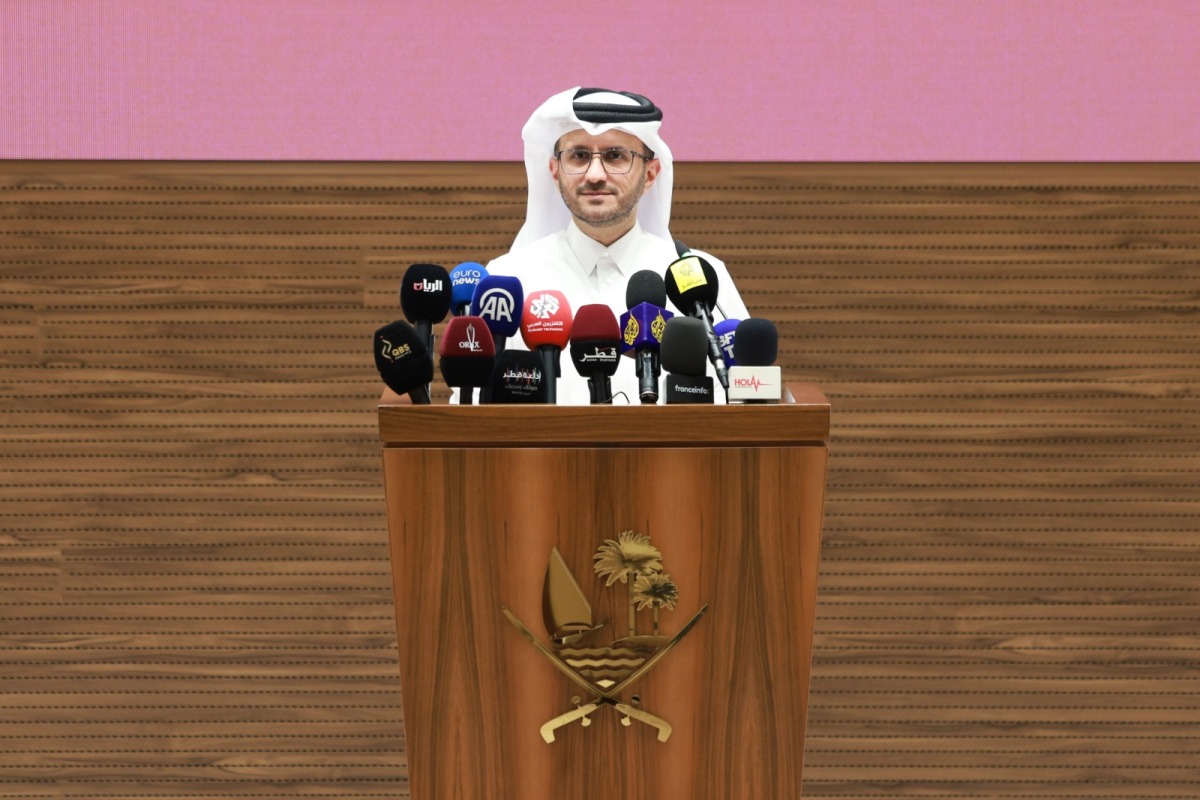
Doha, Qatar: Advisor to the Prime Minister and Official Spokesperson for the Ministry of Foreign Affairs Dr. Majed bin Mohammed Al Ansari affirmed that the State of Qatar continues its full support for the efforts led by the Islamic Republic of Pakistan aimed at reaching an agreement that prevents a return to escalation, stressing that it is not possible at present to predict the results of the ongoing contacts and efforts, in light of the diplomatic activity in the region.
During the Ministry's weekly media briefing, Dr. Al Ansari said that the Amir HH Sheikh Tamim bin Hamad Al-Thani, HE Prime Minister and Minister of Foreign Affairs Sheikh Mohammed bin Abdulrahman bin Jassim Al-Thani, along with a number of Qatari officials are continuing their intensive contacts with their counterparts in the region and the world, with the aim of ensuring the continuation of the ceasefire, preventing a return to escalation, and securing freedom of navigation in the Strait of Hormuz, in order to spare the peoples of the region the repercussions of any new escalation.
Regarding the nature of the contacts that took place during the past period, he indicated that the contacts focused mainly on two main issues, mainly ensuring the continuation of the ceasefire and not returning to escalation in the region, and sparing the people the risks of any further escalation.
He said that no one wants a repeat of the escalation that the region witnessed during the past period, which calls for continued regional coordination and joint action in support of the Pakistani mediation efforts. he noted that supporting this mediation is a priority at the present stage, as it is the entity that conducts official communications between the parties.
Regarding the statement issued by President of the United States of America HE Donald Trump on Monday, Dr. Al Ansari said that the leaders of the region have emphasized since the first day of the crisis the need to maintain calm and give the diplomatic track a full opportunity to reach an agreement that guarantees the security and stability of the region. He pointed out that the State of Qatar has warned for years that the continuation of escalation in the region without establishing a sustainable peace will lead to a comprehensive war that will affect the region and the world.
He added that what was stated in the US President's statement came in response to the contacts made by the leaders of the Gulf states, with the aim of giving diplomacy another chance and continuing contacts. He stressed the continued communication between the leaders of the region and international partners to ensure that there is no return to escalation.
Regarding the decision to postpone the American attack on Iran, as announced by the US President, the Advisor to the Prime Minister and Official Spokesperson for the Ministry of Foreign Affairs indicated that the State of Qatar's stance is based on its cooperation with its partners in the United States, as well as its keenness to protect the people of the region from the repercussions of any war or escalation. He noted that the statements issued by the leaders of the region unanimously supported the Pakistani mediation efforts, the ceasefire, and giving diplomatic means a chance to reach a final agreement.
Regarding the continued closure of the Strait of Hormuz, Dr. Al Ansari pointed out that Articles 38 and 39 of the United Nations Convention on the Law of the Sea stipulate the right of transit passage through international straits. He noted that this right guarantees continuous and rapid freedom of navigation, and no state bordering these straits, including Iran, may obstruct transit passage or suspend this right for any purpose, including security reasons.
He indicated that any attempt to close the strait or impose a legal arrangement that restricts freedom of navigation in it is a violation of international law. He reiterated the State of Qatar's emphasis on the need to respect freedom of navigation in the strait, and on its right to safe passage through it as a natural international waterway.
The Advisor to the Prime Minister and Official Spokesperson for the Ministry of Foreign Affairs stressed that the State of Qatar is not concerned with any arrangements aimed at altering the status quo in the Strait of Hormuz. Instead, Qatar is solely invested in reopening the strait to completely free navigation in full compliance with international law.
He explained that Qatar's supply chains for basic commodities have functioned normally despite the closure of the strait, without the need to tap into strategic reserves, thanks to pre-established contingency plans and alternatives.
He noted, however, that the primary challenge currently lies in exporting energy products, which carries a direct impact on global energy security and prices.
He reiterated that the closure of the Strait of Hormuz further complicates supply chain movements across the region as a whole.
Regarding the movement of Qatari gas tankers through the Strait of Hormuz, Dr. Al Ansari clarified that the tankers Al Khairitiyat and Mahzam crossed the strait over the past few days heading toward the Islamic Republic of Pakistan. This occurred within the framework of regional coordination and communication with the Pakistani side to ensure their safe passage, emphasizing that this does not signify the reopening of the strait or a return to normal gas tanker traffic.
He confirmed that more than ten fully loaded tankers remain stranded inside the Strait of Hormuz, alongside a large number of vessels belonging to Qatar and other nations, all still awaiting an opportunity to enter or exit through the strait.
He emphasized Qatar's full support for Pakistani mediation and its continuous monitoring of regional developments, noting that no one can currently predict the outcome of the ongoing communications, whether positively or negatively.
In a related context, the Advisor to the Prime Minister and Official Spokesperson for the Ministry of Foreign Affairs reiterated Qatar's firm stance rejecting the attacks launched by Iran.
He stated that the goal is to preserve the sovereignty of the State of Qatar and the prosperity of the people, and Qatar has taken all necessary measures to ensure the security and safety of everyone within the country.
The Iranian people, he continued, like other peoples of the region, deserve to live in security, peace, and prosperity away from wars and conflicts. They are part of the population of this region, and Qatar enjoys positive relations with them.
However, he added, Iran chose to target the State of Qatar during this war, which has threatened relations with Qatar, affirming Qatar's keenness and adherence to the principles of good neighborliness with all countries.
Dr. Al Ansari noted that Qatar is not in a position to provide indicators regarding the future of negotiations, but it continues to support the diplomatic efforts led by Pakistan and is intensifying its contacts with various regional and international partners in support of mediation efforts, expressing hope that these endeavors will contribute to reducing escalation and reaching a peaceful resolution to this crisis.
Regarding the NATO meetings to be held in the Republic of Turkiye next month, the Advisor to the Prime Minister and Official Spokesperson for the Ministry of Foreign Affairs said the State of Qatar is a party to NATO's Istanbul Cooperation Initiative (ICI) and maintains an ongoing partnership with the Alliance, pointing out that there are forces belonging to NATO member states stationed in Doha.
He added that Qatar's participation in these meetings comes within the framework of its key defense partnerships; therefore, representation and presence at this summit are part of this partnership, particularly in light of the current security implications and developments the region is witnessing.