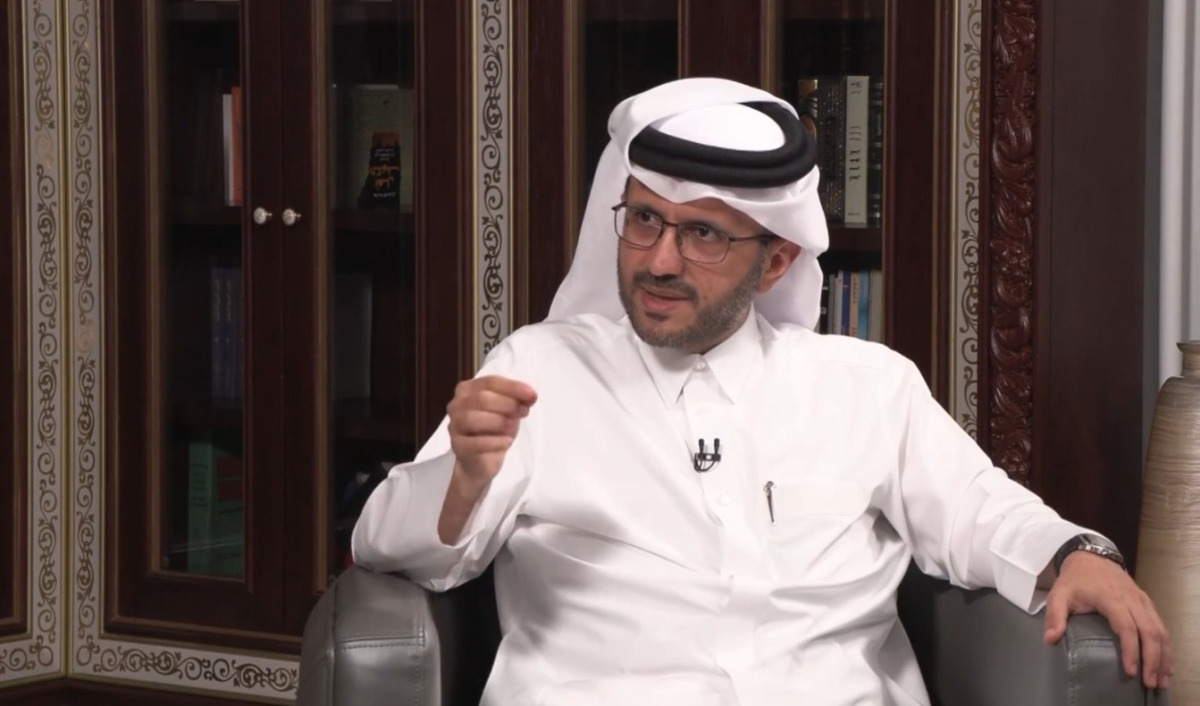
Advisor to the Prime Minister and Official Spokesperson for the Ministry of Foreign Affairs Dr Majed bin Mohammed Al Ansari
Doha, Qatar: Qatar remains committed to international peace efforts despite attacks against the country, while the Gulf states are focusing on rebuilding the regional security system and strengthening their leadership in addressing regional and international crises, Advisor to the Prime Minister and Official Spokesperson for the Ministry of Foreign Affairs Dr Majed bin Mohammed Al Ansari has said.
Speaking in an interview with Al Arabiya, Al Ansari said the region was facing challenges with implications extending far beyond individual crises, stressing that the future of regional stability was closely linked to international security and peace.
“Today, we are reaping the consequences of others’ mistakes, in reality, because many of these crises were left unaddressed,” he said.
He noted that recent Gulf statements and positions had placed strong emphasis on rebuilding the regional security system, strengthening Gulf leadership at the regional level and engaging with the wider region and beyond.
“We are not talking about a passing crisis that could become two pages in a history book a few years from now. We are talking about the future of the region, in its broadest sense, and even the future of international security and peace,” Al Ansari said.
He warned that the failure to address multiple crises could have far-reaching consequences, drawing attention to the possibility that the world might only recognise the historical significance of current events years after they had unfolded.
Al Ansari also highlighted the importance of diplomacy and mediation, saying military action could not be the only option available to the peoples of the region or the world.
“Certainly, at times, the military option may be necessary, but our countries and the Gulf states are peace-loving countries,” he said.
He pointed out that Gulf countries, including Qatar, continued to play mediation roles in several international crises, citing the Russia-Ukraine war and developments in Latin America and Asia as examples of areas where Gulf diplomatic efforts had been present.
“Therefore, when we find these crises on our doorstep, the first option is always to reach a diplomatic solution,” he said, adding that all Gulf states had engaged in diplomatic efforts even amid the ongoing challenges.
Addressing Qatar’s commitment to mediation despite the attacks against the country, Al Ansari said the pursuit of peace should not be mistaken for a willingness to accept aggression.
“First, anyone who believes that peace is cheap has not experienced peace processes in all their forms. Peace is a very expensive commodity, and someone must bear the cost of peace,” he said.
He stressed that Qatar had shouldered significant responsibilities from the outset in pursuing peace across various files.
“However, this does not mean under any circumstances that we accept such attacks against our country,” he said.
Al Ansari explained that, from the first day of the attacks, Qatar’s diplomatic efforts had proceeded alongside the work of the Qatari Armed Forces and the country’s security system.
He said the objective was not only to stop and deter the attacks but also to ensure they would not happen again and that Qatar’s position on the matter would be clearly understood internationally.
“Qatar will continue its peace efforts, regardless of anyone who tries to divert it from that path,” he said.
Addressing anyone seeking to undermine Qatar’s role in international peacemaking, Al Ansari said the country’s leadership and officials had maintained a consistent position throughout the challenges.
“The leaders of Qatar, foremost among them His Highness the Amir, and all Qatari officials have spoken with one voice. The guidance we have consistently received during all these challenges has been clear: Qatar is continuing on its path, and there will be no retreat from it,” he said. He argued that the current situation reflected a political decision to target countries in the region, rather than a decision taken by the Gulf states themselves.
“This decision, after February 28, was taken in Tehran within a few hours; it was not taken in the Gulf states,” Al Ansari said. He added that Iran’s decision to target Gulf countries in this manner had heightened their sense of insecurity and changed how they viewed their relationship with Tehran.
According to Al Ansari, the situation had shifted the perception of Iran from that of a neighbouring country with which the Gulf states hoped to maintain normal relations to one associated with a heightened sense of threat.