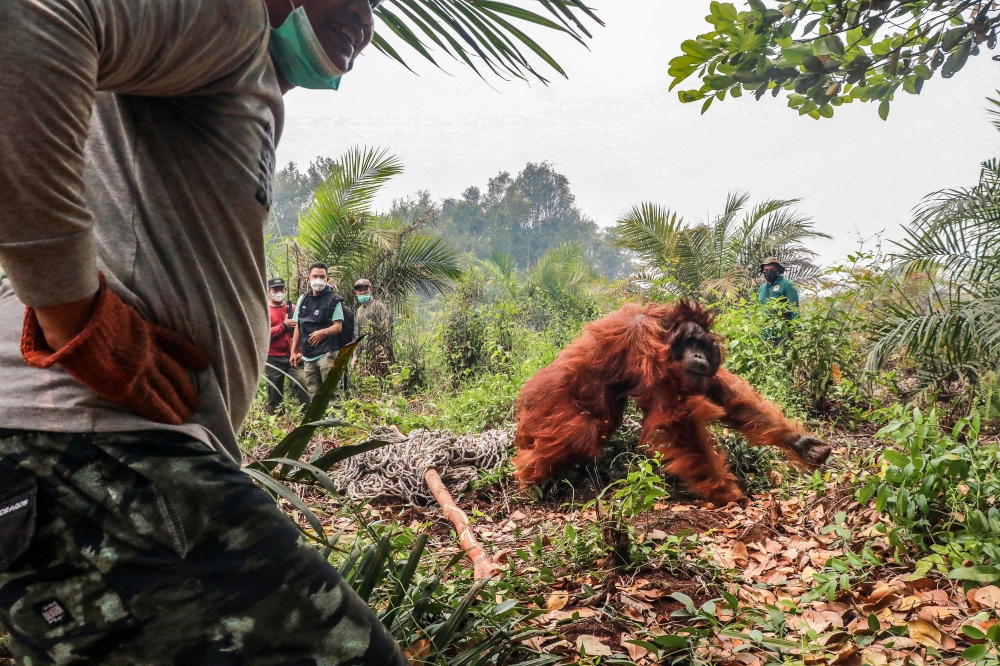
A 20-year-old orangutan tries to escape as members of the BKSDA (Natural Resources Conservation Agency), the Borneo Orangutan Survival Foundation (BOSF) and the World Wide Fund for Nature (WWF) Indonesia evacuate it on October 17, 2026. (Photo by REINA / AFP)
Jakarta, Indonesia: Dozens of critically endangered orangutans have been rescued in recent weeks from rampant wildfires burning across Indonesia that have cloaked the region in toxic haze, conservation groups said.
The fires have triggered a months-long pollution spell that has closed schools, fuelled a surge in respiratory conditions both among humans and animals, and restricted outdoor activities in Indonesia, Malaysia, Singapore and East Timor.
Pollution levels again ranged from unhealthy to very unhealthy across the region on Sunday, cloaking many areas across southern Southeast Asia in toxic haze.
Swiss-based air quality monitor IQAir again ranked Singapore and Kuala Lumpur among the world's top ten most polluted major cities on Sunday afternoon.
Fires on Borneo and Sumatra islands, intensified by a turbo-charged El Nino weather phenomenon, continued to emit smoke.
In Indonesia, groups are working to save wildlife from the fires, including orangutans.
On Saturday, the West Kalimantan conservation agency and Indonesian non-profit YIARI said a team evacuated 51 orangutans from locations in the province from August 6 to October 19.
And figures from Indonesia's forestry ministry suggested this week that the number rescued over recent months in Kalimantan could be as high as 96.
Officials could not be immediately reached to clarify the number.
On Saturday three conservation agencies saved a 20-year-old male orangutan in Hampangen village in Central Kalimantan on Borneo island.
"The evacuation process was carried out with great caution," the agencies said.
"After the orangutan was sedated, the medical team immediately conducted a health examination before taking the animal to the... rehabilitation center," it said.
Indonesia's transport ministry also said around 2,400 flights across the country have been affected by the haze since mid-August.
"Haze reduces visibility around airports, which can lead to delays, disruptions, and even flight cancellations," the ministry said.
'Not enough rain'
In Singapore, concentrations of PM2.5, a fine particulate pollutant, remained elevated in western parts on Sunday, with the 24-hour Pollutant Standards Index staying in the "very unhealthy" range.
Although PM2.5 is the dominant pollutant during haze episodes and one of six indicators used to calculate Singapore's overall PSI, it is not the same as the PSI itself.
Wang Jingyu, a Singapore-based atmospheric sciences expert, said the region was firmly in the grip of a super El Nino weather phenomenon.
Because "of the super El Nino across the entire Southeast Asia, the sea surface temperature is cooler than normal," said Wang.
"Under these conditions, cooler sea surface temperature means we do not have enough evaporation from the ocean," meaning insufficient rain, he told AFP.
"We do not have enough rain, the fire cannot be easily put out."