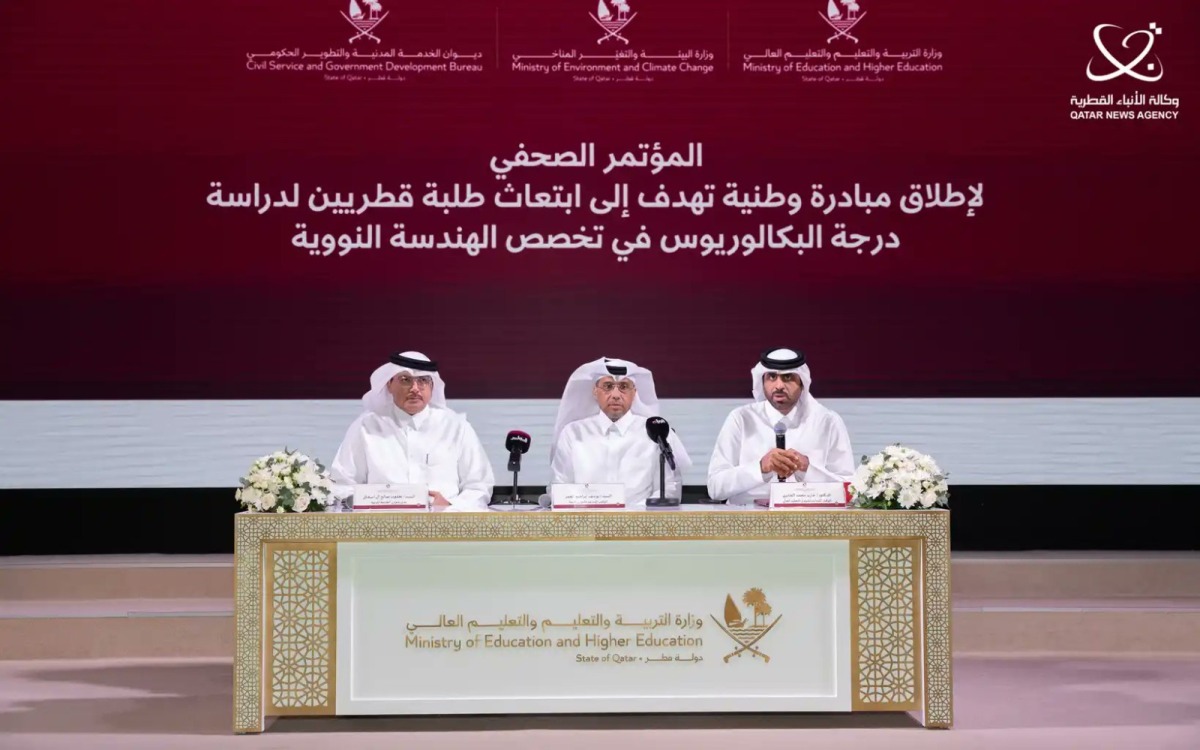
Doha, Qatar: The Ministry of Education and Higher Education (MOEHE), in cooperation with the Ministry of Environment and Climate Change (MECC) and the Civil Service and Government Development Bureau (CSGDB), on Wednesday launched the National Scholarship Initiative to sponsor Qatari students pursuing a bachelor's degree in Nuclear Engineering.
The initiative comes as part of the State's efforts to qualify specialised national cadres that support scientific advancement and radiation security, in line with the objectives of Qatar National Vision 2030.
Speakers at a press conference held by the Ministry affirmed that the initiative is based on a successful scholarship model that links academic study with guaranteed employment upon graduation. It offers exceptional benefits, including counting the years of study as part of service, providing a full salary during the scholarship period, and granting students the opportunity to pursue postgraduate studies later, thereby ensuring a stable and distinguished career path for national talents.
MOEHE's Assistant Undersecretary for Higher Education Affairs, Dr. Hareb Mohammed Al Jabri described the launch of this track as a strategic qualitative step toward building highly qualified national cadres in one of the most critical and future-oriented scientific disciplines.
He noted that the initiative aligns with national efforts to harmonize higher education outcomes with labor market needs, enhance scientific research, diversify the economy, and build a knowledge-based economy.
Al Jabri added that the program focuses on identifying specialisations according to the needs of national institutions and ministries, ensuring students are academically and professionally prepared to integrate into national projects after graduation. Benefits include a scholarship salary, appointment to Grade Nine positions, and counting the study period as years of service, guaranteeing job stability and opening pathways for postgraduate studies.
For his part, MECC's Assistant Undersecretary for Environmental Affairs, Yousef Ibrahim Al Hamar stated that the initiative reflects the State's commitment to strengthening the radiation safety and security framework and establishing an institutional culture grounded in knowledge and competence.
This ensures the Ministry's readiness to manage the use of radiation sources in the health and industrial sectors under advanced regulatory and legislative systems to protect people and the environment from potential risks.
Al Hamar emphasised that building specialised national capacities has become essential to reinforcing oversight and supervision systems, consolidating principles of prevention and sustainability, and providing students with a stable and distinguished professional path, thereby enhancing the State's preparedness to address specialized challenges in this vital field.
CSGDB's Director of Civil Service Affairs, Yaqoub Saleh Al Ishaq explained that the Bureau played a pivotal role in shaping the program, in line with its responsibilities in strategic human resources planning and ensuring alignment between educational outputs and actual career pathways, particularly in priority scientific disciplines.
Al Ishaq noted that the initiative provides an integrated path beginning with overseas scholarship and ending with direct employment in designated Grade Nine positions.
It includes financial benefits and exceptional incentives for Nuclear Engineering, counting study years as service, and specialised technical supervision to ensure the highest standards of training and qualification.
He added that, pursuant to Prime Minister's Decision No. (25) of 2025 regulating entitlement to work nature allowances in government entities, the work nature allowance for Nuclear Engineering reaches 85 percent, the highest among engineering specialisations.
Officials indicated that appointments will be within the MECC's Radiation Protection Department, which oversees the use of radiation sources in medical and industrial applications. Work sites will include laboratories and various departmental units, providing sponsored engineers with comprehensive practical experience.
They explained that student selection criteria are based on academic excellence, achieving specified grades in prior qualifications, meeting English language requirements, and obtaining final unconditional admission from accredited universities, taking into account the limited number of seats reflecting the specialisation's rarity.
Speakers confirmed that the initiative will be accompanied by extensive awareness campaigns in secondary schools to introduce students to this national opportunity, encourage applications, and highlight the advantages of scholarship and direct employment, in addition to supporting future postgraduate academic pathways.
They further stressed that the specialization is not currently available within the State of Qatar, necessitating overseas scholarships at internationally accredited universities.
The program will provide a comprehensive academic track that equips students to practice their specialisation with competence, strengthens the national radiation safety and security system, maximises the utilisation of national scientific talents in vital fields, advances national development goals, and enhances the protection of people and the environment.