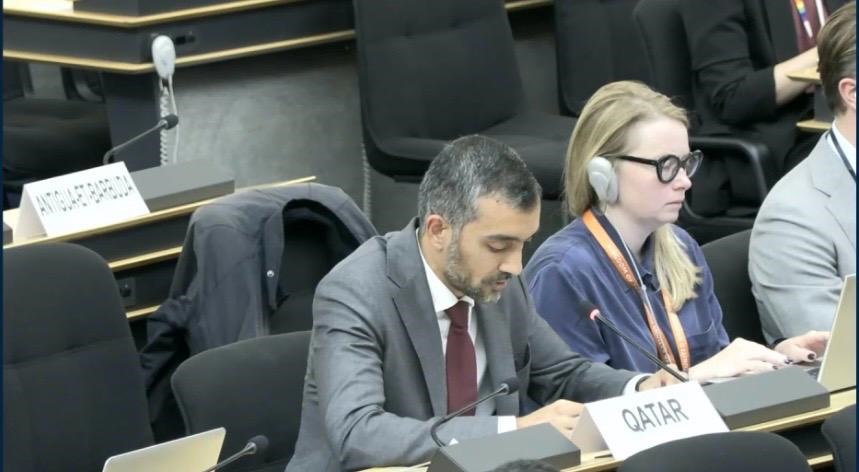
Geneva: The Permanent Mission of the State of Qatar to the United Nations Office and other international organizations in Geneva participated on Thursday in a high-level panel discussion marking the 60th anniversary of the two International Covenants on Human Rights, held under Agenda Item Three of the 63rd session of the Human Rights Council.
In a statement delivered by Deputy Permanent Representative of the State of Qatar to the United Nations Office in Geneva Abdulrahman Mohammed Fakhroo, the State of Qatar conveyed that the adoption of the two International Covenants on Human Rights six decades ago marked a historic turning point in consolidating the human rights system and fostering collective action. The statement noted that while the Universal Declaration of Human Rights laid the foundational building blocks for human rights values and principles, the two International Covenants contributed to transforming many of these principles into legal standards and obligations binding upon States Parties.
He said that, despite all these years, the two International Covenants remain a cornerstone of international efforts to promote and protect human rights and address the many challenges facing the world today.
He further added that the State of Qatar views the two International Covenants as pivotal documents for strengthening the normative framework of human rights. He explained that since acceding to them in 2018, the State has adopted a strategic approach to implementing their provisions, incorporating them into the national legal system, raising awareness of the principles and standards they contain, and submitting periodic reports to the relevant treaty bodies, as a manifestation of commitment to fulfilling its international obligations.
The Deputy Permanent Representative of the State of Qatar to the United Nations Office in Geneva highlighted that the optimal implementation of the two International Covenants requires treating the rights enshrined therein as equal, interdependent, and mutually reinforcing, while taking into account the national, cultural, and religious specificities of each state and drawing upon experiences and best practices, thus reinforcing the principle of the universality of human rights.