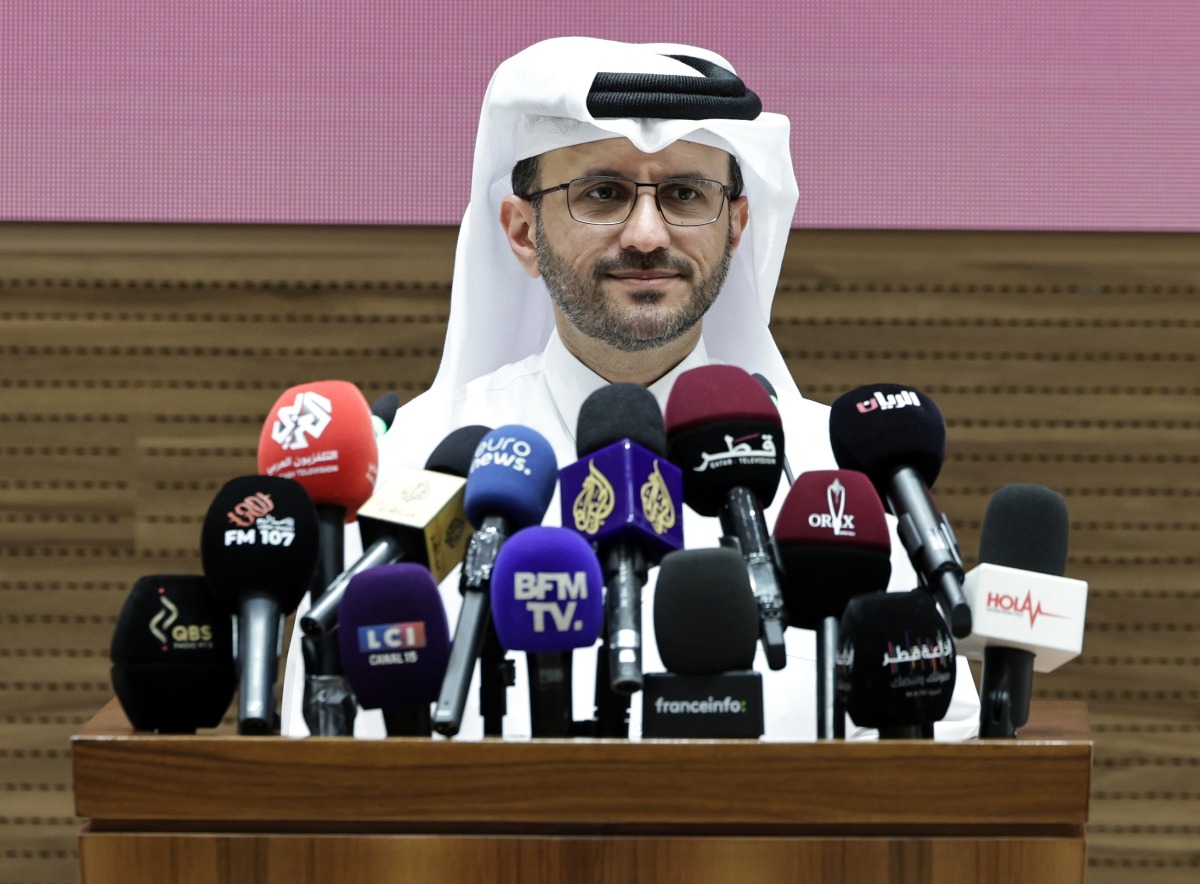
Adviser to the Prime Minister and Official Spokesperson for the Ministry of Foreign Affairs Dr. Majed bin Mohammed Al Ansari yesterday. Picture: Rajan Vadakkemuriyil / The Peninsula
Doha, Qatar: State of Qatar will be represented at the signing ceremony of the Memorandum of Understanding (MoU) between the United States and Iran, scheduled to take place in Geneva, Switzerland, coming Friday (June 19), said Adviser to the Prime Minister and Official Spokesperson for the Ministry of Foreign Affairs Dr. Majed bin Mohammed Al Ansari yesterday.
“The MoU, which had already been signed electronically as a preliminary step will be formally signed on Friday paving the way for the negotiation phase. All regional parties, including Qatar, are working to facilitate communication between the two sides to ensure the success of the process and restore regional peace and security to pre-war conditions,” he said while addressing weekly media briefing.
Praising Pakistan’s mediation role, Dr. Al Ansari said that Qatar had participated in supporting the mediation track led by the Islamic Republic of Pakistan. “Qatar’s role focused primarily on supporting Pakistan’s efforts to develop common ground between the parties, ensuring the restoration of normal navigation through the Strait of Hormuz, maintaining the ceasefire, and advancing negotiations between the United States and Iran.”
To a question about the success of future talks between the US and Iran to address core issues, Dr Al Ansari expressed Qatar’s ‘cautious optimism’ that the signing of the MoU would lead to the next phase of negotiations, contributing to regional stability through talks focused on the nuclear file and broader regional security issues.
“No conflict can be resolved without a sustainable mechanism to address its underlying causes and that lasting peace can only be achieved through a continuous political process and sustained dialogue.”
He reaffirmed Qatar’s support for Pakistani mediation and its backing of Pakistan as the principal mediator between the United States and Iran. “Qatar continues to play its role in supporting regional security and stability in coordination with regional and international partners.”
Al Ansari said that the signing of the MoU would mark the beginning of a negotiation process leading to lasting peace in the region.
“All parties had participated constructively in the discussions, many of which took place through telephone calls and virtual meetings in addition to direct talks.”
He reiterated that from the start of the crisis, Qatar’s primary focus had been the safety and security of its citizens and residents, as well as the protection of national and economic security as integral components of regional stability. “The contacts between the parties remain ongoing,” Al Ansari said.
“Qatar continues, within the framework of its support for Pakistani mediation, to engage with all sides to help bring the agreement to a successful conclusion.”
To another question, he clarified that no meetings involving the concerned parties or any other parties were currently being held in Doha.
“Following the signing of the agreed MoU, the Strait of Hormuz will be reopened to regular navigation, helping restore global energy supplies and reducing the burden caused by the waterway’s closure on energy markets as well as global food markets, which have been affected by fertilizer shortages.”
Responding to another question about broken trust between regional countries and Iran, he said that the ongoing regional dialogue will be essential in the coming phase to rebuild trust among all parties. “The mediation efforts led by Pakistan, with the support of several regional countries, were driven by a commitment to regional peace and security, particularly the security of Gulf states. The efforts also took into account the interests of countries affected by the closure of the Strait of Hormuz and its repercussions for energy and food security.”
On the prospect of a return to normalcy after the crisis, Al Ansari said the region now needs to build a new reality based on restoring trust, reopening channels of communication, and developing a shared understanding of the region’s future in the post-war period.