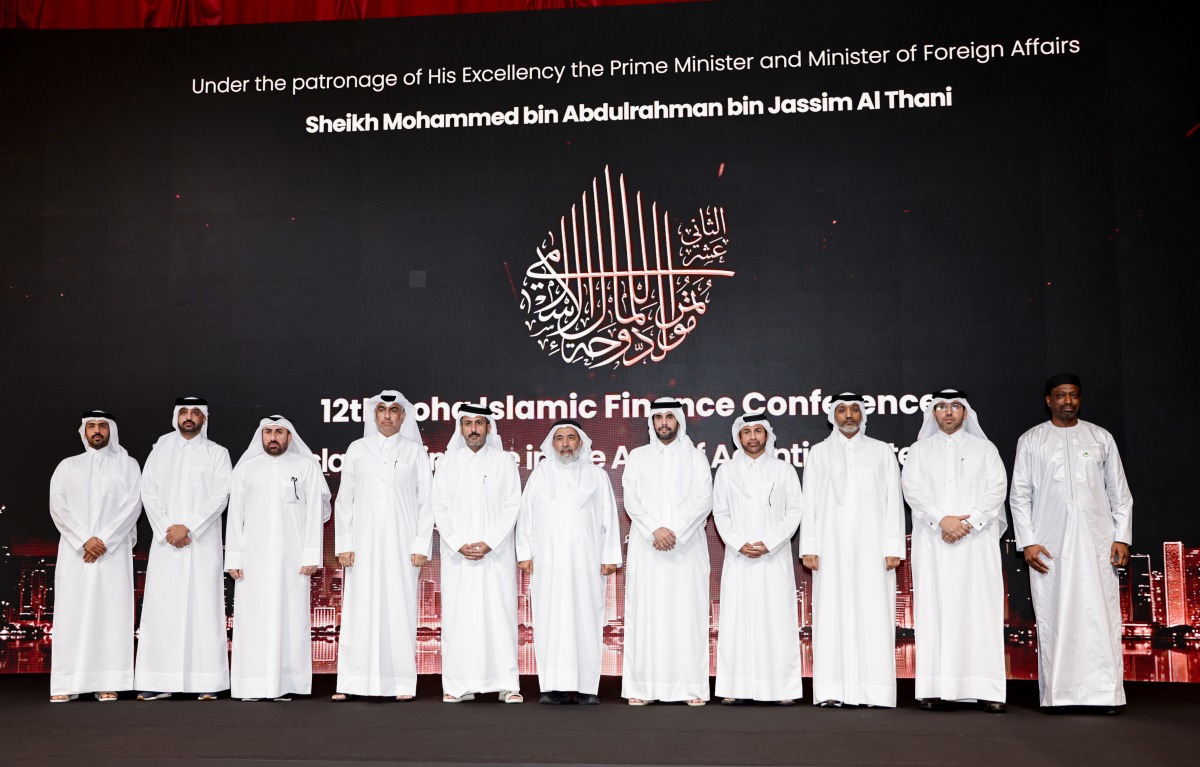
Minister of Endowments (Awqaf) and Islamic Affairs H E Ghanem bin Shaheen bin Ghanem Al Ghanim, Minister of Commerce and Industry H E Sheikh Faisal bin Thani bin Faisal Al Thani, Chairman of the Organizing Committee and Vice Chairman of Bait Al-Mashura Finance Consultations Prof. Dr. Khalid bin Ibrahim Al-Sulaiti with other dignitaries during the conference yesterday. Pic: Salim Matramkot
Doha, Qatar: The 12th Doha Islamic Finance Conference which kicked off yesterday highlighted the transformative impact of AI agentic systems on the global financial sector, as experts and industry leaders examined the opportunities and challenges posed by intelligent technologies capable of self-learning, decision-making and autonomous operations.
Experts stressed the need for strong governance, transparency and Shariah-compliant frameworks to ensure the responsible adoption of these systems across Islamic financial institutions.
Addressing the conference Chief Financial and Tax Officer at the Qatar Financial Centre, Hamed Ali Al-Saadi affirmed that the theme of conference ‘Islamic Finance in the Age of Agentic Systems’ reflects the significance of the transformations the financial sector is undergoing in the age of artificial intelligence. He explained that AI-based solutions offer significant possibilities, including understanding customer needs.
Al-Saadi further noted that despite the major opportunities provided by these technologies, optimal utilisation requires addressing a set of challenges, foremost of which are issues of governance, transparency, and accountability, alongside questions surrounding the degree of autonomy of these systems.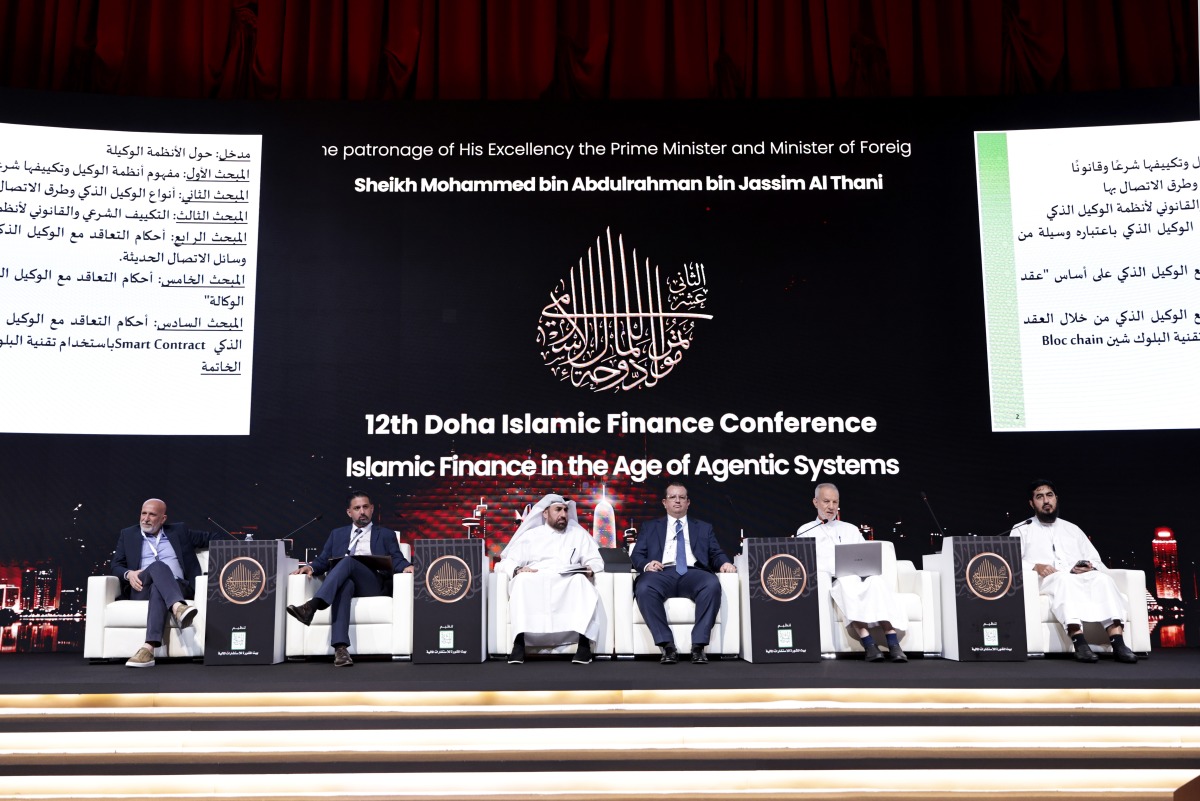 On the other hand, Dr. Koutoub Sanu, Secretary-General of the International Islamic Fiqh Academy, said the challenge today is not in accepting or rejecting intelligent systems, but rather how to guide them and utilise their benefits in accordance with the objectives of Islamic law.
The future relationship between the Muslim community and agentic systems will not be a conflict between humans and machines, but rather a model of integration and cooperation. This model will allow machines to provide services, while ethical and legal responsibility remains with humans, as these technologies contribute to enhancing efficiency, accuracy, and speed of execution, he noted.
The first panel session entitled ‘Islamic Financial Institutions and the Application of Agentic Systems’ examined the applications of AI agentic systems in the Islamic financial sector and analysed their implications for operational efficiency, risk management, and financial product development.
The theme also addressed Shariah rulings related to the use of automated agents, the limits of delegation, liability, and guarantees, alongside reviewing the legal framework governing the operation of AI agents in Islamic finance. Furthermore, it discussed algorithmic trading through automated agents and smart sukuk, highlighting the investment opportunities they offer as well as the jurisprudential and technical challenges they pose.
The panel was moderated by Dr. Osama Al-Deraei, MD CEO of Bait Al-Mashura Finance Consultations. Dr. Chawki Tawbi, Data Analytics and AI Sales Leader, Google Cloud, Qatar discussed the role of agentic AI technologies and their applications in the financial sector.
Dr. Al-Ayashi Fadad, Faculty Member at Marmara University, Türkiye explained the Shariah rulings related to agentic AI systems, Dr. Andrew Mazen Dahdal, Associate Professor at the College of Law, Qatar University discussed the legal framework governing the operation of AI agents in Islamic finance.
Meanwhile Dr. Mohammed Damak, Managing Director & Global Head of Islamic Finance, S&P Global Ratings, UAE; Dr. Nasrullah Khan, Post-doc
Research Fellow, College of Science & Engineering, HBKU; and Prof. Dr. Hussein Abdou, Professor of Finance & Banking, The Northumbria University, UK also participated in the panel session.
According to estimates by S&P Global Ratings, the global Islamic finance industry is projected to grow by 5% - 10% in 2026, with growth expected to accelerate further in 2027. Meanwhile, data from the Islamic Financial Services Board (IFSB) indicates that global Islamic finance assets expanded by 13.4% year-on-year to reach $4.4 trillion in 2025.