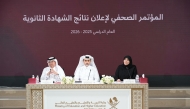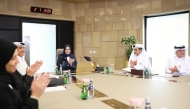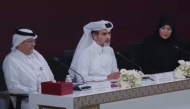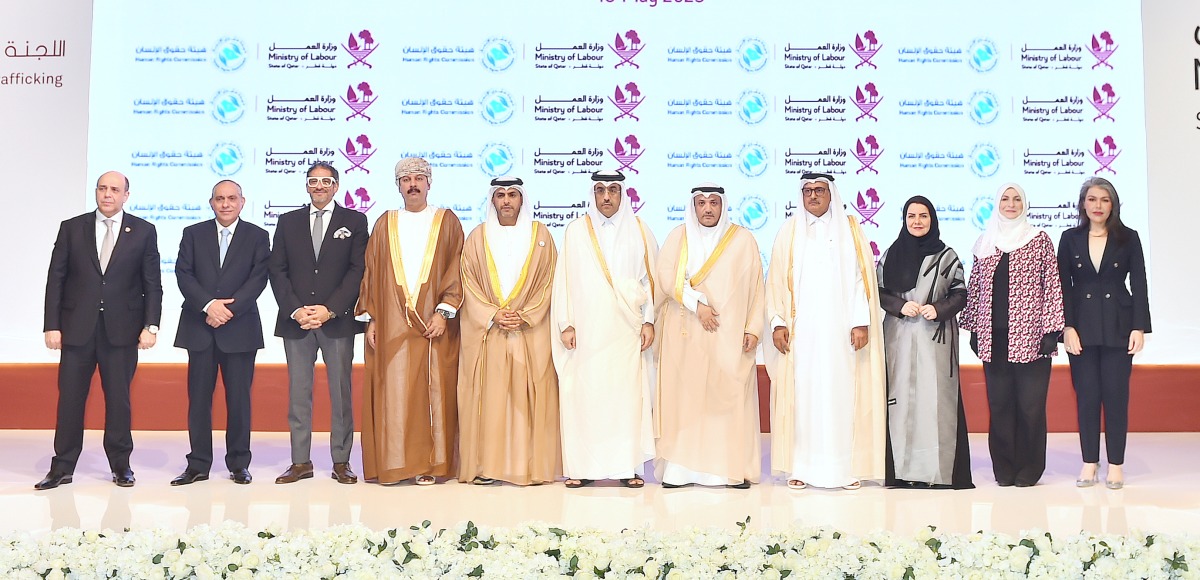
Minister of Labour H E Dr. Ali bin Smaikh Al Marri (centre), Minister of Justice H E Masoud bin Mohammed Al Amri (fourth right), and other ministers and dignitaries at the opening ceremony of the forum in Doha yesterday.
Doha: Minister of Labour H E Dr. Ali bin Smaikh Al Marri has said that Qatar, through its hosting of the World Cup, has exemplified a commitment to upholding human rights and addressing human trafficking concerns associated with significant sports events.
Al Marri, who is also chairman of the National Committee for Combatting Human Trafficking, noted that Qatar has implemented the highest international standards, further solidifying its position as a top-tier tourist destination for organising major international sporting events.
Al Marri was addressing the opening ceremony of the Governmental Forum to Combat Trafficking in Persons in the Middle East which kicked off in Doha yesterday, under the title “Combating Trafficking in Persons in Seasons of Tourism and Sports as an Example”.
The conference, organised by Ministry of Labour represented by the National Committee to Combat Human Trafficking, in coordination with the Permanent General Secretariat of the Governmental Forum to Combat Trafficking in Persons in the Middle East, will discuss challenges, developments and the latest developments on combating human trafficking in Middle Eastern countries, in addition to exchanging experiences and best practices, and how to enhance and develop capabilities. The opening ceremony was attended by Their Excellencies, ministers and heads of bodies concerned in Saudi Arabia, Kuwait, Oman, UAE, Bahrain, Jordan, Egypt, US, the UK and the Office of United Nations on Drugs and Crime.
The Minister of Labour said tourist seasons and hosting international sporting events increase the challenges related to combating human trafficking and respecting human rights.
He noted that the efforts of the sustainable growth team and decent work in the hospitality sector contributed to reducing the risks of human trafficking.
Minister of Labour H E Dr. Ali bin Smaikh Al Marri emphasised that human trafficking has evolved into a widespread global issue, endangering societies and presenting a significant challenge to the collective efforts of the international community in striving for progress and prosperity for all nations.
He said Qatar has made tangible efforts to combat the phenomenon of human trafficking in compliance with international law, and to enhance cooperation in facing common challenges.
Al Marri noted Qatar’s support for the United Nations Global Action Plan to Combat Human Trafficking and the effective response to combat human trafficking by establishing the national legal and institutional framework and supporting all national efforts as well as the international ones.
Al Marri pointed out that the comprehensive reforms of the labour sector during the recent period aim to strengthen the legislative framework in order to address the structural causes leading to the phenomenon of human trafficking, especially by abolishing the kafala system completely, cancelling the exit permit, facilitating the movement of workers and their transfer in the labour market, and setting a minimum limit of discriminatory wages for workers and domestic workers, as well as promoting social dialogue and effective remedies. H E Dr. Hala bint Mazyed Al Tuwaijri, Chairperson of Saudi Arabia’s Human Rights Commission, and Chair of the Committee to Combat Human Trafficking, called for the preparation of a unified regional vision for the exploitation of tourism in crimes of human trafficking and the development of appropriate mechanisms to combat it in cooperation with international organisations. H E Abdullah bin Sultan Al Nuaimi, Minister of Justice and Chairman of the National Committee for Combating Human Trafficking Crimes in the UAE, stressed that human trafficking is an issue of international concern, noting that reports by international organisations indicate that this serious type of organised crime threatens approximately 25 million people worldwide.
H E Dr. Amer bin Muhammad Ali Muhammad, Minister of Justice and Minister of Awqaf and Islamic Affairs, and Chairman of the National Committee to Combat Trafficking in Persons, Kuwait, said Kuwait worked to define crime in national legislation, as the national legislator dealt with it in the penal laws with severe punishment in view of the serious harm it inflicts on the state and its citizens.
He noted that the labour law is targeting a basic goal that is based on a fair balance between the interest of workers and their protection and the interest of business owners.
Sherine Al Saati, representative of the Permanent General Secretariat of the Government Forum, said the fourth session of the forum is being held at a time when we need to further strengthen partnerships and build bridges at the national and international levels to combat trafficking in persons, noting the need to address through pillars that include legal frameworks, prevention, prosecution and protection. and help for the victims.
H E Dr. Hatem Ali, Regional Representative of the United Nations Office on Drugs and Crime for the GCC states, stressed the importance of the government forum to combat trafficking in persons, as it is a platform for exchanging expertise, experiences, policies and strategies developed by member states in facing the challenge targeting the countries of the region.
H E Iman Erekat, Head of Mission of the International Organization for Migration in Qatar, affirmed that Qatar provided a positive and encouraging model in combating human trafficking and made steady strides in this field. Deputy Head of Mission at the US Embassy, Natalie Baker, appreciated the efforts made by Qatar during its hosting of the World Cup in the field of combating human trafficking, praising the reforms it introduced in the work system and combating human trafficking.
The Envoy for Migration and Modern Slavery at the Office of the Foreign, Commonwealth and Development in the UK, H E Stephen Malby lauded the efforts made by the Qatari government in combating the crime of human trafficking through the reforms and legislation it introduced in the work environment, stressing his country’s commitment to partnership with Qatar to combat this crime.