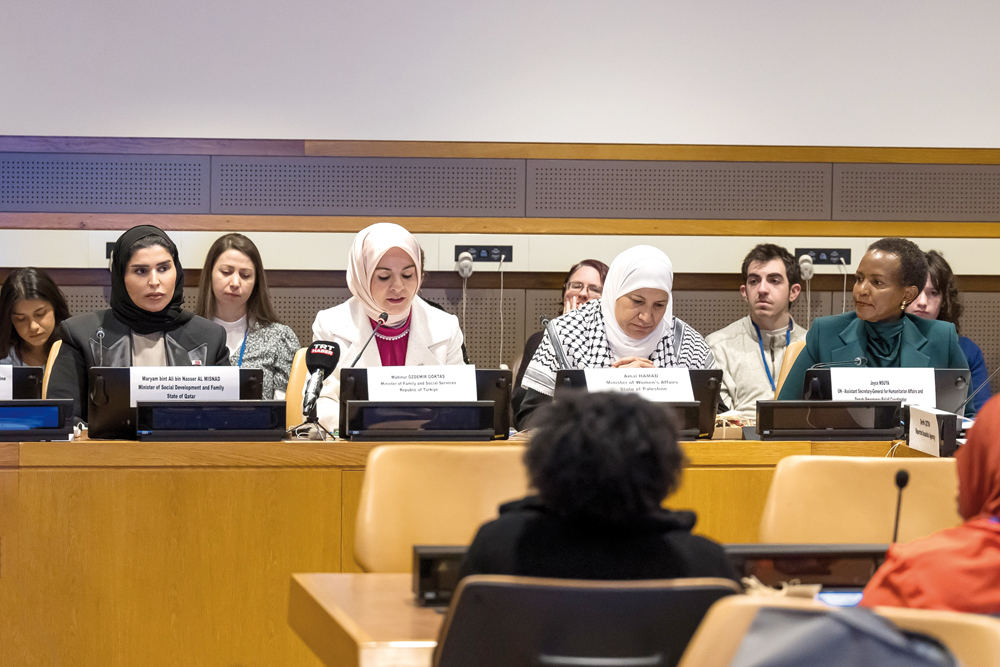
Minister of Social Development and Family H E Maryam bint Ali bin Nasser Al Misnad (front left) and other delegates at the event.
New York: Qatar has wrapped up its participation in the 68th Session of the Commission on the Status of Women (CSW68). Minister of Social Development and Family H E Maryam bint Ali bin Nasser Al Misnad headed Qatar’s delegation to the session.
The (CSW68) discussed the policies and strategies applied to accelerate achieving the principle of social gender equality and the empowerment of women and girls by addressing poverty and strengthening financing institutions with a gender perspective, in addition to reviewing the obstacles and challenges facing women on their path towards achieving their development at all levels.
The participation of Qatar emerged through bilateral meetings and high-level events discussed important issues, most importantly the support for Palestinian women, and urging the international community to take real and decisive measures on the ground to activate mechanisms of protection, empowerment and rehabilitation, primarily stopping the heinous crimes committed against women and children in the Gaza Strip.
Addressing the opening session which was themed “Accelerating the achievement of gender equality and the empowerment of all women and girls by addressing poverty and strengthening institutions and financing with a gender perspective”, Al Misnad delivered a speech calling for supporting women in the field of work and protecting the family system.
In her speech, she showcased the efforts of Qatar in adopting policies and measures aimed at equal opportunities for women in various fields, including education, social support, decision-making, investment and entrepreneurship, as well as achieving fairness in wages in the government sector. She said that the State of Qatar has come a long way in this regard.
She explained that the legislation and policies adopted by the state aim to achieve a balance between work and family responsibilities, and have greatly contributed to empowering Qatari women and enhancing their role and participation not only in the workforce, but also as an active partner in the state’s development.
Emphasizing Qatar’s rejection of double standards in applying international law, Her Excellency drew the attention of the participating delegations to the situation of Palestinian women, saying that the Commission’s meeting will have no meaning, if it keeps discussing some topics while Palestinian women have more pressing priorities.
She also participated in a side event titled “Revealing the Untold: The Devastating Impact of Conflict on Women and Girls.” During her participation, Al Misnad adopted the approach of the principle of involving women in areas of armed conflict in the processes of establishing peace and security, especially since they are among most affected by wars and conflicts, while they continue to be excluded from developing solutions and making policies that guarantee peace.
She touched on the situation of Palestinian women in the Gaza Strip, and said that they have gone from searching for means of development, establishing a family, and practicing motherhood, to simply searching for ways to survive, in light of a catastrophic humanitarian situation and a deliberate, complete crime of genocide being committed against the Palestinian people in the Gaza Strip.
She explained that this initiative came in the context of a series of humanitarian and development projects implemented by the State of Qatar, represented by the Qatar Fund for Development and other national institutions in conflict areas around the world. She also referred to the “Educate a Child” initiative, which provides access to quality education for marginalized communities in 42 countries.
Her Excellency also participated in an event entitled “Advancement of Women in the Judiciary, where she spoke about the strategies adopted by Qatar to enact laws and policies that provide job opportunities in the courts and the judiciary on an equal basis between women and men.
She said that the women judges in Qatar are expected to reach 30 percent by 2030, without these professional responsibilities causing imbalance between them and their family roles.