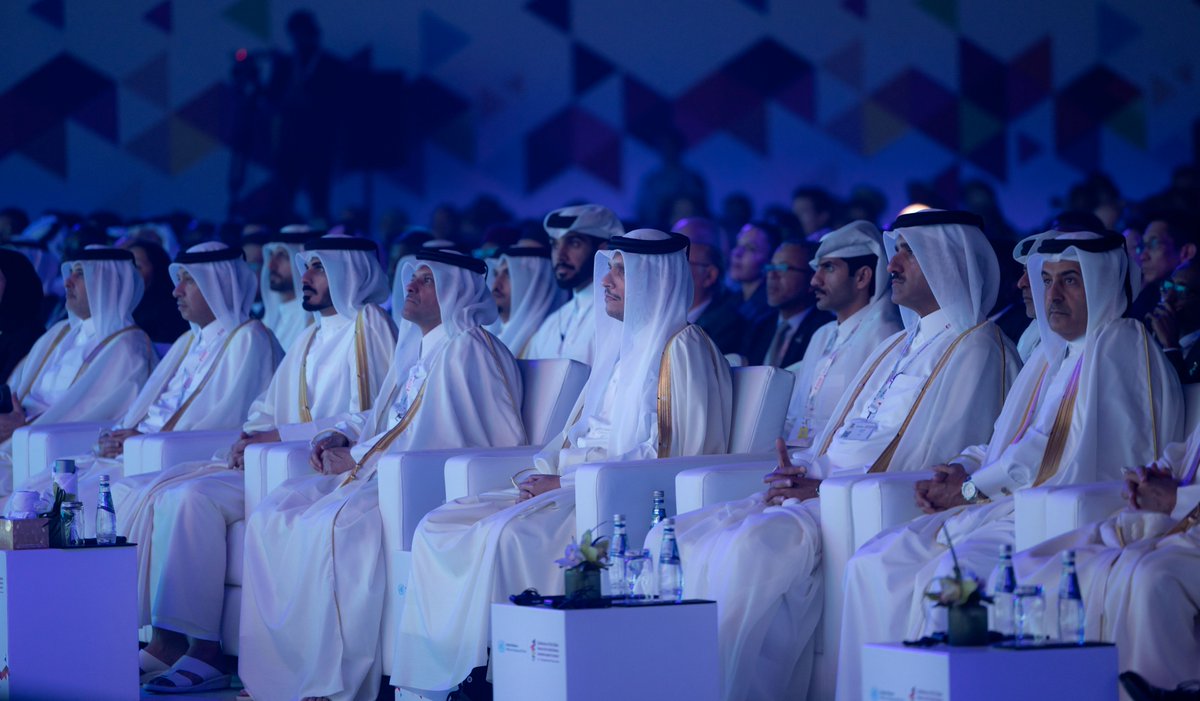
Prime Minister and Minister of Foreign Affairs H E Sheikh Mohammed bin Abdulrahman bin Jassim Al Thani and other dignitaries during the opening of eleventh session of the Conference of the States Parties to the United Nations Convention against Corruption in Doha yesterday.
Doha, Qatar: The Eleventh Session of the Conference of the States Parties to the United Nations Convention against Corruption (COSP11) opened yesterday in Doha, convening global leaders, policymakers and experts to strengthen international efforts against corruption under the theme ‘Shaping Tomorrow’s Integrity.’
The opening ceremony was attended by the Prime Minister and Minister of Foreign Affairs, H E Sheikh Mohammed bin Abdulrahman bin Jassim Al Thani, along with other Ministers, government officials and leaders across the globe.
More than 2,500 participants from 170 States Parties are taking part in the week-long conference, which is expected to conclude on Friday with a set of outcomes guiding the next phase of global anti-corruption cooperation.
Addressing the opening, the outgoing President of the tenth session, Christine Cline, reflected on progress achieved during the previous cycle, while the incoming President of the eleventh session and Chairman of COSP11, H E Hamad bin Nasser Al-Misnad, outlined priorities for the days ahead.
“This conference is an essential platform for all of us to exchange experiences but also to continue mobilising anti-corruption efforts at the global level,” Al-Misnad said. “I look forward to our deliberations this week and a productive outcome on Friday.”
He also welcomed the accession of Saint Kitts and Nevis and San Marino to the Convention in 2024 and 2025, bringing the total number of States Parties to 192. “With this, the Convention has now reached a truly global reach,” he said, urging countries that have not yet joined to accede as soon as possible.
Al-Misnad noted that previous COSP sessions had produced tangible results, particularly in prevention, combating corruption-related crime, asset recovery and mutual legal assistance.
He stressed that countering corruption requires “high-level commitment, effective international cooperation, and a solidarity of efforts among all sectors,” grounded in respect for sovereignty, equality and non-intervention as enshrined in the Convention. Highlighting emerging challenges, he noted that technological advances, cyberspace and transboundary crimes were further complicating the fight against corruption. “Countering corruption is not a mere procedural matter but a collective path requiring cooperation among governmental and non-governmental stakeholders alike,” Al-Misnad added.
In a video message, UN Secretary-General António Guterres thanked Qatar for hosting and warned of the far-reaching impacts of corruption. “Corruption is not a victimless crime,” he said. “It fuels conflicts, entrenches inequalities, and drains the resources needed to protect people and planet.” Stressing the dual role of emerging technologies such as artificial intelligence, he emphasised the need for regulation, accountability and cooperation under the framework of the UN Convention against Corruption.
The President of the UN General Assembly for its 80th session, H E Annalena Baerbock, echoed these concerns, stressing that corruption has “real, measurable consequences for people,” from unsafe infrastructure to weakened justice systems. She described COSP11 as “an opportunity to build on and evolve our common commitments to prevent corruption,” calling for stronger oversight, protection of whistleblowers and the use of technology for transparency.
The Acting Executive Director of the United Nations Office on Drugs and Crime (UNODC), John Brandolino, warned that corruption enables criminal networks worldwide.
“There is a need for an integrated and coordinated approach, one where agencies work across sectors and borders,” he said, calling all States Parties to make full use of UNODC’s tools and initiatives and to “reassert the universal vision of the Convention for a new age.”
The five-day conference will witness high-level discussions, thematic panels and negotiations aimed at shaping the future global anti-corruption agenda.