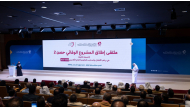
Doha: The Qatar Forum for Authors, affiliated with the Ministry of Culture, held a literary seminar on the memory of place on Wednesday.
Led by writer Badriya Hamad Al Marikhi, the seminar examined the role of place in literary works and how the built environment can evolve into an identity and a living memory in novels and short stories.
Forum Director Iman Al Kaabi said the forum is forging ahead with efforts to enrich the cultural scene, nourish minds and embrace writers and intellectuals by organizing regular cultural programs and seminars that span the gamut of intellectual and creative experiences across the country. The seminar drew on a book by Al Marikhi, published by the Ministry of Culture on the aesthetics of place in the Qatari novel.
Al Kaabi highlighted the project as one of the forum's largest cultural initiatives, designed to support intellectual output and literary research in Qatar. She said the forum will continue to stage cultural seminars and programs aimed at enriching the literary scene, nourishing minds and embracing writers and intellectuals, with such efforts helping revive the cultural landscape and invigorate intellectual and creative activity in Qatar.
For her part, Al Marikhi said place in a literary work is not merely a set of coordinates or a lifeless geographic point. Rather, it is a space shaped by physical structures and intertwined with the people, relationships, circumstances and scenes that emerge within it.
Places may disappear from our physical surroundings, she said, but they never leave our memory. Literature thus becomes both a means of preserving that memory and a vessel that gives it another place to live.
Human memory does not simply recall a place in the abstract or within the confines of its geographic boundaries, Al Marikhi added. It evokes the full gamut of sensations associated with it, as sound, smell, touch and sight converge to shape the emotional architecture of a place.
In a literary text, place goes beyond its traditional role as a setting or backdrop for a story. At times, it becomes a protagonist in its own right, actively shaping the narrative, charting the course of events and influencing the fates of its characters.
Delving into the architectural and heritage features of place, Al Marikhi examined the concept of Al Fereej in the Qatari and Gulf collective consciousness. She stressed that it is not merely a collection of walls or neighboring houses, but an interconnected social world in which collective memory takes root and national identity takes shape.
She described a hierarchy tied to the memory of the built environment, beginning with the home and expanding into the Fereej, from which the wider community emerges. That community, in turn, generates memory, ultimately contributing to the formation of human identity and shaping the cultural forces that drive society.
Al Marikhi said that when a novel gives due attention to place, it becomes a living archive, preserving its architectural features, human relationships, enduring social customs, sounds, settings, and the temporal and historical transformations societies undergo. In this way, narrative fiction becomes a repository of national and human memory.