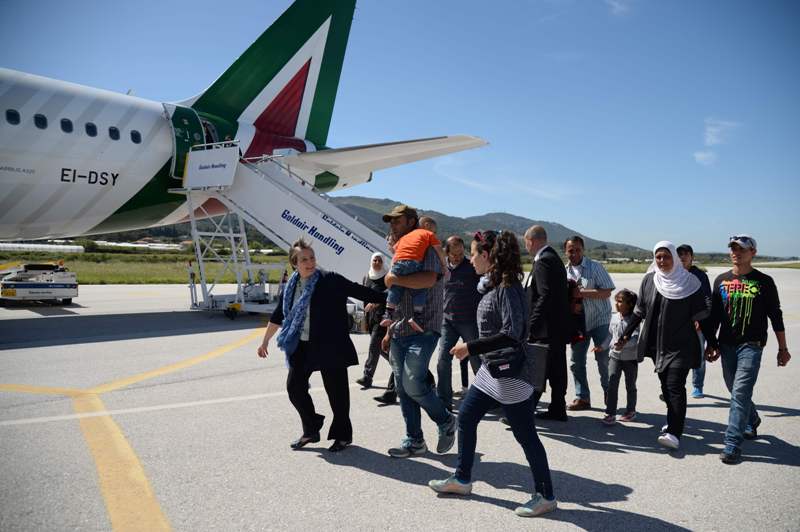
MYTILENE, Greece: The Vatican has confirmed that 12 Syrian refugees, all of them Muslim, are traveling with the pope back to Italy from Greece.
The three families, including six children, met with Francis on the tarmac on the island of Lesbos and boarded the plane.
In a statement, the Vatican said Francis wanted to "make a gesture of welcome" to the refugees, who were in camps on the Greek island before the agreement between the EU and Turkey to return migrants came into effect on March 20.
The Vatican will take responsibility for supporting the families. But the Catholic Sant'Egidio community will take care of getting them settled initially.
Some 200 protesters have been stopped about 100 meters (109 yards) from where the heads of the Catholic and Orthodox churches were holding a prayer ceremony at the Mytilene port on the Greek island of Lesbos.
The protesters were chanting "No Borders, No Nation. Stop Deportation" as Pope Francis, Ecumenical Patriarch Bartholomew I and Archbishop of Athens Ieronymos II held a prayer ceremony and tossed floral wreaths into the sea in memory of the refugees and migrants who died trying to reach Europe.
Moments earlier, police detained a woman attempting to display a banner inside the enclosure of the crowd gathered to watch the ceremony. As she was being led away, the woman said she was a volunteer working in Lesbos on the refugee issue.
The pope and the leaders of the world's Orthodox Christians and the Church of Greece have conducted a prayer ceremony for refugees at the Lesbos port of Mytilene.
Francis, Ecumenical Patriarch Bartholomew I and Archbishop Ieronymos II prayed for the many men, women and children who lost their lives in the Aegean Sea as they attempted the short but dangerous journey from Turkey in overloaded and unseaworthy boats.
The three led a minute of silence in front of a crowd of hundreds of people at the port, before tossing a floral wreath each into the sea in memory of those who perished.
Hundreds of thousands of migrants have passed through Mytilene on their perilous journeys from Turkey toward Europe.
AP