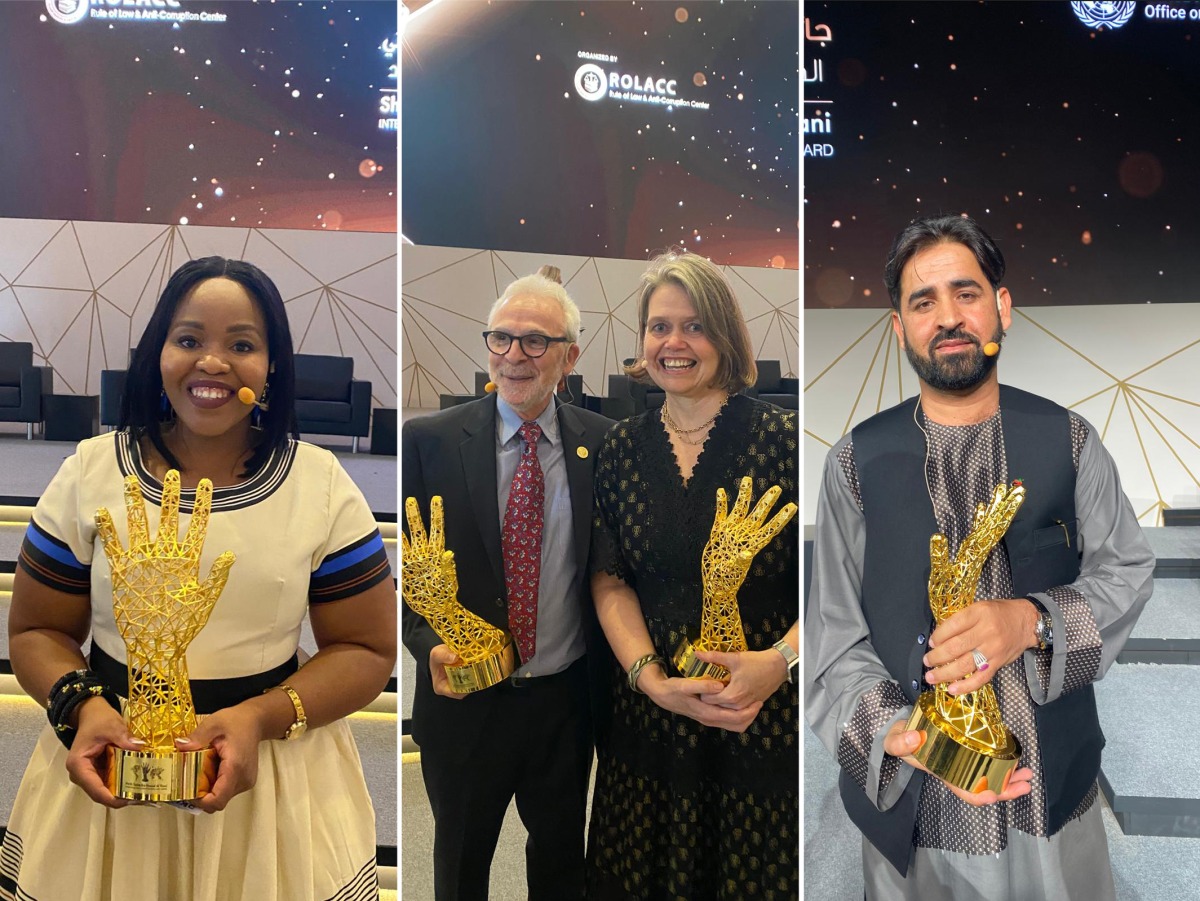
From left: Andiswa Matekenka, Professor Nikos Passas and Dr. Marianne Camerer, and Motiullah Wesa.
Doha, Qatar: Winners of the ninth Sheikh Tamim bin Hamad Al Thani International Anti-Corruption Excellence (ACE) Award have praised the initiative for its effective role in promoting the global fight against corruption and reinforcing the principles and measures enshrined in the United Nations Convention Against Corruption (UNCAC).
Speaking to The Peninsula on the sidelines of the award ceremony held in Doha yesterday, they said the award not only recognises individual excellence but also builds an international community committed to integrity, accountability, and good governance across sectors and regions.
Professor Nikos Passas, recipient of the Academic Research and Educational Materials Award, described the honour as a meaningful recognition of decades of dedicated work. He emphasised that the ACE Award celebrates individuals who “give their heart and soul for integrity in public affairs and governance,” while also creating a supportive network of like-minded professionals. According to Prof. Passas, such recognition provides moral shelter and encouragement for anti-corruption advocates who often face significant challenges and risks in their work.
He explained that corruption, in essence, occurs when individuals elected or appointed to serve the public instead prioritise personal interests. This, he noted, can take place across governments, private sector entities, international organisations, non-governmental organisations, and even academic institutions.
“Combating corruption, therefore, is not solely a legal exercise but a broader battle for integrity and the protection of the common good." With the world facing complex risks related to technology, health, the environment, finance, debt, and shifting global dynamics, he underlined that quality leadership is essential. “Our job,” he said, “is to contribute to this human capital for our sake and for the sake of future generations.” Dr. Marianne Camerer, also a winner of the Academic Research and Educational Materials Award and affiliated with the Nelson Mandela School of Public Governance at the University of Cape Town, expressed deep gratitude for the recognition.
She noted that researchers often work behind the scenes and are unsure whether their efforts are visible, making such acknowledgment particularly meaningful. Being among a global community committed to fighting corruption, she said, was both affirming and inspiring.
Dr. Camerer underscored the value of independent, evidence-based research in understanding corruption and designing effective interventions. She also highlighted the importance of the award’s link to the United Nations, which she said reflects a shared global commitment and creates an international space for collaboration. The cross-pollination of ideas among youth, academics, innovators, and civil society organisations, she added, can generate new thinking and solutions. Dr. Camerer emphasised that civil society plays a crucial role in sharing lessons, inspiring action, and sustaining momentum in anti-corruption efforts. Motiullah Wesa, winner of the Youth Creativity and Engagement Award, described the ACE Award as a significant opportunity to continue his work against corruption while advocating for education, particularly girls’ education, in Afghanistan.
He linked years of conflict in his country to widespread lack of education and corruption within the education sector. As one of the first Afghans to challenge corruption in this field, he has focused on ensuring that children have access to schooling as a foundation for rebuilding the country.
Wesa reiterated his commitment to working with communities to advocate for the reopening of girls’ schools, stressing that education is both a basic and Islamic right. He expressed hope that one day all Afghan children, girls and boys, will be able to attend school and contribute positively to their nation. He also highlighted the importance of international networking through the award, noting his aspiration to extend anti-corruption efforts beyond national borders for the benefit of future generations.
Andiswa Matekenka, winner of the Innovation and Investigative Journalism Award, said she was proud and honoured to receive the recognition. An investigative environmental journalist from South Africa, she thanked the award’s patrons for encouraging journalists to continue their work despite difficult circumstances.
She urged young and emerging investigative journalists across the region to persist in exposing corruption, particularly in sectors involving natural resources and environmentally damaging development.
Matekenka emphasised that investigative journalism plays a vital role in amplifying the voices of communities affected by corruption. She noted that anti-corruption work is demanding and often carried out under challenging conditions, making institutional backing and recognition crucial. The ACE Award, she said, validates the efforts of those on the front lines and supports the tireless work of anti-corruption fighters worldwide.