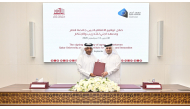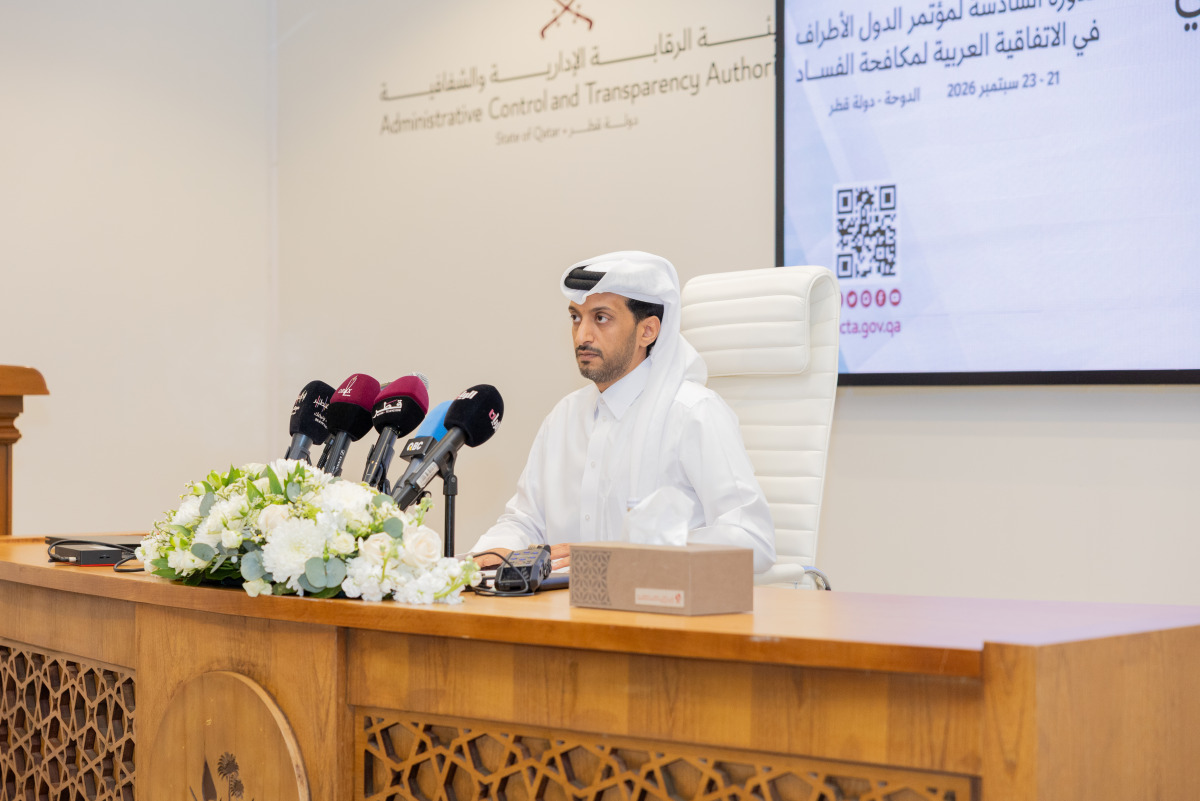
ACTA Official Spokesperson Abdul Wahab Al Kuwari speaking at the conference.
Doha, Qatar: Qatar will host the sixth session of the Conference of States Parties to the Arab Anti-Corruption Convention from September 21 to 23, bringing together Arab countries and relevant regional and international organisations to strengthen cooperation on integrity, transparency and the prevention and combating of corruption.
The announcement was made at a press conference held by the Administrative Control and Transparency Authority (ACTA) yesterday. The conference will be chaired by President of ACTA H E Hamad bin Nasser Al Misnad.
The press conference outlined preparations for the three-day conference, its main themes and the accompanying Arab Forum, highlighting the importance of strengthening joint Arab efforts to prevent and combat corruption and improving mechanisms for implementing the Arab Anti-Corruption Convention.
ACTA Official Spokesperson Abdul Wahab Al Kuwari said that several initiatives and projects are expected to be considered during the conference, including the proposed Doha Declaration on enhancing preventive measures against corruption and a draft decision on a mechanism for reviewing implementation of the Arab Anti-Corruption Convention, both submitted by Qatar.
He said other proposals include holding a regional expert meeting to develop a unified Arab guide for parallel financial investigations into financial corruption crimes, a project to strengthen international cooperation by accelerating responses to mutual legal assistance requests, and an initiative to enhance beneficial ownership transparency and identify ultimate beneficiaries.
Al Kuwari said the sixth session represents an important milestone in Arab joint action on integrity, transparency and the rule of law. He said the conference builds on the achievements of the five previous sessions, with a greater focus on moving from general principles to practical implementation and measuring results.
The conference comes at a time when stronger Arab cooperation is increasingly needed amid evolving methods of concealing illicit proceeds, increasingly complex financial and legal transactions, and the rapid movement of money and information across borders, Al Kuwari said.
He added that Qatar’s hosting and presidency of the session give it particular significance, while the proposed “Doha Declaration on Enhancing Preventive Measures against Corruption” places prevention at the forefront of efforts to address corruption.
Al Kuwari said that the provisional agenda includes reviewing measures taken to implement decisions adopted by the fifth session, as well as recommendations issued by subsidiary groups responsible for implementing the convention.
He said that participants will also discuss developing a mechanism to review implementation of the Arab Anti-Corruption Convention.
“The mechanism is intended to monitor progress by States Parties, identify successful practices and existing challenges, and determine technical assistance needs,” said Al Kuwari.
He said that the conference will also feature an accompanying Arab Forum addressing contemporary issues related to integrity and corruption prevention. “Among the key topics will be the impact of codes of conduct in promoting integrity in the public sector, the role of artificial intelligence in supporting corruption-prevention efforts, and the role of parliamentary councils and anti-corruption bodies in strengthening integrity systems and cooperation,” said Al Kuwari.
He said these issues have gained greater importance in light of rapid institutional, legislative and technological developments, which require countries to continuously improve preventive tools and enhance the effectiveness of integrity and transparency institutions.
Al Kuwari said that the expected outcomes of the conference will primarily include decisions, recommendations and a final declaration, subject to agreement by the States Parties. “Follow-up will be conducted through several mechanisms, including the General Secretariat’s monitoring of adopted decisions and preparation of reports on measures taken to implement them. The results of the follow-up will also be included on the agendas of subsequent meetings and sessions,” said Al Kuwari.
He said that the sixth session is expected to bring together 22 Arab countries, including 15 States Parties that have ratified the Arab Anti-Corruption Convention and seven Arab countries participating as observers.
“A number of relevant regional and international organisations will also participate as observers. Participation will primarily include delegations from States Parties, along with heads and officials of national bodies responsible for integrity, transparency and the prevention and combating of corruption. The rules of procedure also allow non-party Arab states, Arab, regional and international governmental organisations and eligible non-governmental organisations to participate as observers,” said Al Kuwari.
Al Kuwari identified differences among Arab countries in legislative frameworks and institutional and technical capacities as among the main challenges facing regional anti-corruption efforts. He said that other challenges include the need for stronger coordination among specialised national authorities and faster legal cooperation between countries.