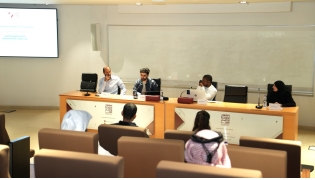
Doha: The Qatar Research, Development and Innovation (QRDI) Council hosted a webinar titled, “Global Competition for Innovation Talent.”
The webinar featured several distinguished guests as part of QRDI’s “Spotlight On” series, which aims to shed light on the innovation system. These included Dr. Khalid M Al Ali, founder and CEO of STA; Khalid Aboujassoum, founder and CEO of Else Labs Inc.; Fayez Mohamood, co-founder and CEO of Bluecore and Melis Abacioglu, founder and CEO of Wellbees.
Moderated by Hind Zaki, QRDI’s Director of RDI Programmes, the webinar attracted a mix of local, regional, and international audiences. Panellists provided an overview of their entrepreneurial journeys. They offered analyses on how countries attract and retain talent while reflecting on what steps can be taken to reproduce successful innovation models in Qatar. The webinar concluded by noting Qatar’s potential as a springboard for global innovative talent and entrepreneurial ventures.
The panellists began their entrepreneurial ventures in different parts of the world and described the factors influencing their decisions. Khalid Aboujassoum reflected that he sought to be an entrepreneur in a place with existing capabilities. He initially moved to Silicon Valley, where he aimed to learn to build a company from the ground up. However, he eventually moved to Canada to establish his company because it was both cost-effective and allowed him to tap into the available talent there. Emphasizing that as an entrepreneur, “you have to make sure you’re getting highly skilled people while making sure you can survive as a startup.”
Entrepreneurs and businesses face difficulties in finding, acquiring, and retaining talent. Additionally, approaches to talent acquisition change at various stages of a business. Fayez Mohamood noted, “it’s somewhat easier in some markets to find talent that wants to build from scratch.” He pointed out that talent acquisition increased in difficulty as his business grew to pass the one-billion-dollar mark. However, his company kept an “open mind in terms of where [they] were able to recruit that talent.”
Melis Abacıoğlu observed that “talent is looking for something completely different today. They’re looking for meaning, for flexibility.” Developing work environments that ensure well-being would accommodate both. Ultimately, innovation ecosystems that emphasize well-being would be more capable of attracting and retaining talent.
The discussion showed the multifaceted nature of thriving innovation ecosystems. In addition to cost, talent, and environmental incentives, Mohamood stressed that innovation ecosystems need strong communities that focus on inspiration and “instilling that aspect of ‘you can do it’ anywhere in the world.” “Focusing on inspiration so you can light up a generation,” he added.
Dr. Khalid M Al Ali spoke about his firsthand experience in California, where the state’s concerted long-term efforts through world-class educational and R&D institutions, steady and targeted government funding, and conducive legal and regulatory environments developed ecosystems, such as its Silicon Valley, that were hotbeds of innovation, producing top talent for companies to leverage, and giving birth to many of the largest technology companies in the world.
He acknowledged Qatar Foundation was a key component of realizing this potential in Qatar. He added that Qatar is a place where the long-term focus is on science, education, and health, and for it to have made the progress it has made is a mark of its leadership’s ingenuity. Qatar’s innovation ecosystem is on the rise, and “is a magnet attracting excellent talent, “ he added.