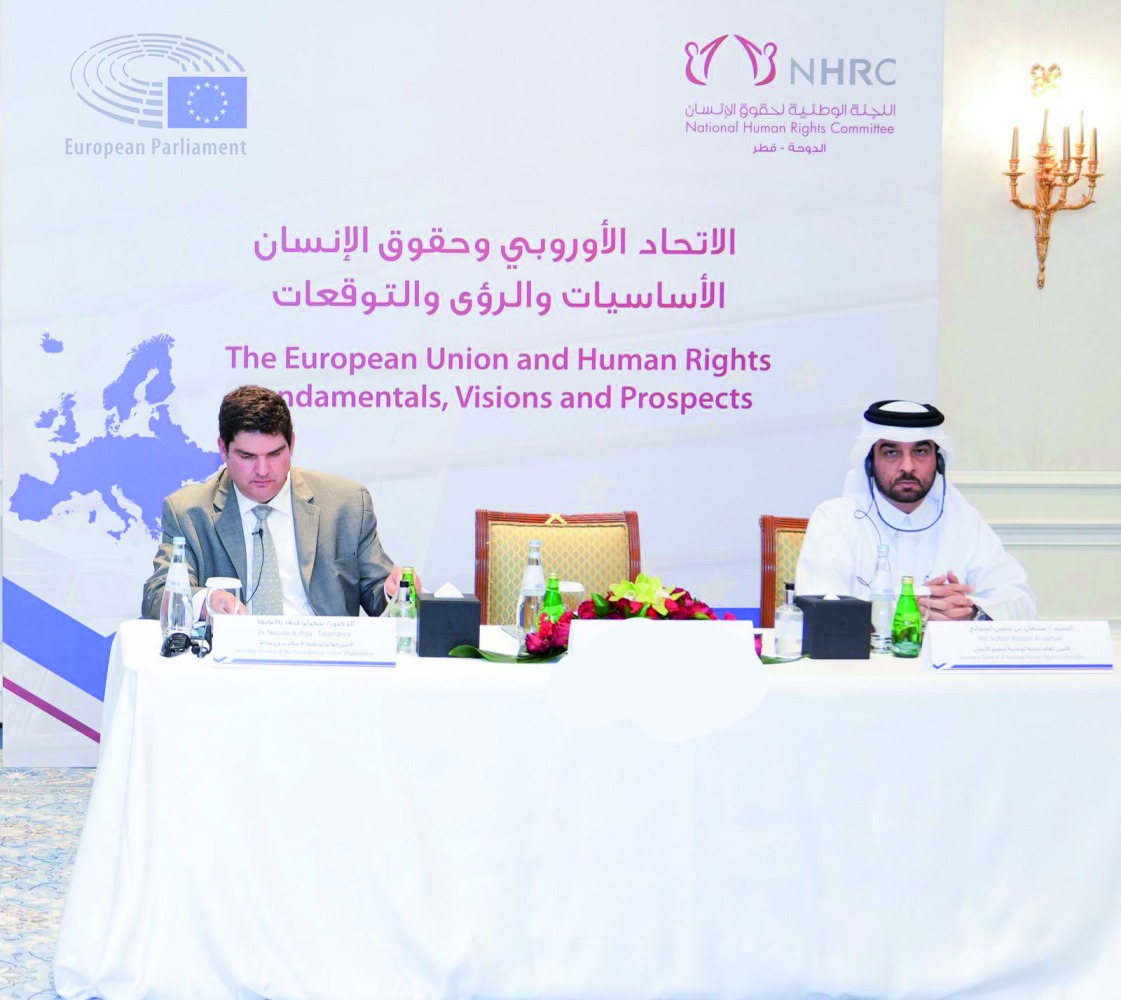
NHRC Secretary-General Sultan bin Hassan Al Jamali and Secretary-General of No Peace Without Justice, Dr. Niccolo Figa-Talamanca, at the workshop.
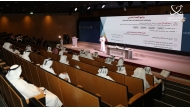
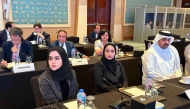
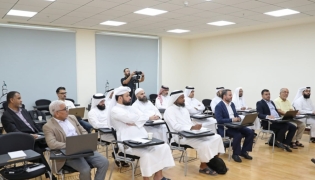
Doha: The first public training workshop “European Union and Human Rights: Fundamentals, Visions and Expectations” kicked off in Doha yesterday.
The workshop is organised by the National Human Rights Committee (NHRC) in cooperation with the European Parliament’s Subcommittee on Human Rights (DROI).
The workshop comes within the framework of the fruitful cooperation with all actors in the field of human rights. It aims to learn about the European human rights system, and discuss the promotion and protection of human rights, as well as current and future challenges.
NHRC Secretary-General H E Sultan bin Hassan Al Jamali said in his opening speech that the main objective of the training workshop is to give the participants a background on the European charters, mechanisms and institutions concerned with human rights, especially the European Union, the Council of Europe and the European Parliament; in addition to introducing the Charter of Fundamental Rights of the European Union, the EU agencies, and the European Court of Human Rights.
He noted that the European system for the protection of human rights has many pillars related to human rights issues and matters, at the forefront of which is the Council of Europe which has the most important and effective human rights protection systems at the regional and global levels.
He added that the European system for human rights is one of the most advanced regional systems in the field of protection and fundamental freedoms. The European system has paid great attention to this matter more than seven decades ago. The Council of Europe was established in 1949 to encourage cooperation between member states, to achieve progress and prosperity in a democratic society based on the freedom of expression.
The NHRC Secretary-General underlined that the National Human Rights Committee in the State of Qatar has put the importance of networking relations and partnerships with stakeholders at the international and regional levels at the core of its strategy in order to further advance its national role in protection and promotion of human rights, which has resulted in a solid partnership with the European Parliament in its various specialised committees, especially the Subcommittee on Human Rights.
This partnership was crowned in April of 2018 by a consultative memorandum of understanding for the exchange of experiences and consultations between the National Human Rights Committee and the Subcommittee. This memorandum is considered the first of its kind for the European Parliament with a Gulf and Arab national human rights institution.
Al Jamali pointed out that the existing partnership between the two parties reflects the credibility and true will for close cooperation between them in many joint programmes in the various fields of human rights, noting that the European Parliament and its senior officials have a large and distinguished presence in many major activities organized by the National Human Rights Committee, such as the international conference held in Doha, and the European Parliament hosted many hearings, meetings and exhibitions for the National Committee at its headquarters in Brussels. This workshop is an extension of this solid cooperation between the two sides.
NHRC Secretary-General H E Sultan bin Hassan Al Jamali looked forward to further consolidating the joint cooperation with the Subcommittee on Human Rights, and to developing and activating the strategy contained in the consultative memorandum of understanding between the Ntional Human Rights Committee and the Subcommittee in order to strengthen the relationship and promote it to broader horizons.
For his part, Secretary-General of the No Peace Without Justice, Dr. Niccolo Figa-Talamanca, praised the efforts made by the National Human Rights Commission and the organization of this workshop, saying: “I am very impressed with the strength and independence of the National Human Rights Committee.”
During his opening speech to the workshop, he stressed that his participation as the Secretary-General of the No Peace Without Justice - an organization defending human rights - and the cooperation with the National Human Rights Committee and the Subcommittee on Human Rights is an honor.
He noted that the workshop will address human rights in Europe and its institutions, and will try to solve the complications by clarifying the specializations and powers of each of them.
He indicated that the workshop will review the basic dynamics of human rights, noting that human rights are part of political matters, but they must arrange the relationship between individuals, groups and institutions, as politics is the relationships between these different entities.
He said that the workshop will discuss the challenges faced by human rights policies in Europe, and how human rights affect citizens, the reality of the member states of the European Union, the Union as a whole, as well as the foreign policies of Europe.