Oil prices rose on Friday as US gasoline prices jumped to a record high as China looked ready to ease pandemic restrictions and investors worried that supplies will tighten if the European Union bans Russian oil, noted the report by Al Attiyah Foundation.
An EU embargo, if fully enacted, could take about 3 million bpd of Russian oil offline, which will completely disrupt, and ultimately shift global trade flows, triggering market panic and extreme price volatility.
Brent futures rose $4.10, to settle at $111.55 a barrel. US West Texas Intermediate crude rose $4.36, to settle at $110.49. For the week, WTI gained 0.7 percent, while Brent fell 0.7 percent.
In the US, gasoline futures soared to an all-time high after stockpiles fell last week for a sixth straight week. That boosted the gasoline crack spread - a measure of refining profit margins - to its highest since it hit a record in April 2020 when WTI finished in negative territory.
In China, authorities pledged to support the economy and city officials said Shanghai would start to ease coronavirus traffic restrictions and open shops this month.
Pressuring oil prices, coupled with inflation and rate rises, drove the US dollar, last week, to a near 20-year high against a basket of currencies, making oil more expensive when purchased in other currencies.
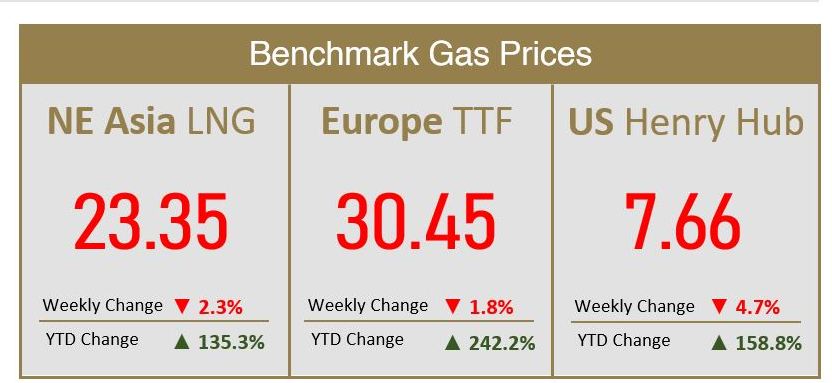
Asian spot liquefied natural gas (LNG) prices inched down last week despite some spot procurement activities by utilities and traders from Japan, Korea, and India to replenish stocks.
Muted Chinese activity during COVID-19 lockdowns continued to suppress overall Asian demand. The average LNG price for June delivery into north-east Asia was estimated at $23.35 per metric million British thermal units (mmBtu), around $0.55 lower than the previous week, industry sources said.
In Europe, LNG prices continued to trade at a record discount to Benchmark Dutch TTF gas, as Russian pipeline gas supply issues dominated sentiment, given the region’s dependence on Russia. European LNG prices were assessed at $22.15 per mmBtu for June deliveries to Northwest Europe, equivalent to a $10 per mmBtu discount to the June TTF contract, analysts said.