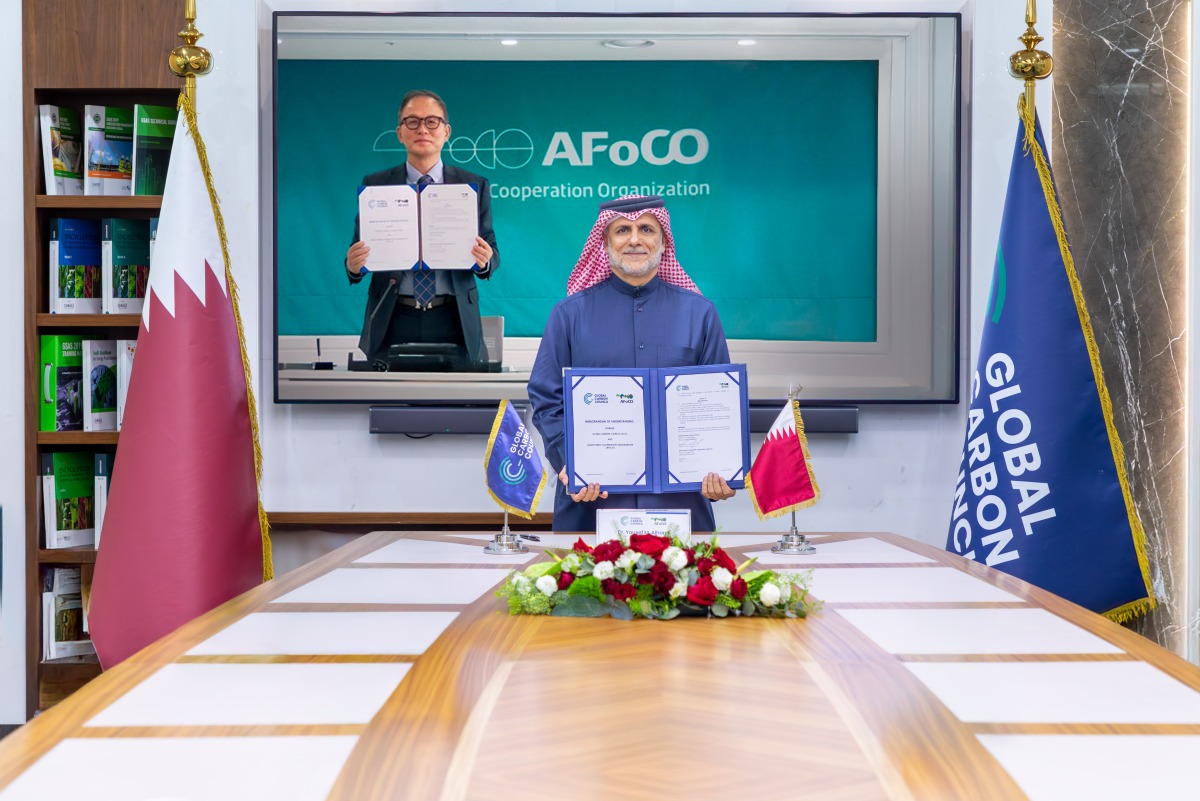
The MoU was signed virtually by Founding Chairman of the Global Carbon Council Dr. Yousef Alhorr and Executive Director of the Asian Forest Cooperation Organization Dr. Chongho Park.
Doha, Qatar: The Global Carbon Council (GCC) and the Asian Forest Cooperation Organisation (AFoCO) have signed a memorandum of understanding (MoU) to strengthen cooperation in addressing global climate change through the promotion of Nature-based Solutions (NbS) and fostering an enabling and high-integrity carbon market ecosystem across Asia.
The MoU was officially signed during a formal ceremony by Founding Chairman of the Global Carbon Council Dr. Yousef Alhorr and Executive Director of the Asian Forest Cooperation Organization Dr. Chongho Park .
The partnership was initiated not only in response to UNEP’s inaugural State of Finance for Forests (SFF) report, which highlights the significant global shortfall in forest and environmental finance, but also to align with broader international efforts aimed at forest restoration, resilience, and long-term sustainability.
In this context, the partnership seeks to leverage carbon-based incentives in line with the Paris Agreement, particularly Article 6, as a means to mobilize private sector engagement through internationally aligned carbon market mechanisms.
According to the report, annual forest investments must more than triple from $84bn in 2023 to $300bn by 2030 to meet global climate and biodiversity targets. Currently, the world faces a forest finance gap of $216bn per year, underscoring the need for scalable and credible market-based solutions. To this end, the agreement between GCC and AFoCO establishes a cooperative framework to support sustainable, verifiable, and impactful forestry and climate initiatives across the region.
Through this MoU, the two organisations will promote collaboration on Public–Private Partnership (PPP)-based Nature-based Solutions carbon incentive programmes, aligned with the Land Use, Land-Use Change and Forestry (LULUCF) initiatives implemented by AFoCO to strengthen climate change mitigation, adaptation, and resilience.