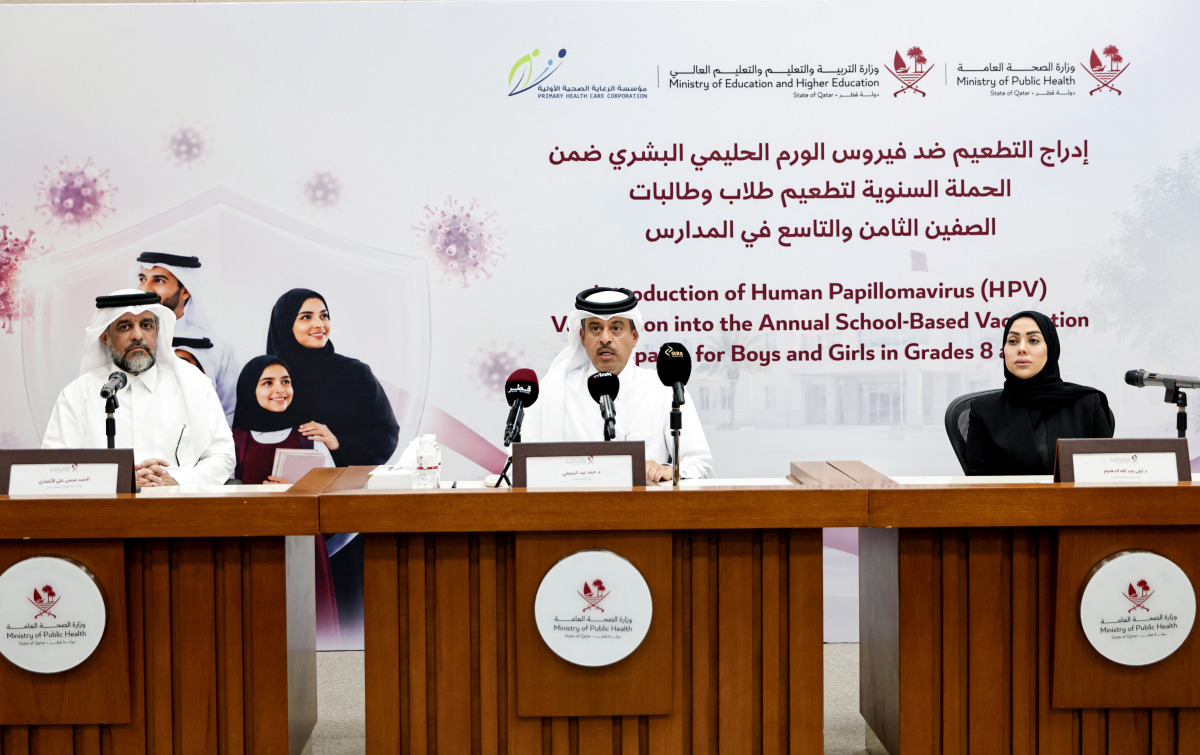
Director of the Health Protection and Communicable Diseases Control Department at the Ministry of Public Health, Dr Hamad Eid Al Rumaihi (centre), with other officials at a press conference announcing the introduction of Human Papillomavirus vaccination into the National School Vaccination Campaign. Pic; Salim Matramkot/The Peninsula
Doha, Qatar: The Ministry of Public Health (MoPH) has included the human papillomavirus (HPV) vaccine in National School Vaccination Campaign, marking a major step in the country’s efforts to prevent HPV-related cancers, particularly cervical cancer.
The inclusion of the vaccine aligns with the Ministry’s policy to combat cancer and forms part of its strategy to eliminate cervical cancer through early prevention and vaccination, said Director of the Health Protection and Communicable Diseases Control Department at MoPH, Dr. Hamad Eid Al Rumaihi, yesterday.
The campaign, launched in collaboration with the Ministry of Education and Higher Education (MoEHE) and the Primary Health Care Corporation (PHCC), will cover 301 government and private schools and target 76,264 male and female students in Grades 8, 9 and 10.
The first phase of the campaign will run from September 20 to November 18, 2026, while the second phase will take place from April 25 to May 16, 2027.
Announcing the campaign at a press conference yesterday, Dr. Al Rumaihi said the HPV vaccine was approved for Qatar’s Routine Immunisation Framework in 2023 following a recommendation by the National Immunisation Technical Advisory Group.
“The inclusion of this vaccine aligned with the Ministry of Public Health’s policy to combat cancer, specifically as part of its strategy to eliminate cervical cancer,” he said.
The vaccine used in Qatar protects against nine strains of HPV, which account for approximately 95% of cervical cancer cases and are also associated with several other types of cancer. Dr. Al Rumaihi said the World Health Organization (WHO) recommends HPV vaccination for both males and females. “The HPV vaccine is safe and effective. It has been in use worldwide for over 20 years, since 2006,” he said.
“Globally, 164 countries, including all Arab Gulf states, have incorporated the vaccine into their national immunisation programmes,” he added. For the first time, the HPV vaccine will be administered to students through the annual school-based vaccination campaign.
According to Dr. Al Rumaihi, the decision to conduct the campaign in two phases this year is an exceptional measure aimed at catching up on delays in the previous academic year caused by exceptional regional circumstances. During the first phase, Grade 9 students in government and private schools will receive the first dose of the HPV vaccine. Grade 10 students in government schools will also receive the booster dose of the tetanus, diphtheria and pertussis (Tdap) vaccine, for the last time this year. The second phase will include the first dose of the HPV vaccine for Grade 8 students and the second dose for Grade 9 students in government and private schools. The Tdap booster will also be administered to Grade 9 students in government and private schools. Grade 10 students who missed their targeted doses during the previous academic year will also be covered. The HPV vaccine is licensed and approved by the WHO and the US Food and Drug Administration (FDA), with hundreds of millions of doses administered worldwide.
Dr. Al Rumaihi emphasised that the vaccine has an efficacy exceeding 90%, while vaccination at an early age, particularly between 11 and 14 years, produces the highest immune response compared with older age groups. Common side effects are generally mild and may include local symptoms at the injection site, low-grade fever, fatigue or mild headache. These symptoms usually resolve within 24 to 48 hours.
Vaccination is optional and requires prior consent from a parent or guardian. Parents will receive an awareness leaflet and a designated consent form, and vaccination will only be administered after the signed form is submitted.
Students will receive the vaccines in school health rooms, including designated clinics and equipped areas within schools, in accordance with approved health regulations.