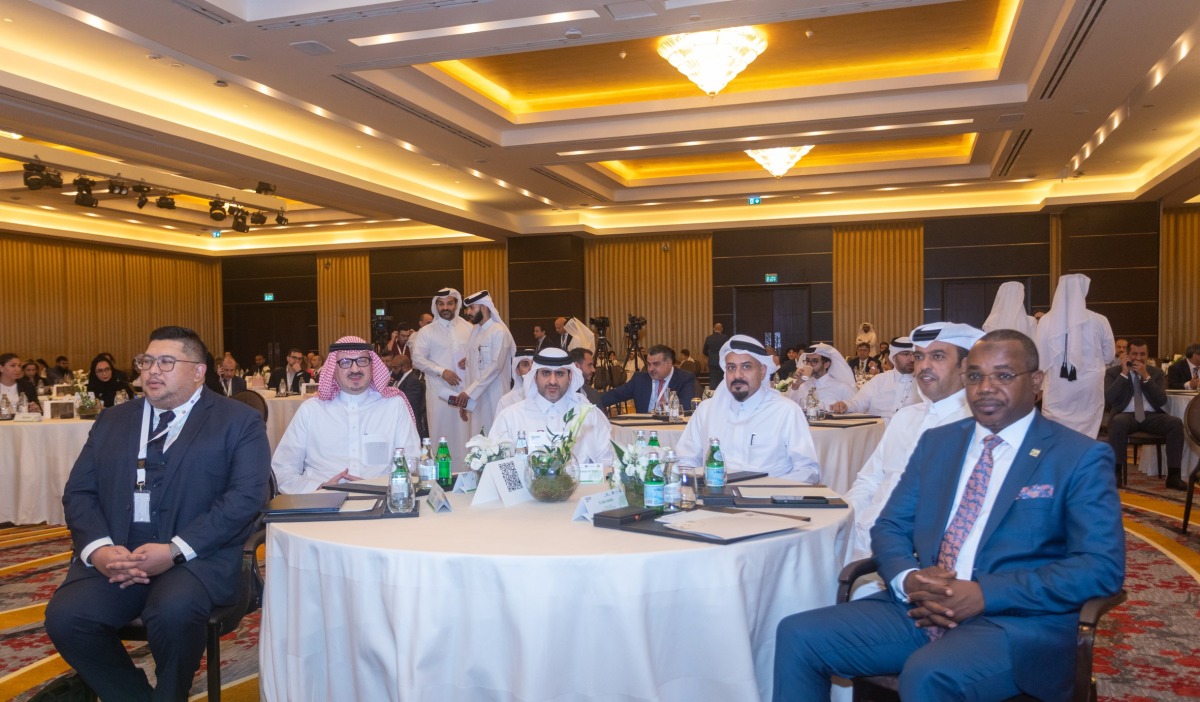
Doha: The fourth IFSB Innovation Forum for market players in Islamic Financial Services Industry (IFSI) kicked off on Wednesday under the auspices of the Qatar Central Bank (QCB) in collaboration with Malaysia-based Islamic Financial Services Board (IFSB) and the Qatar Financial Centre (QFC).
Themed "Innovations for Sustainability and Regulating Financial Services," the 4th IFSB Innovation Forum brought together a lot of specialists and those interested in international Islamic and sustainable financing.
In a speech delivered at the inauguration of the forum, HE Governor of Qatar Central Bank Sheikh Bandar bin Mohammed bin Saoud Al-Thani said that the Islamic banking assets of four Islamic banks in the State of Qatar amounted to $154bn in June 2022, which represents 28 percent of banking assets.
His Excellency added that IFSB's latest report ranked the State of Qatar as one of the top five countries in the Islamic finance industry through its sound regulatory and supervisory policies that cope with relevant international standards.
The report also classified as systemically important among the 15 countries where Islamic banking has reached more than 15 percent of the market share, His Excellency noted, ascribing these results to the State of Qatar's four-decade experience in Islamic banking services.
The banking sector in the country continues its important role in economic growth and meeting the requirements for the infrastructure financing for the FIFA World Cup Qatar 2022, due to be held November 20, said His Excellency, noting that QCB's dual banking system guarantees equal opportunities for Islamic and conventional banks in Qatar, and aims to develop a regulatory framework that promotes growth and innovation in the financial industry, and is committed to playing a prominent role in developing the financial technological ecosystem in Qatar.
In this respect, His Excellency noted that digital transformation and climate change recently captured the attention of the real economy, the financial sector and the private sector, transforming the role of banks and central banks in the financial services industry into a role that enables market empowerment, digital acceleration and innovation. His Excellency added that the two areas fall within the Qatar National Vision 2030, highlighting the digital transformation strategies launched by the national banks which demonstrates the importance of financial digitization as the future of the banking industry.
His Excellency highlighted QCB's multiple initiatives ahead of the upcoming FIFA World Cup to enable safe, fast and affordable digital payments, most notably its first license in the country to provide digital payment services by launching Google Pay last month in Qatar. On the regulatory level, the QCB released several guidelines that regulate and license various payment activities in the country, His Excellency pointed out.
His Excellency added that the increasing significance of environmental sustainability and social responsibility made the need to rebuild the world with sustainable and eco-friendly investments more urgent. Qatari banks already embarked on transformation into green banking by issuing green bonds, implementing green loans, and the increasingly growing standardized ESG disclosures.
His Excellency further stressed the global financial system went through unprecedented developments over the past two decades escalated by continuous challenge facing financial regulators to deal with a wide range of issues ranging from unconventional monetary policies in the wake of the global financial crisis to unprecedented COVID-19 pandemic scenarios, His Excellency said, calling for collective action to achieve further benefits amid challenges related to digital transformation and green finance.
IFSB Secretary-General Dr. Bello Lawal Danbatta said that the assets of the global Islamic financial services industry grew by 11.3% year-on-year with a total value estimated at $3.1tn in 2021, explaining that the progress made by the Islamic financial services industry, despite the challenges imposed by the COVID-19 pandemic, is a testament to the growing interest in Islamic finance products and services among broader stakeholders in the financial sector, including non-Muslim majority countries.
He clarified that many digital innovations in the Islamic financial services industry, launched during the pandemic, not only helped Islamic financial services institutions to overcome the challenges of the pandemic, but also provided opportunities for Islamic financial services institutions to popularize and expand the scope of Islamic finance beyond traditional borders, with an increased interest in the possibilities of Islamic finance in the development of products and services related to sustainability, which are well suited to the sustainable development goals and beyond.
Dr. Danbatta added that an increase in demand for sustainability-related products and services has recently taken place, as environmental, social and governance factors are gaining more attention among global investors due to the unprecedented manifestations of climate change and the subsequent risks to finance and investments made by financial institutions.
In this regard, he stated that in 2021, the issuance of sustainability-related sukuk amounted to $5.3bn, of which $1.6bn or 29% are green sukuk, and this increased interest was reflected by the large-scale issuance of sustainability and environmental, social and institutional governance sukuk from sovereign and private issuers.
He predicted that this trend will continue, taking into account the strong commitment of global leaders and industry actors towards sustainability and climate-related initiatives, in addition to increasing investors' appetite for sustainable investments, and the need to finance green transformation and sustainability projects is likely to lead to an increase in the issuance of sustainability-related sukuk in the near future; indicating that Islamic financial technologies have the potential to contribute significantly to addressing sustainability factors and environmental, social and institutional governance through their innovative financing and investment ideas.
He reiterated that examples of this include charitable, zakat and waqf funds collected through crowdfunding platforms to be used for activities eligible for climate finance, financial transfers through Islamic fintech that supports families in obtaining low-cost clean energy.
The IFSB Secretary-General explained that the Innovation Forum is an annual event organized by the IFSB that aims to develop creative thinking and dialogue in the Islamic financial services industry, as it focuses on innovation that creates a competitive advantage for these institutions and contributes to promoting the growth of Islamic finance.