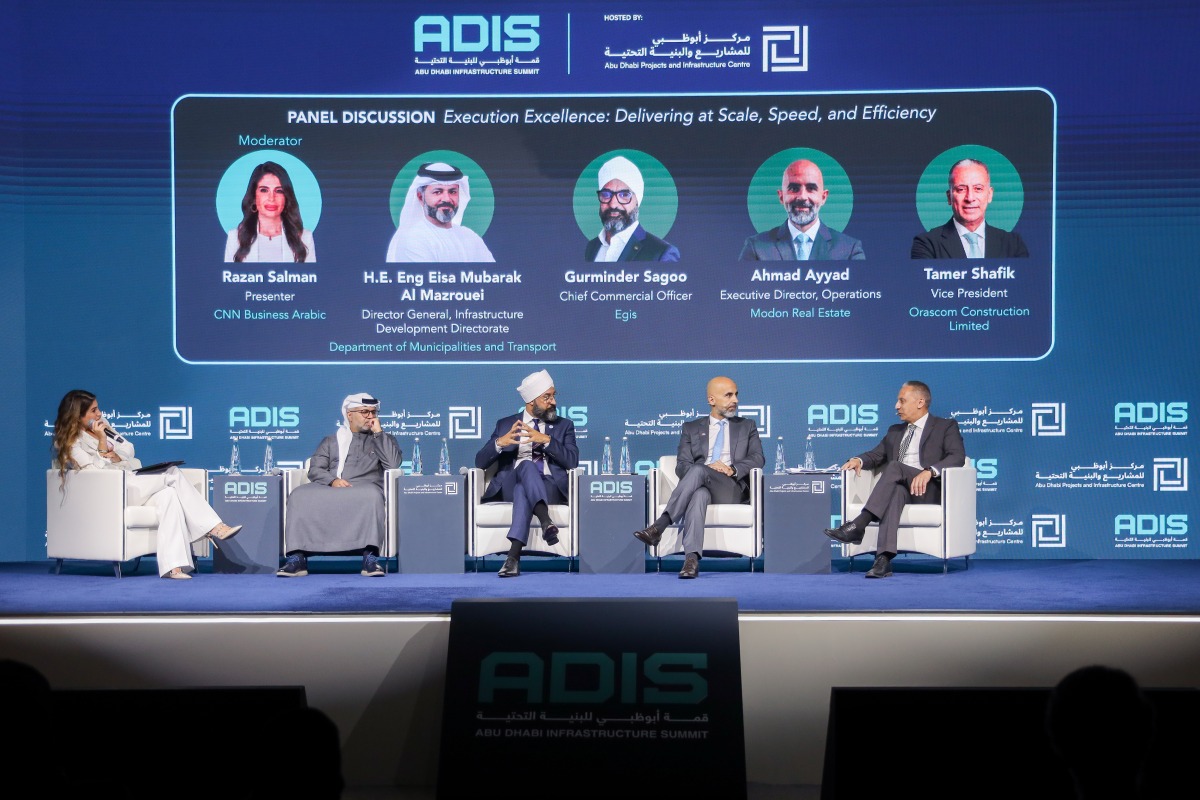
Panellists at a session during Abu Dhabi Infrastructure Summit yesterday.
Abu Dhabi: Collaboration, long-term planning, and integrated delivery models are becoming essential to executing large-scale infrastructure projects efficiently, speakers said during a panel discussion on the second day of the Abu Dhabi Infrastructure Summit (ADIS) 2026.
The session, titled ‘Execution Excellence: Delivering at Scale, Speed, and Efficiency,’ convened senior government officials and industry leaders to discuss how Abu Dhabi and regional markets are accelerating project delivery while maintaining quality, sustainability, and long-term value.
Opening the discussion, Director General, Infrastructure Development Directorate at the Department of Municipalities and Transport, H E Eisa Mubarak Almazrouei said excellence in Abu Dhabi’s infrastructure sector is “not an option” but a core requirement underpinning the emirate’s development ambitions.
“Excellence with us in Abu Dhabi is not an option, it’s a mandate,” he said. “We have to deliver our projects with excellence, speed, and quality because we are in Abu Dhabi.” Almazrouei said Abu Dhabi’s ability to deliver world-class infrastructure is driven by close collaboration between government entities, consultants, contractors, and private sector partners.
“All of the entities work as a team because we are all under one umbrella, with the same objectives,” he said, citing agreements signed between nearly 14 entities to streamline project delivery and support developers operating in Abu Dhabi.
He noted that long-term planning frameworks, including five-year and 20-year development strategies, allow government and industry stakeholders to coordinate infrastructure needs well in advance.
“We involve everyone from the planning stage,” he said. “This coordination and involvement from the government sector and the private sector allow us to be more agile and have more flexibility.” Almazrouei added that Abu Dhabi’s authorities increasingly encourage contractors and consultants to propose alternative delivery methods and innovative construction solutions.
Meanwhile, Chief Commercial Officer at Egis, Gurminder Sagoo, said the infrastructure industry is increasingly moving away from focusing solely on low upfront costs towards evaluating projects based on long-term lifecycle performance.
“If you look at the infrastructure and the assets built around the Emirates, you wouldn’t think we need to be innovative,” Sagoo said. “It’s really an exceptional place where you see world-class infrastructure and world-class buildings.”
Executive Director, Operations at Modon Real Estate, Ahmad Ayyad, said infrastructure procurement models must evolve to consider the full lifecycle of projects, including design, construction, and long-term maintenance.
“We need to look at projects from their whole life cost rather than as three different components,” he said. Ayyad stressed the importance of breaking down silos between consultants, contractors, developers, and maintenance teams to create more integrated delivery systems. “It’s the project that comes first,” he said.
The discussion also explored sustainable construction methods and collaborative delivery models through regional case studies.
Vice President, Orascom Construction Limited, Tamer Shafik, highlighted the company’s monorail project in Egypt as an example of integrated execution and sustainable construction practices.
He said the project adopted a collaborative approach between government authorities, contractors, and consultants from the outset, while also minimising construction waste and reducing on-site disruption through extensive use of precast elements.