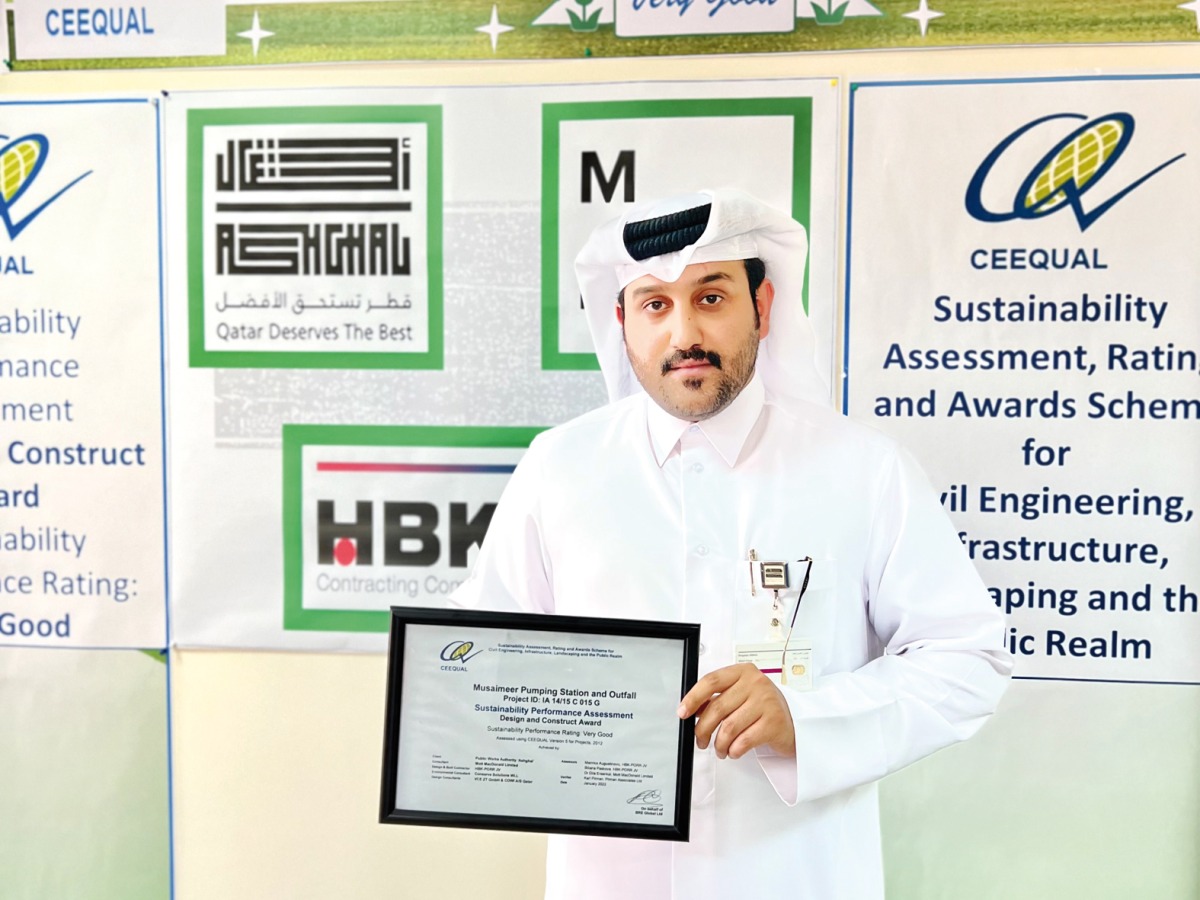
Eng. Saad Al Marri from Ashghal's Drainage Networks Projects Department with the award.
Doha: The Public Works Authority (Ashghal)'s Mesaimeer Pumping Station and Outfall Project has successfully achieved the Civil Engineering Environmental Quality Assessment and Award Scheme (CEEQUAL) Design and Build Award with a ‘Very Good’ rating, in recognition of Ashghal’s commitment to deliver sustainable infrastructure projects.
The award was received by Eng. Saad Al Marri, representing the Drainage Networks Projects Department at Ashghal, as part of a ceremony held at the project site, with representatives from Ashghal, the project’s supervision consultant (Mott MacDonald) and contractor (HBK-PORR JV) in attendance.
Eng. Al Marri said that winning the award in one of the most important and largest infrastructure projects implemented by the authority reflects the extent of Ashghal’s commitment and its success in implementing its strategic goal to deliver sustainable infrastructure projects with enhanced team collaboration, and in compliance with proven sustainability standards.
CEEQUAL is an international scheme that was launched in 2003 to reward designers, and contractors and clients that demonstrate a distinctive performance in the legal, environmental, and social domains. It uses an evidence-based rating system to assess performance of the projects during the design and construction phases, including projects from all fields such as civil engineering, infrastructure, landscaping, and public realm.
The Mesaimeer Pump Station and outfall Tunnel project aims to enhance the capacity to accommodate rainwater serving more than 270 km2 South of Doha during the rainy season. This project helps in reducing negative impacts of the high ground water levels on the environment, residents, and communities, and protecting up to 23 major road tunnels.
The project includes the construction of the 10 km-long outfall, which is one of the longest outfall tunnels in the world. At a depth of 15 meters below the seabed, excavation of the outfall tunnel is a major construction challenge due to the changing geological features, the ground pressure, and the water pressure at this depth.
Therefore, excavation is done using the tunnel boring machine (TBM) with “earth pressure balance” technique, designed to operate in a range of ground conditions in Qatar. A highly professional and specialised team carries out all the marine works.
The second part of the project includes a pumping station with 10 pumps and auxiliary facilities. The pumping station will be located at the end of Mesaimeer Tunnel south of Hamad International Airport. The pumping station will operate at a capacity of 19.7 cubic metres per second, and its function is to pump water from Mesaimeer Tunnel, which was completed in 2016, to the new outfall tunnel.
The project is designed to ensure the preservation of the marine environment, as the water that will be pumped complies with the international environmental standards, and it is discharged ten kilometres off-shore to reduce the effect on the marine environment.
Mesaimeer Pumping Station and Outfall is the second phase of the Overall Mesaimeer Surface and Storm Water Drainage Project, which aims to discharge the non-reusable stormwater into the sea, thus decreasing the surface water level and reducing pumping costs in construction projects around the country. It will also preserve the foundations of buildings as well as infrastructure services, and reduce land subsidence due to rain.