By Ingrid Melander
PARIS: The French people voted on Sunday in runoffs for regional elections that will show whether the far-right National Front (FN) can turn popularity into power.
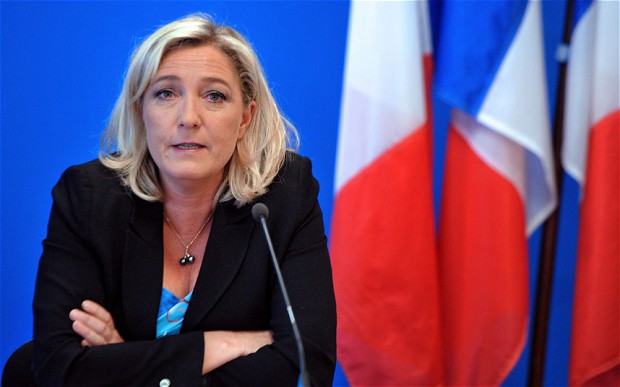
Marine Le Pen's party achieved a breakthrough last week by taking the lead in the first round of the vote, drawing strength from fears over Europe's refugee crisis and the Islamic State militant attacks that killed 130 people in Paris a month ago.
"For me, she is going to win. Maybe it will make all those politicians stop and think," said voter Evelyne Risselin in Le
Pen's electoral home base Henin-Beaumont in northern France.
But the anti-immigrant, anti-European Union FN was by no means certain to take any of the 13 regions.
The outcome will depend largely on what left-wing voters will do after the ruling Socialist party withdrew from the race in the two regions where the FN was best placed - the north where Le Pen is a candidate and the southeast where her niece Marion Marechal-Le Pen is running.
The Socialists urged their supporters to back Nicolas Sarkozy's conservatives in those two constituencies to keep the
FN out of power, and a series of opinion polls have shown that voters might well be heeding that call.
"Voters should not be treated like children, nor be terrorised," a smiling Marine Le Pen told reporters after
casting her vote in Henin-Beaumont.
Voter turnout stood at 19.59 percent at midday compared 16.27 percent at the same time in the first round last week, when full-day turnout totaled 49.91 percent.
The Socialists fear that some of their supporters might stay home rather than go and vote for the party of Sarkozy, who is widely despised by the left. Just under one in two registered voters turned up at the polling stations last week.
President Francois Hollande voted in his electoral home base in Tulle, southwest France, amid tight security following the Paris attacks on Nov. 13.
Voters took selfies with a relaxed Hollande, who scored a big diplomatic victory on Saturday by getting almost 200
countries to agree a pact to limit global warming.
"VERY TIGHT RACE"
Voter intention polls were not run for all regions and several polls - especially in the southeast - forecast only
small differences between the candidates that were often within the margin of error for such surveys anyway.
"The only thing that is certain is that it will be a very tight race," political analyst Joel Gombin, a specialist on the
far-right, said of the run-offs.
First estimates are due at 1900 GMT, when voting stations close.
The Socialists, who currently govern in all but one of the 22 regions under a map that was redrawn for this election, were sure to suffer big losses of popular vote. But, paradoxically, the FN's strength, by weakening Sarkozy's conservatives, could help the Socialists cling to more regions than they hoped.
Much attention will also be focused on the northeast Alsace-Champagne-Ardenne-Lorraine region, where the Socialist candidate rejected his party's call to drop out of the run-offs.
The run-offs were seen as a testing of the waters for all three front-runners for the 2017 presidential elections, the Socialists' Hollande, ex-president Sarkozy and Le Pen. The FN has never managed any constituency larger than a few small and medium-sized towns, and winning a region is key to its strategy to try and convince voters it could eventually be trusted to govern the country.
In local elections in March, the National Front failed to win any department - councils that are smaller than the regions - in the run-offs despite a strong showing in the first round. That was partly because, as opposed to mainstream parties, it is isolated to the extent that it could attract no parties to strike alliances with between the two rounds.
For Sarkozy, who was hoping a landslide victory would raise his chances for re-election in 2017, the first round was a severe disappointment that weakened his hand within his Republicans party.
How many regions the conservatives eventually win will be pivotal to the struggle for power within the party.
Reuters