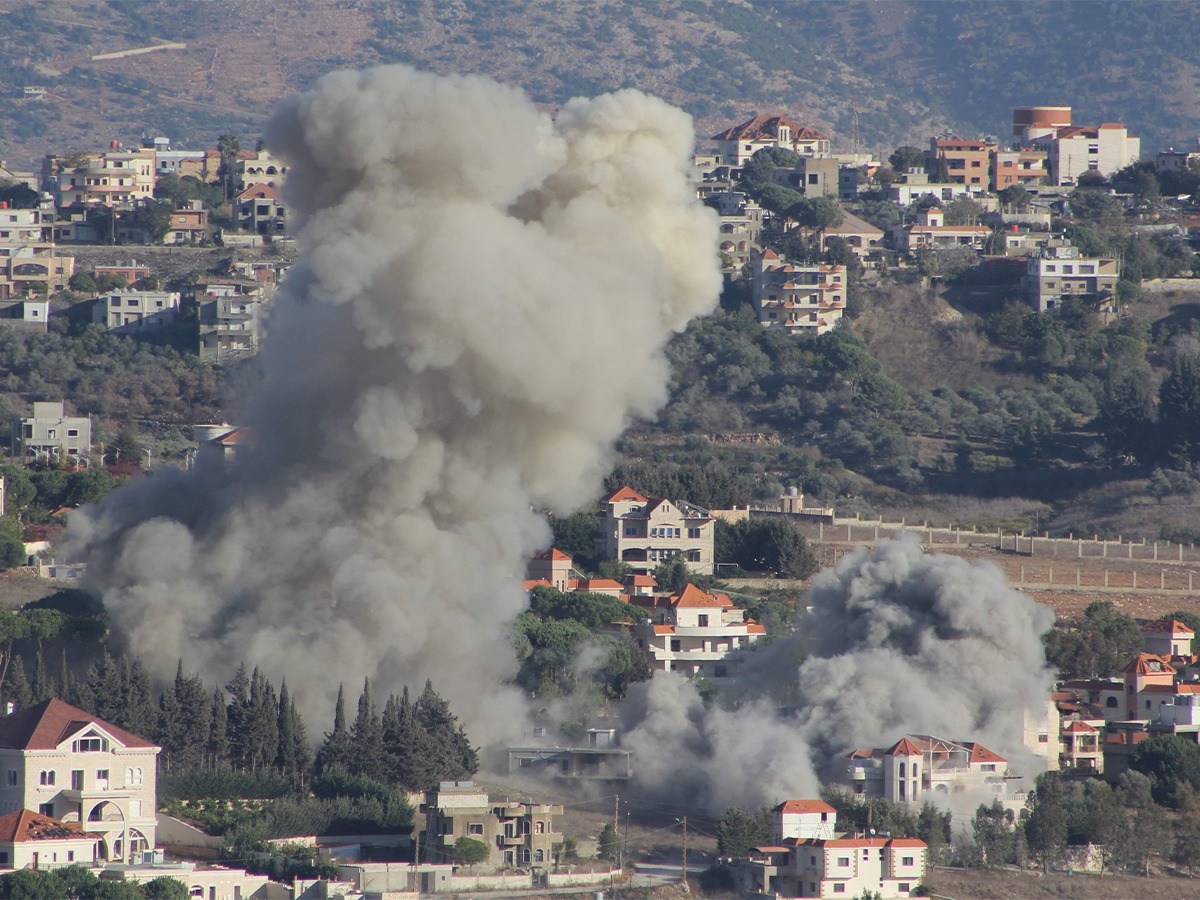
Beirut: Between villages whose residents have been displaced, homes reduced to rubble, and towns where those who remain live under the constant threat of shelling and tension, the future of southern Lebanon is becoming increasingly uncertain as Israeli offensives continue and the area under military control expands.
For thousands of residents waiting to return to their villages and homes, the question is no longer simply when the shelling will end, but whether they will be able to return at all, and whether their villages will remain part of their daily lives or become areas increasingly difficult to reach amid a new reality on the ground.
These concerns heightened after Israeli forces announced their takeover of Ali Al-Taher Hill, located on the fringe of Nabatieh, north of the Litani River and overlooking the city, in a strategic position facing the historic heights of Beaufort Castle, which Israeli forces also seized.
With Israel proclaiming its intention to remain in southern Lebanon and establish a security zone known as the "Yellow Line,” spanning 10 kilometers deep, consternation is deepening among residents of southern villages and towns over the disposition of their communities, the future of an Israeli withdrawal, and the prospects for rebuilding what the war has decimated.
The picture is becoming even more blurred as home razing operations persist, alongside shelling of several villages and towns. Displaced residents, meanwhile, find themselves facing an open-ended wait, torn between their longing for their homes and their fear of what they may find upon returning.
Lebanese President Gen. Joseph Aoun said during a surprise visit Monday to the Nabatieh area of southern Lebanon that the indomitable spirit of residents of the south is the greatest badge of honor on their chests, adding that their remaining despite the war relays a message to the world that Lebanese society in the south can rise again, won't bend, and remain resilient.
Aoun hoped that the wound of the south will finally heal once and for all, stressing the right of residents of the south to live in safety, rebuild their homes without fear of their being leveled, cultivate their land, and live with dignity and enduring security after longstanding suffering since 1969, generation after generation.
He stressed that the withdrawal of Israeli forces, the return of prisoners and displaced people, and reconstruction are immutable principles that the nation is committed to implementing, describing them as a single consequential objective on which the Lebanese agree and over which there is no dispute.
Political analyst Dr. Mohammad Moussa Issa told Qatar News Agency (QNA) that the occupation’s posture in southern Lebanon can be characterized through threefold dimensions, each with its own humanitarian, living, and field circumstances.
Issa, who is from the southern border town of Mais Al Jabal, described the reality facing border villages and towns, noting that the first dimension consists of the occupied villages adjacent to occupied Palestine, or what is known as the Yellow Line.
These villages have been entirely effaced after most of the residents suffered widespread destruction, reaching 95% in some towns, Issa cautioned.
He added that the razing operations against what remains of the buildings are still ongoing, particularly on the outskirts of the villages, after their neighborhoods and centers were almost entirely decimated.
Crops and orchards have also been burned, Issa recalled, stating that agricultural machinery and equipment were destroyed, and everything residents left behind when they were displaced has been damaged or destroyed.
Issa went on to expatiate on the second dimension, which consists of villages adjacent to the Yellow Line, where some residents of the occupied villages and towns who were displaced have settled, while others were forced to move out to other parts of Lebanon, particularly Beirut, Mount Lebanon, and the north.
The third dimension, he continued, consists of villages whose residents have remained in their towns, such as Rmeish and Ain Ebel, where the situation of residents can be described as akin to a prison without iron bars, as leaving and moving around these towns requires prior permission.
The entry of food and basic items into these villages is throttled, further compounding the hardships of daily life, he said.
Issa added that the approach of winter poses a new challenge, as residents are impotent to repair homes that sustained partial damage, particularly windows and structures, amid the absence of compensation.
Many are also holding back from carrying out repairs because the security situation remains unclear, and they fear that the war could resume, triggering a new wave of displacement, Issa warned.
Issa stressed that southern Lebanon is living through a state of complete paralysis, as daily attacks, aerial surveillance, and repeated shelling have become part of everyday life for residents of villages adjacent to the Yellow Line, who have been forced to adapt to this forbidding security reality.
Lastly, Issa contended that the situation in southern Lebanon isn’t limited to the scale of material destruction but reveals an all-out crisis whose fallout extends to security, housing, education, agriculture, the economy, and basic services, with fears that the crisis could spill over into other areas.
Residents are caught between displacement and the inability to return to their villages, he underlined, and between fears that attacks will continue and war will erupt again, invariably exacerbating uncertainty over the future of these villages and their residents and leaving them facing numerous possibilities and challenges.
Political analyst Wagdi Al Aridi said the plight of that resident is not new. Since the 1970s, they have been dealing with an overwhelming security and political reality and have endured decades of crises, harsh conditions, oppression, and occupation in multiple forms, through 2000.
Al Aridi added that the current reality, albeit the south’s residents having historically grown accustomed to crises, differs sharply from the 1970s and 1980s and even the period following liberation, as the scale of destruction today is far greater, affecting infrastructure, homes, and institutions, while socioeconomic conditions have also deteriorated.
He further noted that those residents are now beset by incredible difficulty in securing the basic necessities of life and that the adaptation that once prevailed in earlier periods is no longer there because current conditions are largely different.
Daily life has become akin to a life of oppression amid economic and social pressures and continuing shelling and security threats, pushing residents to their breaking point, Al Aridi warned.
Al Aridi said daily life for them has become extremely tough, explaining that Lebanese return to their villages only to be forced to flee again because of shelling, moving from one area to another in pursuit of safety. This makes organizing their lives and securing their livelihoods and basic needs incredibly difficult, he remarked.
He added that the continuing pressures are snowballing to alarming proportions, while the consequences of daily strikes are becoming profound for residents amid formidable political and field conditions and worrisome developments.
Finally, Al Aridi said the crisis is metastasizing as the security and political realities continue to deteriorate, while any response to the situation must remain proportionate to the scale of the challenges facing residents and their communities. If the current tensions continue to spill over, he warned, the consequences could become increasingly difficult to contain.
Dr. Anis Abu Diab, a member of the Economic and Social Council in Lebanon, affirmed to QNA that thus far there are no full and enduring security assurances that allow large-scale reconstruction in southern Lebanon.
Field escalation is still mounting, with recent developments emphasizing the ongoing strikes and rising fatalities in the south, despite a cessation-of-hostilities deal being in place, he continued.
Abu Diab added that there is some sort of international path to link reconstruction with these assurances, highlighting that one of the foremost propounded ideas is that Lebanon shall incrementally assume security responsibility in limited regions through its military and security forces.
International support for reconstruction shall begin when those regions remain secure and inhabitable for residents, Abu Diab noted.
Abu Diab further indicated that the primary issue is that international donors aren't inclined to provide funds for something that could potentially be devastated once again after months or years, because sustainable reconstruction requires three tiers of assurances, primarily the security assurance, which includes a full cessation of military actions and holding borders in check.
Abu Diab noted that this approach is already taking shape in international programs, pointing out that the World Bank-financed LEAP project provides a reconstruction framework worth up to $1 billion. It began with initial financing of $250 million, with the possibility of securing additional financing from development partners.
He explained that the project is designed as a phased program, with financing scaled up as conditions permit, noting that reconstruction and recovery needs have been estimated at about $11 billion.
The Lebanese government, the European Union, Denmark and France launched a €32 million program for conflict-battered areas in southern Lebanon and the Bekaa Valley, Abu Diab remarked, explaining that it focuses on local institutions, agriculture, the economy and job creation, with a transition to long-term recovery when security conditions permit.
This comes in the wake of relentless field escalation in southern Lebanon, despite the understandings pertaining to the cessation of hostilities, as political efforts are laser-focused on consolidating the ceasefire, exploring an Israeli drawdown, and the muster of Lebanese military forces in the south.
Overall, reconstructing battered areas largely hinges on the security situation and a plethora of assurances that preclude the flare-up of military actions once again, amid appreciations of a spike in essential funding needs for recovery and reconstruction.