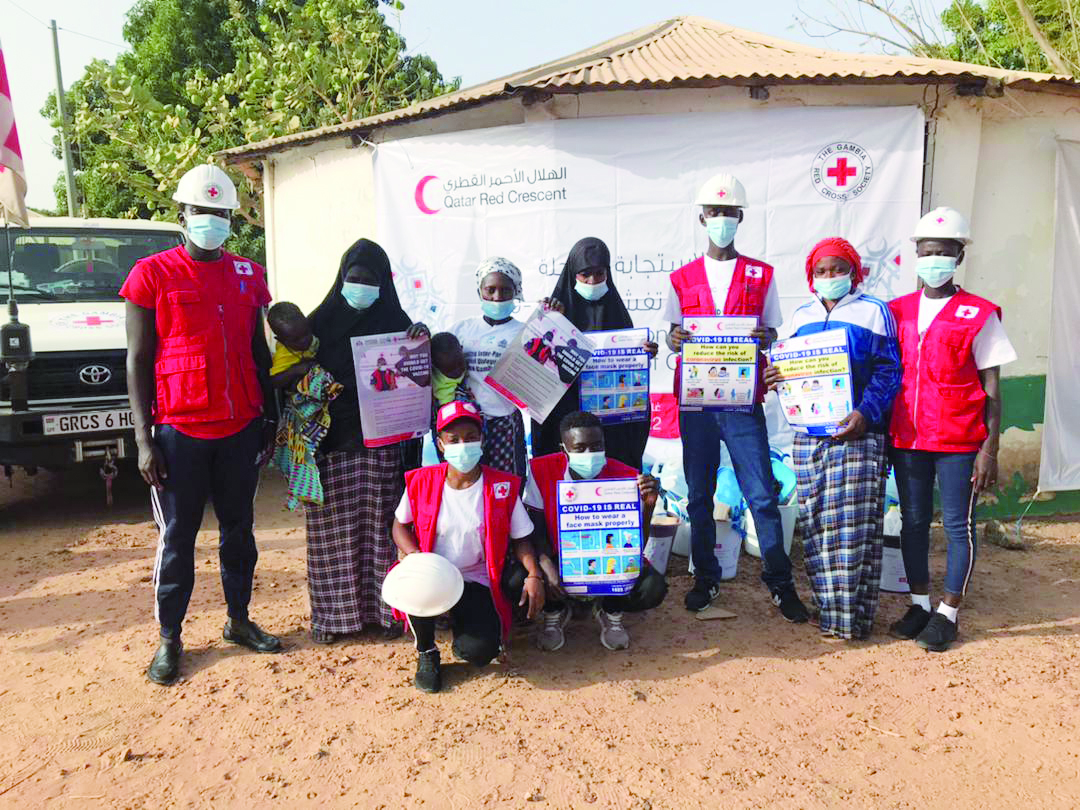
QRCS volunteers distributing sanitation and hygiene kits to people in Gambia.
Doha: As part of its efforts to control the spread of COVID-19 in the world and protect vulnerable communities, Qatar Red Crescent Society (QRCS) recently completed a project to support the efforts of the Gambian Red Cross Society (GRCS) to respond to the pandemic around the Greater Banjul Area, Banjul, Kanifing and West Coast.
The response was centred on outreach activities in three regions/municipalities with key messages on COVID-19, using different approaches such as caravans, sensitisation in public places, school sensitisation, house-to-house sensitisation, community meetings, social media pages, posters, and leaflets containing information on COVID-19 prevention and vaccination. In coordination with local authorities, the volunteers distributed sanitation and hygiene materials at key public spaces such as garages, bus and ferry terminals, markets/supermarkets, petrol stations, community centres, places of worship, schools, institutions, residences of infected individuals, health facilities, commercial vehicles, and police stations.
Influential community leaders (such as imams, school principals, village leaders, pastors) across the three regions on COVID-19 prevention and control measures, as well as the misconceptions related to COVID-19 vaccination. A total of 1,449 households, or about 18,000 people, were reached out in the house-to-house visits, and 12 caravans were deployed to markets, public places and community centres spreading sensitisation messages in all different languages in the country.
GRCS works with the Ministry of Health (MoH) to support case transfers across the country. The volunteers and staff were trained to provide case transfers through its emergency ambulance and COVID-19 remains management services.
QRCS’ donation helped to purchase and distribute family hygiene kits containing COVID-19 control materials (such as soap, masks, hand sanitisers, bleaches, buckets, water purification tablets, female underwear, toothpastes, and toothbrushes).
Some inmates of isolation/quarantine facilities were provided with material assistance, such as gloves, masks, thermometers, hand sanitisers, water, and disinfectants. Personal protective equipment (PPEs) were prepositioned at the branches to support family members in washing and preparing COVID-19 remains for safe burial, and for the headquarters/branch volunteers and staff, and the staff of the two major mortuaries, to operate under safe conditions.
This project supported both the Edward Francis Small Teaching Hospital (EFSTH) and Kanifing General Hospital (KGH) with spraying tanks to disinfect the mortuary facilities (the two biggest hospitals in the country).
Training courses were held to build the capacity of community volunteers to be able to actively search for COVID-19 suspects and other priority diseases, such as measles, acute flaccid paralysis (AFP), in the communities. Finally, 43 health facilities received infection prevention and control (IPC) support.