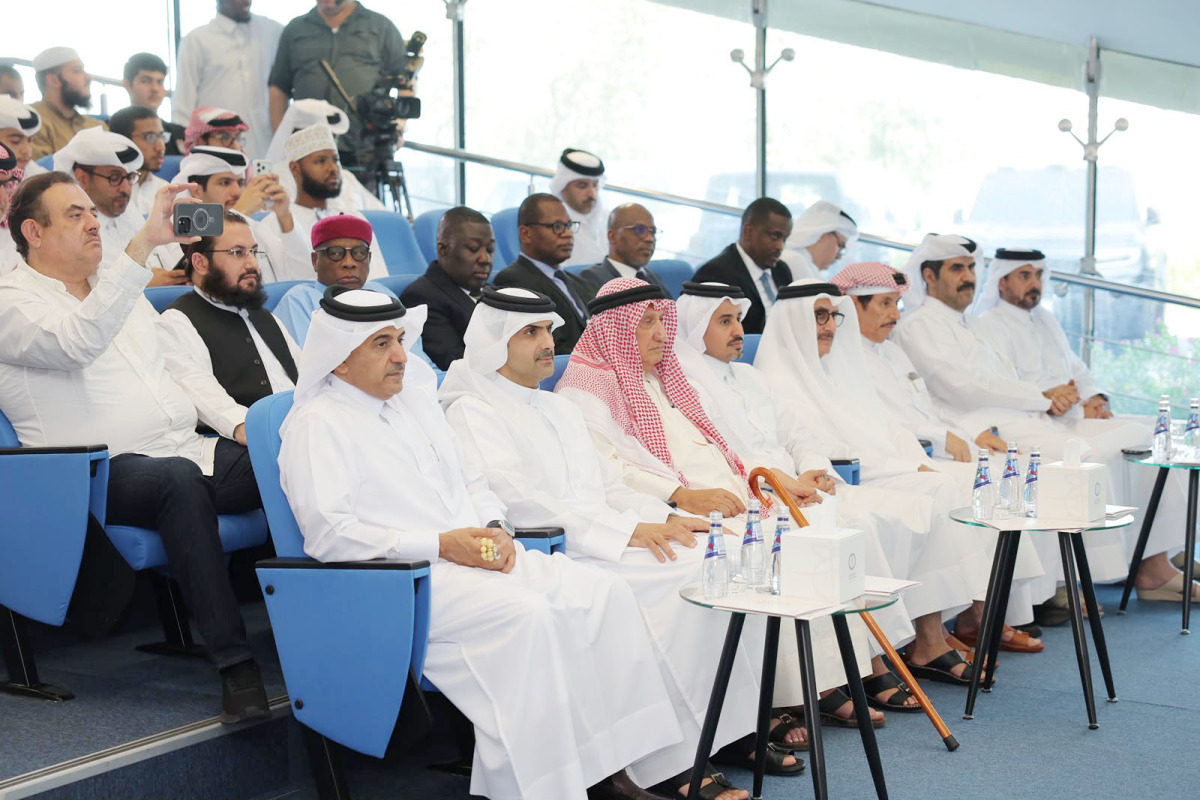
Minister of Culture H E Sheikh Abdulrahman bin Hamad Al Thani, Chairman of the Board of Trustees of Lusail University H E Dr Ali bin Fetais Al Marri, and Undersecretary of the Ministry of Culture H E Dr Ghanem bin Mubarak Al Ali with other officials during the session.
Doha, Qatar: The Ministry of Culture on Sunday wrapped up the fifth season of seminars at Lusail University and held a seminar to mark its conclusion, attended by Minister of Culture H E Sheikh Abdulrahman bin Hamad bin Jassim bin Hamad Al-Thani; Chairman of Board of Trustees of Lusail University H E Dr. Ali bin Fetais Al Marri; and Undersecretary of the Ministry of Culture H E Dr. Ghanem bin Mubarak Al Ali.
Tackling the esoterica of the Prophet's Hadiths, spanning centuries of recording and critical examination, the gathering featured Arab renowned thinker, historian, and author Prof. Dr. Bashar Awad Marouf.
It examined the history of recording and critically editing the Noble Prophetic Hadith; the methods scholars have developed to scrupulously verify narrations and distinguish authentic reports from weak ones; the evolution of methodologies for critically examining chains of transmission and Hadith texts; and the future of critical manuscript editing in the age of digitisation and artificial intelligence.
Recording began early, and some Prophetic sayings had been written down during the lifetime of the Prophet Muhammad (Peace be upon him), Prof. Marouf said, highlighting that the first century AH witnessed extensive recording of the Prophet's sayings, while the processes of compilation, indexing, and classification evolved during the second century AH.
Prof. Marouf stressed the importance of distinguishing between the existence of written narrations and the completion of their classification into independent works. He explained that the chains of transmission that survived into later centuries were associated with compilations, written records, and other written materials circulated among scholars and students of Islamic knowledge.
Prof. Marouf pushed back on the claim that the recording of Hadith began during the reign of Umar ibn Abd Al-Aziz or through the efforts of Imam Al-Zuhri, if that claim is taken to foreclose the possibility that written Hadith records existed before then.
Marouf further stressed the need to scrupulously examine the sources, chains of transmission, and documentary evidence to arrive at an accurate understanding of Hadith history, underscoring the importance of preserving Arab and Islamic history as a repository of the Muslim community's heritage and collective memory.
Many attendees weighed in during the seminar, foremost among them Chairman of the Board of Trustees of the Sheikh Hamad Award for Translation and International Understanding, Dr. Hassan Al Naama, who emphasised the importance of constantly studying the Islamic heritage and devising approaches that keep up with intellectual and scientific developments, with particular emphasis on preserving the foundations of Islamic belief and firmly instilling them in generations to come.
Dr. Al Naama highlighted the multiplicity of schools and approaches in Islamic thought, including transmission and critical analysis, alongside the efforts scholars have made across the ages to advance human knowledge.