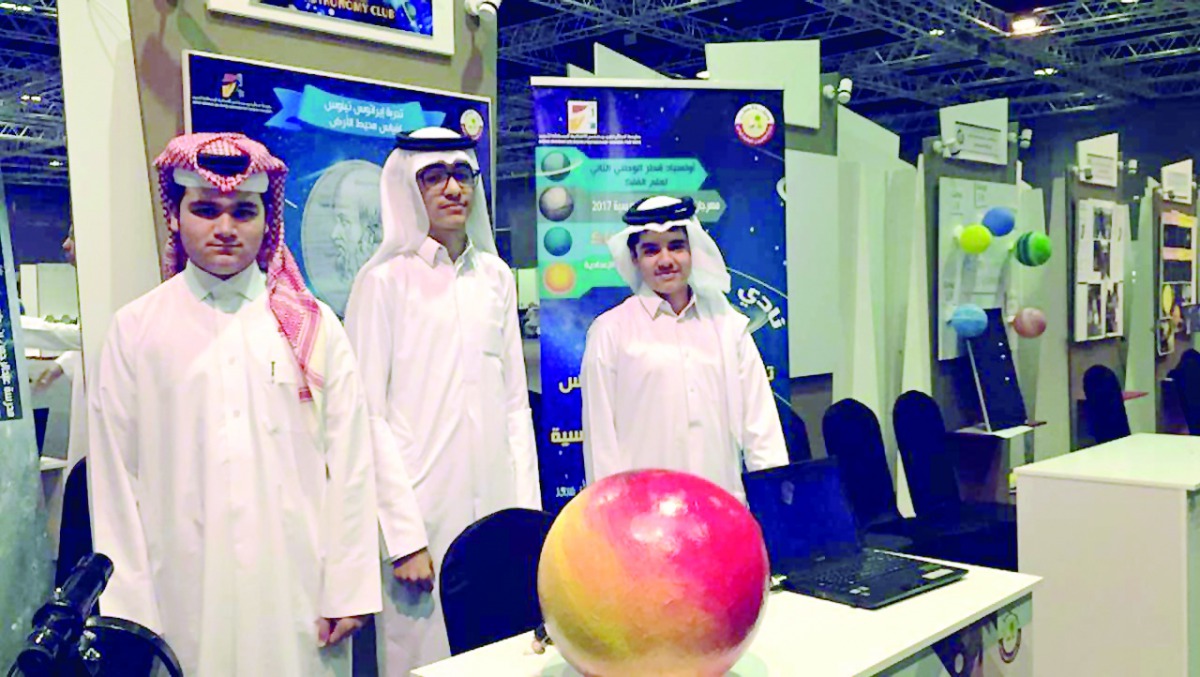
Students at the second Qatar Astronomy Olympiad.
Some 344 students from 59 preparatory and secondary independent and private schools yesterday participated in the finals of the second Qatar Astronomy Olympiad.
The event is part of a series of workshops and activities taking place as part of the Education Conference and National Scientific Research Week kicking off today at Qatar National Convention Center (QNCC) under the slogan of “Pioneering and Creativity." The preparatory schools competitions focused on Land Measuring while “Astrolabe and Sundials” were the topics of competition for secondary schools students.
During the conference over 142 researches will be assessed and discussed in 44 workshops. The conference and the research week event will continue until March 16.
Along the competition of astronomy, the first workshop for introducing the work of the Scientific Research Arbitration Committee was launched yesterday. Some 142 students and 52 members of the judging committees attended the workshop.
Dr Hamdan bin Ibrahim Al Mohammad, head of the Scientific Researches judging committee from the Medical College of Qatar University, who is also Director of the National Center for Research Talent at King Faisal University, introduced during the workshop the criteria and method of assessing student’s researches.
There are new standards and criteria introduced this year to evaluate the students researches said Abdullah Al Kamali, Director of Special programs at Qatar National Research Fund (QNRF) adding that these criteria match with the global standards.
Al Kamali pointed out that six of the researches of Secondary schools students will be selected to represent Qatar in a research competition which will take place in May in Los Angeles, USA, where 70 countries will participate.
There are a total of 142 research projects and each of it will be evaluated by a committee of five members who will be transparent and accurate in their assessment procedures he added.
The director of the Education Proram at QNRF, Aisha Al Ubaidali, said the QNRF has a database with over 700 students who presented research projects.