Seoul: North Korea may have nuclear weapons, but in a high-decibel, cross-border propaganda shouting match, South Korea insists its superior technology is winning hands down.
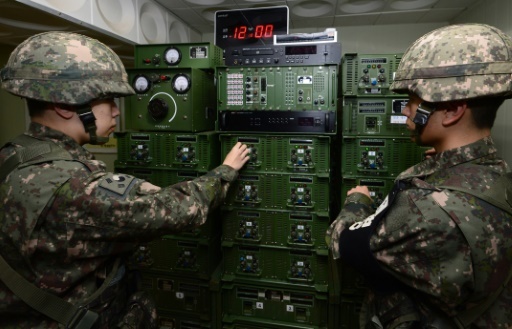
South Korea started blasting a mix of K-pop and propaganda messages into North Korea on Friday, using giant banks of speakers located close to the heavily militarised border.
The resumption of the broadcasts, which had driven the North to threaten military strikes when they were employed last year, was a direct response to Pyongyang's decision to conduct a fourth nuclear test two days earlier.
Since the speakers were plugged back in, the North has sought to respond in kind, with its own amplified messages extolling the virtues of leader Kim Jong-Un, and attacking South Korean President Park Geun-Hye.
"Currently, North Korea's loudspeaker broadcasts have been turned on in 10 locations, but with negligible impact," a defence ministry official said.
"The reason is that North Korea's output capacity is very low compared to ours.
"Their broadcasts are audible within a one- to three-kilometre radius, while ours can be heard 10 kilometres away," the official said.
The last time South Korea used the speakers was during a sharp escalation in military tensions after two of its soldiers were maimed by a landmine on the border.
The South kept up the broadcasts for several weeks, finally unplugging the speakers in line with an August agreement aimed at defusing a crisis that had driven both sides to the brink of an armed conflict.
The agreement had stipulated that the speakers would remain off, barring any "abnormal case" in the future.
Seoul deemed that last Wednesday's nuclear test -- which Pyongyang claims was of a powerful H-bomb -- fell into the "abnormal" category and so the speakers were switched back on.
The South has given no indication of how long it intends to keep the broadcasts going this time.
AFP