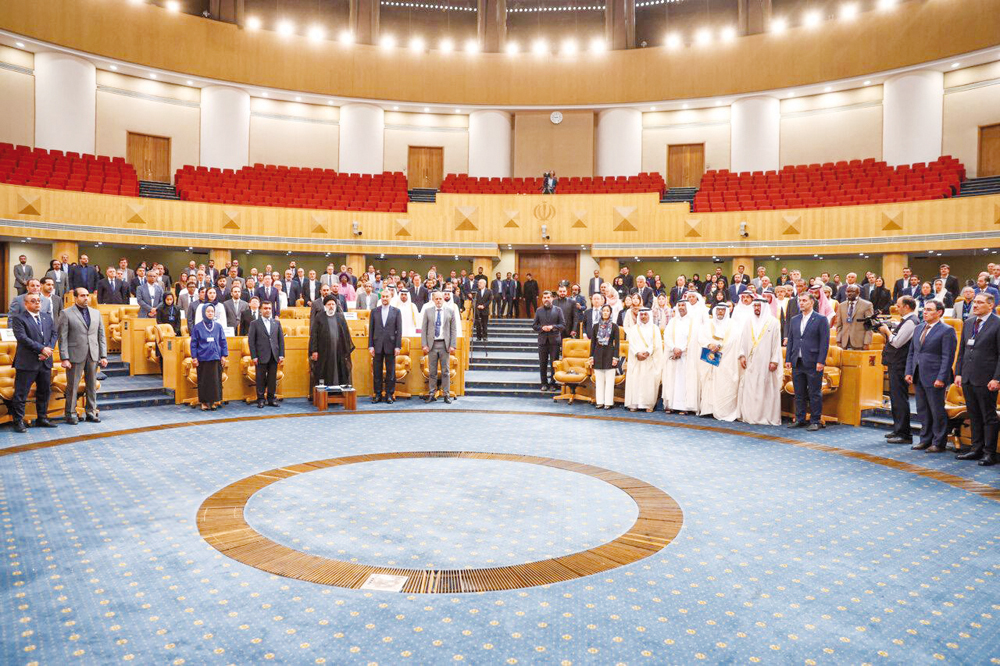
President of the Islamic Republic of Iran H E Ebrahim Raisi and Minister of Environment and Climate Change H E Sheikh Dr. Faleh bin Nasser bin Ahmed bin Ali Al Thani with other ministers and dignitaries during International Conference on Combating Sand and Dust Storms in Tehran.
Tehran: The State of Qatar participated in the International Conference on Combating Sand and Dust Storms, organised by the Islamic Republic of Iran in cooperation with the United Nations from September 9-10 in Tehran.
Minister of Environment and Climate Change H E Sheikh Dr. Faleh bin Nasser bin Ahmed bin Ali Al Thani chaired the State of Qatar’s delegation to the conference.
In his speech during the conference, Minister of Environment and Climate Change stressed that sand and dust storms are an inevitable consequence of climate change and global warming, which cause human health issues, in addition to the pressure they pose on countries’ infrastructure, pointing to the major economic losses they cause due to the disruption of air, land, and sometimes maritime navigation, in addition to other problems related to food shortages as a result of soil erosion and fertile arable land.
His Excellency indicated that Qatar has warned of the dangerous effects of this issue in many international and regional conferences, as it has taken many steps aimed at reducing this problem at the local and international levels.
The Minister reviewed Qatar’s efforts to combat sand and dust storms by developing a national framework to combat desertification based on the principles of sustainable development within the Qatar National Vision 2030, pointing to the launch of the National Environment and Climate Change Strategy (QNE), and the National Climate Change Action Plan 2030.
He noted what the State of Qatar has done to realize these visions on the ground through the implementation of various programs and projects to preserve vegetation, such as rehabilitating the gardens and planting the Qatari land with plants from the local environment, in addition to launching the initiative to plant a million trees and launching an initiative to create a green belt around the city of Doha and its suburbs.
The Minister pointed to the launch of a soil quality monitoring program, which conducts environmental surveys of 52 sites in all regions of the country, which contributes to preserving the soil against desertification and maintaining its quality. His Excellency pointed out the several laws and legislations that the state issued to regulate grazing operations and preserve green cover, in addition to collecting large quantities of wild plant seeds and enhancing the state’s seed stock in the gene bank.
The Minister also reviewed Qatar’s efforts to combat desertification at the international level through its accession to the United Nations Convention to Combat Desertification since 1999, as well as its contribution of $100m to support Small Island Developing States (SIDS) and Least Developed Countries (LDCs) to deal with climate change and natural disasters and challenges and to build the capacity to confront their devastating effects.