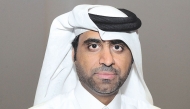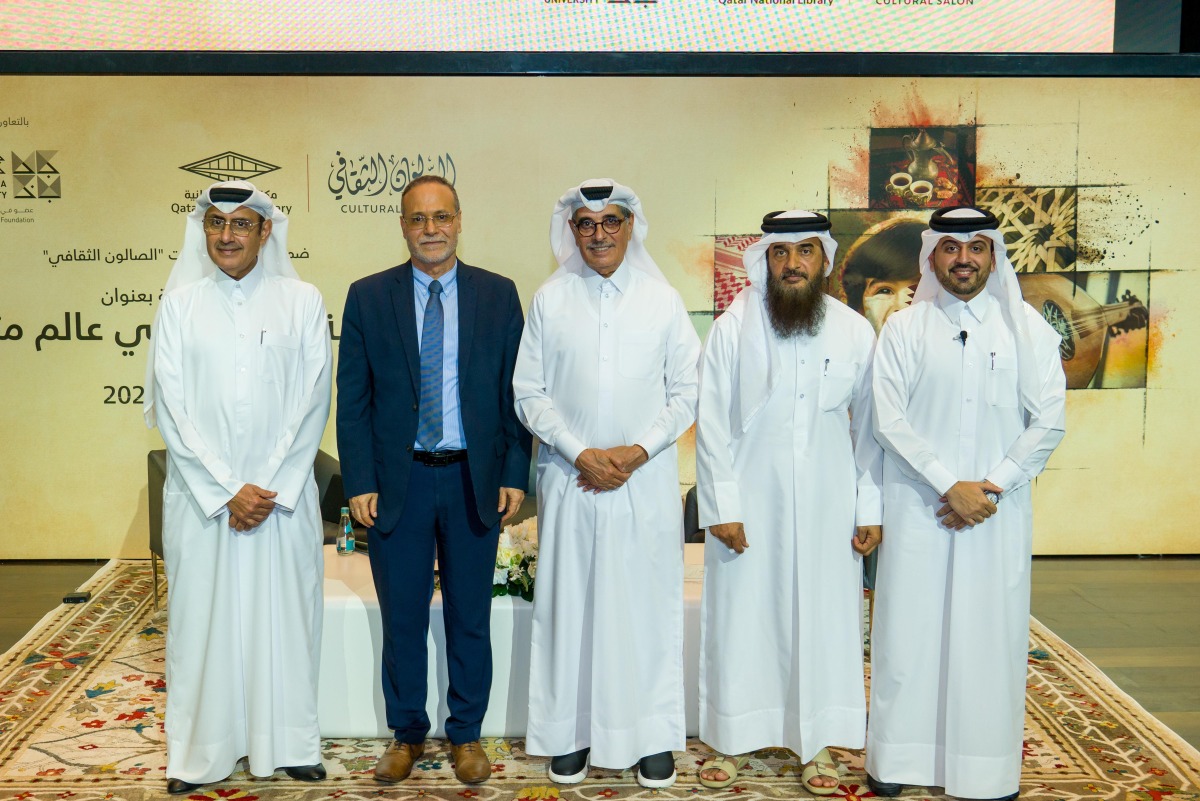
Minister of State and President of Qatar National Library H E Dr. Hamad bin Abdulaziz Al Kawari (centre) with other officials at the event.
Doha, Qatar: In the latest episode of its Cultural Salon series,Qatar National Library delved into the multifaceted aspects of national identity in an increasingly interconnected and globalised world.
Titled “National Identity in a Changing World,” the session provided insights into the dynamic nature of national identity amid the 21st century’s shifts in demographics, and accelerating economic, cultural, and technological transformations.
The session highlighted that the national identity has become increasingly complex and contested. As distances shrink, demographics shift, and economic, cultural, and technological transformations accelerate, national identities face mounting pressures, leading to new challenges and conflicts. Navigating these complexities requires a thoughtful examination of identity from within, one that acknowledges the evolving nature of belonging and the need for a nuanced understanding of identity’s role in shaping individuals, communities, and nations.
H E Khalid bin Ghanim Al Maadheed, a member of the Shura Council, and Dr. Ezzeddine Abdelmoula, Manager of Research at Al Jazeera Center for Studies,explored the complexities of national identity and how individuals and societies can adapt, thrive, and maintain their unique identities in a dynamic global landscape.
Navigating these complexities, they argued, requires a nuanced understanding of identity’s role in shaping individuals, communities, and nations, and a thoughtful examination of the evolving nature of belonging.
Al Maadheed touched on the various definitions of identity, emphasizing its role as a distinguishing trait of an individual or group. He elaborated on the foundations and various layers of identity, as well as the interconnections between its visible and underlying components. Visible components include dress, architecture, and language as opposed to the underlying components of shared history and societal, religious and humanitarian values, he explained.
Dr. Abdelmoula, on the other hand, emphasized that the issue of identity is as old as history itself, tracing back to the philosopher Aristotle, who sought to formulate the principles of logic and sound thinking. The first principle he identified was the principle of identity, which asserts that a thing is identical to itself, he explained.
Minister of State and President of Qatar National Library H E Dr. Hamad bin Abdulaziz Al Kawari said the Cultural Salon series and the intellectual questions it raises have enriched Qatar’s cultural landscape.
“These conversations underscore Qatar National Library’s role as a platform for the community to express its interests and concerns and strengthen the Library’s position as a center of reading and learning and as an institution that spearheads efforts to preserve the cultural heritage of Qatar and the region,” Dr. Al-Kawari said.
“Our Cultural Salon has become a well-established platform for constructive dialogue on cultural and intellectual issues that impact our society. The past sessions featured rich discussions that left a clear imprint on the Qatari cultural scene. In today’s session, we addressed an issue of great importance, which is preserving one’s national identity in the era of globalization, with all its momentum, complexities, and technological developments.”
The event marked the fifth instalment in the Cultural Salon series, which has featured – since the launch of the assault on Gaza – several events to raise awareness about the Palestinian cause and its deep-rooted Arab identity.