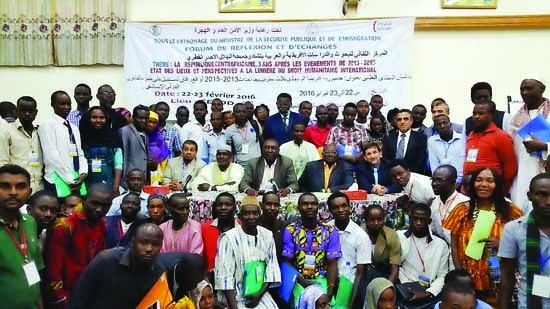
Doha: Qatar Red Crescent Society (QRCS) has co-organised a two-day reflective discussion forum in N’Djamena, Chad, under the theme ‘The Central African Republic Three Years After the Events of 2013-2015: Status Quo and Perspectives in light of International Humanitarian Law’.
Under the patronage of Chad’s Minister of Public Security and Immigration Ahmed Mohamed Bashir, the forum was held under an initiative by Dr Haggar Mohamed Ahmed, Chairman, Cultural Centre for Arab and African Research, in cooperation with QRCS.
In his opening remarks, Dr Fawzi Oussedik, Head, International Relations, QRCS, praised the initiative and said it came at a critical time when Central African Republic (CAR) is witnessing a democratic shift.
According to him, international humanitarian law stipulates protection of and shelter for refugees under a protocol agreement between humanitarian organisations and governments.
“The Shariah pays special attention to the issue of refugees,” Dr. Oussedik said, calling on international humanitarian organisations and Chadian government authorities to continue to support CAR refugees.
Bashir urged the refugees to join hands, forget the past hostilities, and work together towards comprehensive reconciliation and peace in CAR.
“Reconciliation between the belligerents is imperative for them to build a brighter future that encompasses everyone in the country,” he stressed.
The forum aimed to discuss the tragic situation of hundreds of thousands of CAR refugees and internally displaced persons due to the protracted political and security unrest sweeping the country.
The bloody massacres against the Muslim-majority Séléka resulted in an unprecedented state of insecurity and chaos and pushed more than one million civilians to neighbouring countries.
The forum also aimed to communicate with the CAR refugees in Chad to better understand the situation in their country after three years of displacement and homelessness; exchange ideas about the perspectives of permanent peace, community dialogue and potential repatriation; and create a platform or framework to initiate talks and pursue sustainable reconciliation between the fighting parties.
Government and international organisations involved in the refugee crisis were engaged in the discussions, including the Chadian Ministry of Public Security and Immigration, Ministry of Interior, Ministry of Foreign Affairs and African Integration, the CAR embassy in Chad, United Nations High Commissioner for Refugees office, Red Cross of Chad and Qatar Charity office in Chad. Scientific papers on eight topics were introduced. Discussions were balanced between the two parties to the conflict, with a focus on women. The Peninsula