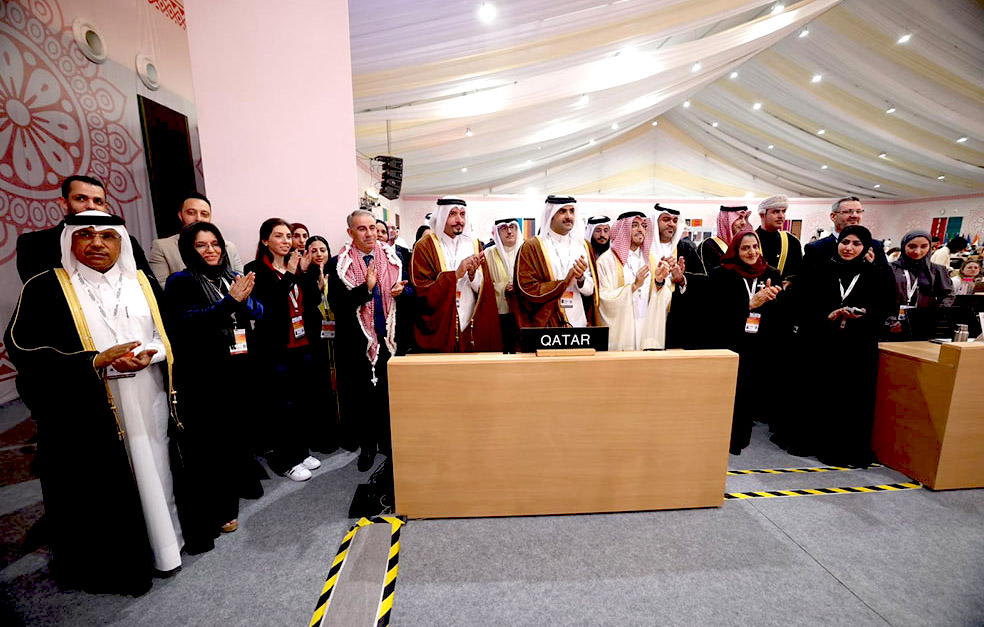
Minister of Culture H E Sheikh Abdulrahman bin Hamad Al-Thani with other officials during the event.
Doha, Qatar: The State of Qatar is taking part in the 20th Session of the Intergovernmental Committee for the Safeguarding of the Intangible Cultural Heritage of the United Nations Educational, Scientific and Cultural Organization (Unesco), convened in India from December 8 to 13.
The Qatar delegation was headed by Minister of Culture H E Sheikh Abdulrahman bin Hamad Al-Thani.
The session witnessed the inscription of the Arab "Bisht" on Unesco’s Representative List of the Intangible Cultural Heritage, marking the first joint Arab file led by the State of Qatar with the participation of nine Arab countries.
This cultural milestone reflects the preeminent standing of Gulf and Arab heritage and its enduring ability to articulate collective identity and shared civilizational memory.
This milestone is the result of the Ministry’s efforts to project the local legacy and safeguard traditional crafts, foremost among them the craft of bisht-making in Qatar, which represents one of the most significant crafts tied to social identity and national symbolism.
The inscription of the file affirms Qatar’s commitment to protecting this time-honoured craft, enhancing its presence in the cultural consciousness, and transmitting it to emerging generations amid rapid economic and social transformations.
Addressing the session, the Minister affirmed that the file showcases the Arab "Bisht" as a cross-generational cultural element, serving as a symbol tied to social life, explaining that it was worn by Qatari forebears during celebrations and educational settings and has remained a witness to the history of the region.
Amir H H Sheikh Tamim bin Hamad Al-Thani draped Lionel Messi, captain of the Argentina national team and winner of the 2022 FIFA World Cup, in the Qatari bisht. This noble gesture reflected the prestigious status of the bisht in Qatari culture, the Minister highlighted.
He asserted that the Bisht would not be the last cultural heritage file that Qatar seeks to inscribe on Unesco’s Representative List.
In essence, the Bisht has become a symbol of prestige, social standing, and dignity. For over a century and a half, its craftsmanship has flourished. The inscription of the bisht file on Unesco’s Representative List marks a significant milestone in the path toward safeguarding Qatari and Arab heritage.
The step underscores Qatar’s commitment to protecting its heritage components and ensuring their transmission to future generations.
This listing also reflects the success of the Ministry’s 2023 initiative to register the Arab "Bisht" as intangible heritage, thereby constituting a global recognition of its cultural and social value.