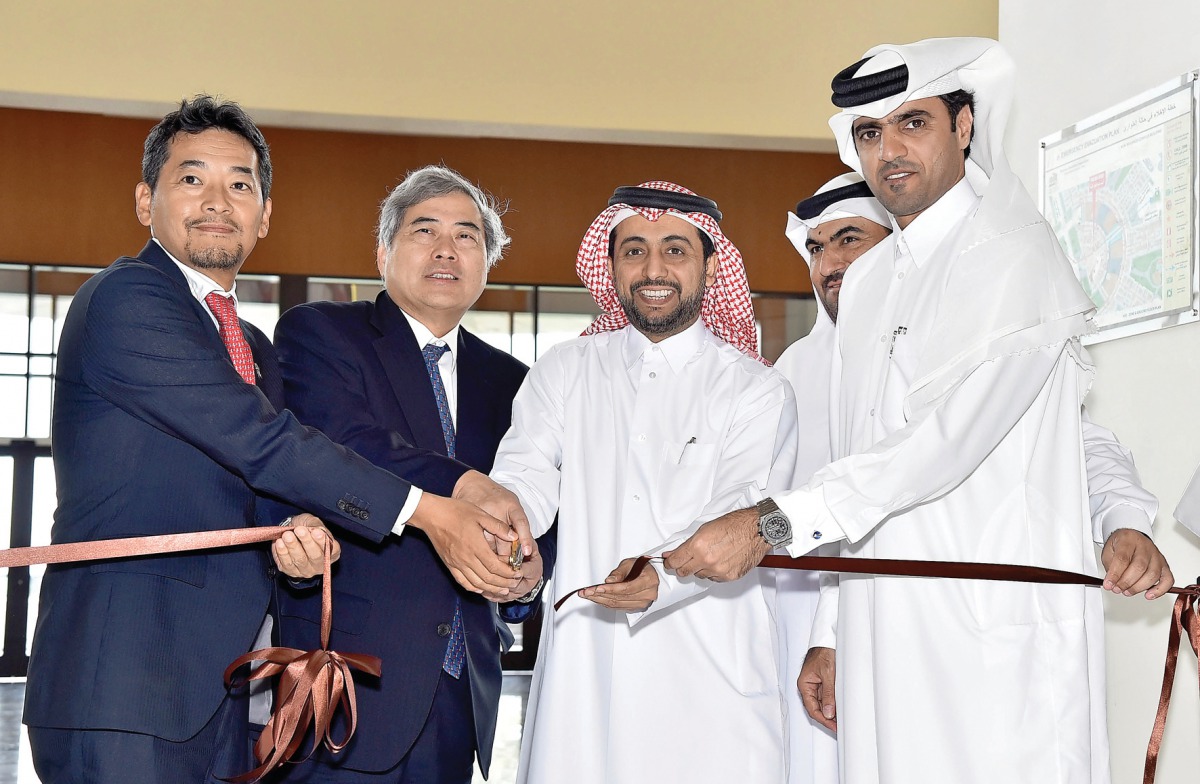
Officials cutting the ribbon at the launch event.
Qatar University College of Arts and Sciences (QU-CAS) on March 5 launched a photo exhibition themed “East Japan Earthquake Exhibition: Then and After” on the occasion of the 6th anniversary of the March 11, 2011 Great East Japan earthquake.
Organised in collaboration with the Embassy of Japan in Qatar and Marubeni Corporation, the exhibition will run until March 30. It showcases photos of the devastation caused by the tsunami and the recovery which has been achieved so far. There are more than 60 pictures and one of the photograph shows that Sendai Airport was buried under tsunami rubble, but one month later, the airport resumed operation.
The launch ceremony was attended by QU President Dr Hassan Al Derham, Ambassador of Japan to Qatar Seiichi Otsuka, Qatar Fund For Development (QFFD) Director-General Khalifa bin Jassim Al Kuwari, CAS Dean Dr Rashid Al Kuwari, CAS Associate Dean for Research and Graduate Studies Prof Hala Al Easa, Marubeni Corporation Managing Director Toshiaki Hato, Associate Professor of International Relations and Gulf Studies at CAS Gulf Studies Center (GSC) Dr Steven Wright, embassy representatives as well as CAS faculty and staff.
Dr Hassan Al Derham said: “Today, we have an opportunity for deep reflection on the power of nature. The March 11, 2011 Great East Japan Earthquake shocked the world. Such a tragedy allows us to reflect on the power of the natural world and the vulnerability of humankind; it is in such circumstances that we can often witness the best qualities that we, as people, have. In the aftermath, what we see is a story of resilience, reconstruction, and support. It is in the spirit of friendship that the State of Qatar provided humanitarian relief of $100m to help rebuild the devastated areas in Eastern Japan, through the Qatar-Japan Friendship Fund. The exhibition which will be opened today, will allow us to consider the strength of this friendship, and how those affected by the earthquake have been able to rebuild and recover from this devastation.”
He added: “The photos that have been selected for this exhibition will allow us to reflect on how the friendship between our two great countries has continued to flourish from strength-to-strength. Indeed, such efforts by the Japanese people and how they have overcome this tragedy, is something I, and many others across the world, draw strength and inspiration from. Qatar and Japan have a deeply rooted friendship which has progressively been developed over the last 40 years. At Qatar University, we are proud to have a special relationship with Marubeni Corporation, who made the largest donation to Qatar University of $6m, as part of an effort to foster deeper relations and cultural awareness between Qatar and Japan. A significant number of activities have emerged from this relationship and served to strengthen the friendship between the two countries. Indeed, this event is a product of Qatar University’s relationship with Marubeni Corporation and the Embassy of Japan.”
Seiichi Otsuka said: “This gracious aid led to the setup of the Qatar Friendship Fund, focusing on child education, health care and fisheries. Last October, Qatar Fund For Development concluded the activities of Qatar Friendship Fund in Japan which helped thousands of people to restore their lifestyle through 13 projects among which some are still going on. The first mega-project was the Masker Fish processing facility, which was a wonderful gift to Onagawa town.
Khalifa bin Jassim Al Kuwari said: “Qatar University stands today distinguished among a cluster of globally renowned academic institutions, all contributing to the achievement of Qatar’s growth and development. In a world continuously grappled with natural and man-made disasters, economic stagnation, and changing geo-political landscape, partnerships and building bridges between people and countries can never be more important. Such unity among friends, and close ties among members of the civil society, academia, and corporates, to name a few, are nothing less than safety nets at times of great need."