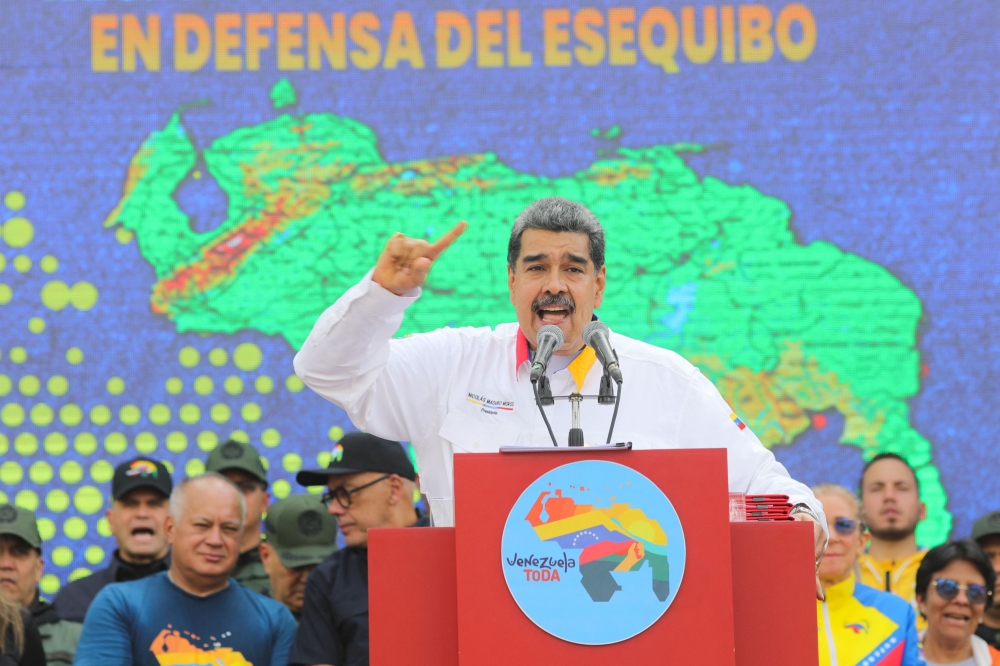
This handout picture released by the Venezuelan Presidency shows Venezuela's President Nicolas Maduro speaking during a meeting outside the Miraflores Presidential Palace in Caracas on December 8, 2023. (Photo by MARCELO GARCIA / Venezuelan Presidency / AFP)
Over the course of a decade, Venezuelan President Nicolás Maduro has held tight to power despite mass protests, widespread poverty and despair, tough US sanctions, and an international attempt to recognize an alternate government. His survival instincts are kicking in again.
Maduro’s regime ordered the arrest this week of key aides to his top political adversary, testing the patience of American officials who temporarily relieved sanctions because Venezuela promised free and fair presidential elections next year.
He’s also been slow to meet US demands for the release of detained citizens.
And he’s rattled even regional allies in recent days by calling for a large chunk of land claimed by neighboring Guyana to become a Venezuelan state, threatening to shut down oil producers who do business there.
While Venezuela’s assertion of rights to the territory known as the Essequibo date back more than a century, Maduro’s choice to escalate the dispute now is adding to the sense of chaos in Caracas.
There is a certain logic to the machinations of Maduro, 61, who at this point has ruled longer than his predecessor Hugo Chávez, the inspirational leader of Venezuela’s brand of socialism who died in 2013.
With slim chances of winning an open election, Maduro is pulling almost every lever at his disposal to rally domestic support and ensure he extends his presidency.
Maduro is "spiraling,” said Christopher Sabatini, senior fellow for Latin America at Chatham House, a policy institute in London. "He doesn’t want to have free and fair elections.
Now that there’s a remote possibility for political change that didn’t exist before, all the commitments they agreed to suddenly look really scary.”
The risk is that Maduro goes too far, alienating the US and other global powers and sending Venezuela’s economy reeling.
Thus far the US has shown tolerance, since the Biden administration would like nothing more than to open the spigots of the world’s biggest oil reserves and slow the exodus of Venezuelan migrants northward.
But every new affront by Maduro chips away at the argument that the sanctions relief is steering the country toward democracy and international cooperation.
To be sure, Maduro has proven adept at maintaining control of the levers of power even in times of crisis.
His military leadership remains loyal, and he’s built his own version of Chavismo, replicating his predecessor’s legendary hours-long televised speeches but sprinkling in some moves toward capitalism.
His crackdowns on dissent have thus far kept opponents in check despite his unpopularity. Polls show Maduro losing badly to opposition candidate María Corina Machado if elections were held freely.
This week the government’s public prosecutor charged three of Machado’s aides with treason, conspiracy and money laundering, saying they were plotting to sabotage a referendum that was designed to whip up support for a takeover of the Essequibo.
"Maduro acts in a moment when he needs to rescue internal connections with the population and raise popularity and mobilization capacity,” said Luis Vicente León, head of local pollster Datanalisis.
"I don’t think he intends to advance beyond this. Although, of course, when you engage in these strategies, you don’t know when someone is going to go out of hand.”