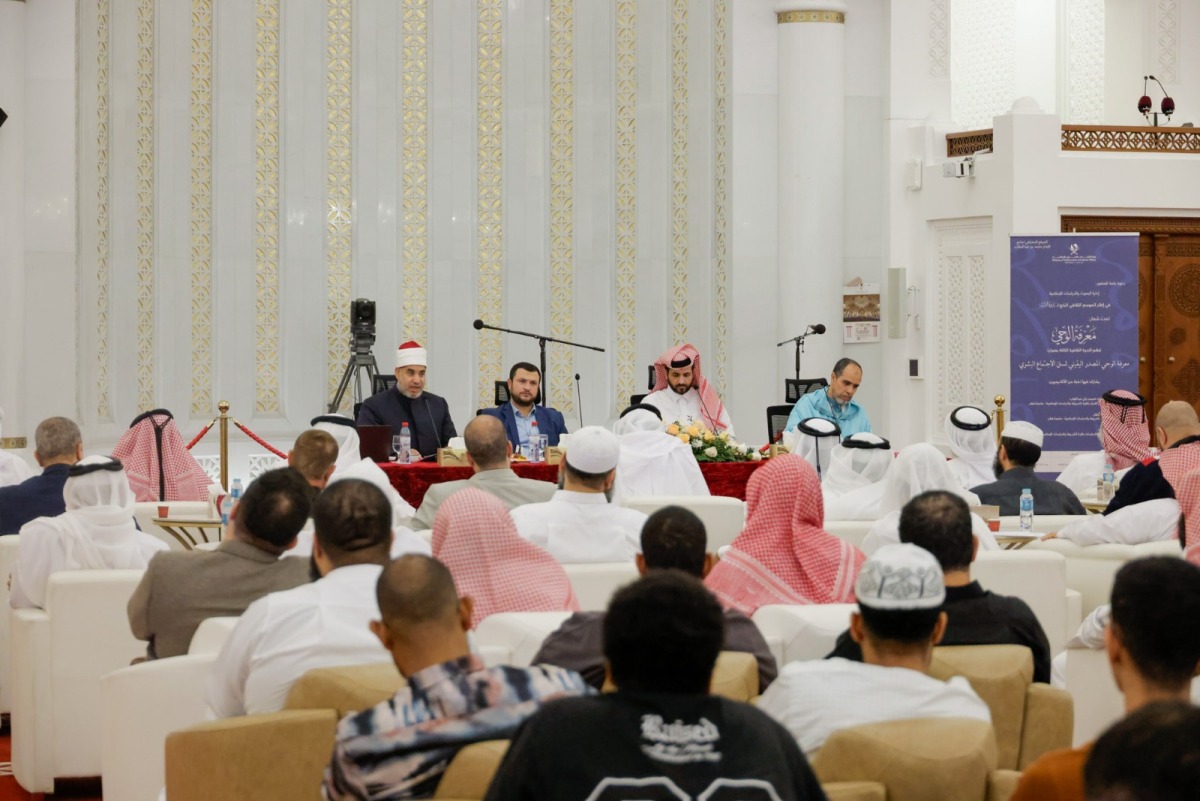
Scholars during the seminar held at Imam Muhammad ibn Abd al-Wahhab Mosque.
Doha, Qatar: The Ministry of Awqaf and Islamic Affairs, represented by its Islamic Research and Studies Department, organised the third seminar of the fourth season of its cultural initiative “Ummah Symposium,” under the theme “Knowing Revelation.”
The event, held Tuesday evening at Imam Muhammad ibn Abd al-Wahhab Mosque in Doha, brought together prominent academics, researchers, and preachers, alongside the participation of scholars from Qatar University’s College of Sharia and Islamic Studies. Minister of Awqaf and Islamic Affair H E Ghanem bin Shaheen bin Ghanem Al Ghanim also attended the event.
The seminar, titled “Knowing Revelation as the Certain Source of the Laws of Human Society,” examined how divine revelation serves as a definitive reference for understanding the governing principles of human life and societal development, and how this understanding can shape future foresight and civilizational awareness.
Opening the session, Sheikh Dr. Ahmed bin Mohammed bin Ghanem Al Thani, Director of the Islamic Research and Studies Department, stressed that understanding the laws governing human societies represents a fundamental step toward the renaissance of the nation.
He highlighted that revelation is the ultimate source of these laws, while reason serves as the tool for comprehension and deduction. He added that the symposium seeks to explore both the human being and the broader horizons of society to better understand the nation’s future.
The first session, presented by Professor Ramadan Khamis Zaki Abdel Tawab, focused on the certainty of revelation as the source of universal laws. He outlined how the Quran emphasises these divine laws as guiding principles shaping life and history.
Abdel Tawab explained that Quranic narratives are not merely historical accounts but serve as lessons that reveal patterns of societal rise and decline. He noted that the collapse of nations often begins with moral deviation rather than material weakness, while revival is rooted in ethical and doctrinal reform.
In the second session, Dr. Mahmoud Nimer Al-Naffar highlighted the role of reason (intellect) as a central tool in understanding and applying these laws. He described a comprehensive intellectual framework that begins with observation and analysis, leading to the formulation of explanatory models that connect causes and outcomes.
Al-Naffar emphasised that these laws are not abstract theories but consistent divine principles governing both human and cosmic existence. He also warned against contemporary challenges, including the separation between revelation and reason, intellectual stagnation, and misapplication of these principles.
The final session, presented by Dr. Aziz Al-Batyoui, offered a forward-looking perspective on how understanding societal laws can enhance future planning. He stressed that these divine laws represent a consistent system governing the rise and fall of civilizations, and that recognising them is essential for achieving civilizational progress.
Al-Batyoui underscored the close link between these laws and the future, noting that lessons drawn from history can guide reform efforts and help societies navigate crises effectively.