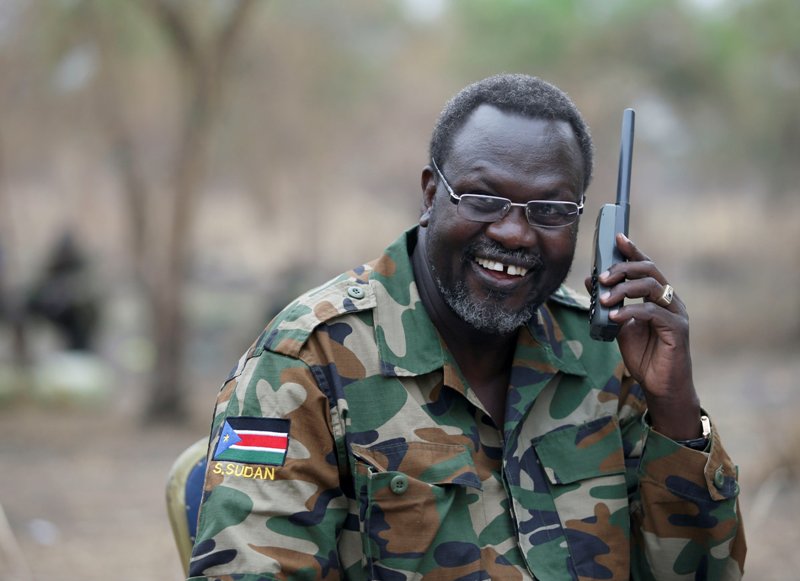
JUBA, South Sudan: South Sudan’s internal displaced persons living in a huge, crowded UN protected area in the capital Juba say they see a first flicker of hope for stability in their war-torn country in the much-awaited return of Riek Machar, first-vice president designate, to form a transitional government of national unity with President Salva Kiir.
The United Nations Protection of Civilians Site in Juba hosts approximately 27,000 internally displaced persons (IDPs) of ethnic Nuers from Machar’s tribe who say they were largely targeted in the conflict that broke out in December 2013 and that their hopes for returning home after two years in the camp depend on the return of the Sudan People’s Liberation Movement opposition leader.
“Machar’s coming was our dream for stability to come to South Sudan and we will be able to return home and rebuild our lives. We [IDPs] are extremely grateful to God and believe that his return would end our misery,” Stephen Makol, leader of the South Sudanese communities internally displaced at the UN site in Juba, told Anadolu Agency.
“After more than two years of inhuman displacement and suffering, we finally see a ray of hope returning to the country, His return is the most valuable gift to us,” he added.
Tut Andrew Ruon, displaced from the devastated town of Bor in the country’s northeast Jonglei State, said Machar’s return to Juba will be an exceptional blessing, not exclusively to those trapped in UN Peacekeeping Mission camps across the country under UN protection, but also the average people on the streets in Juba and small towns across the country, who are begging for lives free from insecurity, diseases and famine.
“It will be an opportunity for forgiveness and redeveloping the broken social fabric for the common good if the leadership meant what they said. People who may die in a few days, weeks, or months because of famine and other causes could be saved, and this is what the leadership is about,” he added.
"I hope peace will be restored in our young nation and see the end of this senseless war the country has been going through for the last two years,” said Ochan Yohanese, who fled his home in Leer, Unity State, which has seen killings, rapes, and massacres.
Nyabeel Danhier, a widow and mother of 3 living with her children in a tent, called Machar’s return “a ray of hope” but said it’s no guarantee they will return to their homes.
“The most important step is to ensure that peace is fully implemented and assuring IDPs that nothing will happen again… we are traumatized because the suffering we underwent during the two years of civil war, we have strange feelings and we cannot just move out from the camps without meaningful peace implementation,” she said.
The South Sudan National Platform for Peace and Reconciliation (NPPR) says Machar’s return needs efforts for reconciliation to heal the wounds of civil war.
“About 30 women from different civil society and community base organizations are undergoing training in peace mediation and reconciliation. These women will go to the grassroots level to preach peace and the need for reconciliation and unity once the transitional government of national unity is formed,” said NPPR Coordinator William Ongoro Peter.
After training they will organize a series of worship services and meetings to promote reconciliation, healing, and forgiveness that will include church leaders, elders, chiefs, and young people on the both sides of the conflict.
“These women will work with faith-based groups to play a pivotal role in the peacemaking process across the country, engaging in both top-down diplomacy, as well as bottom-up reconciliation.”
South Sudan Finance Minister Deng Athorbei last month told local media that he expects South Sudan to recover from its severe economic crisis once Machar returns to take his post as first-vice president.
“Implementation of the August 2015 peace deal and the coming of SPLM-IO Chairman Riek Machar for the formation of a transitional government of national unity are fundamental,” he said.
“Once these hurdles are overcome, then donors will reinstate funding to government projects.”
The South Sudan civil war erupted in December 2013 when President Kiir accused his former deputy Machar of planning a coup, setting off a cycle of retaliatory killings that split the young nation along ethnic lines.
Tens of thousands have been killed and more 2.4 million people displaced from their homes after the fighting spread across the country when Machar and his supporters left the capital where the fighting started.
AA