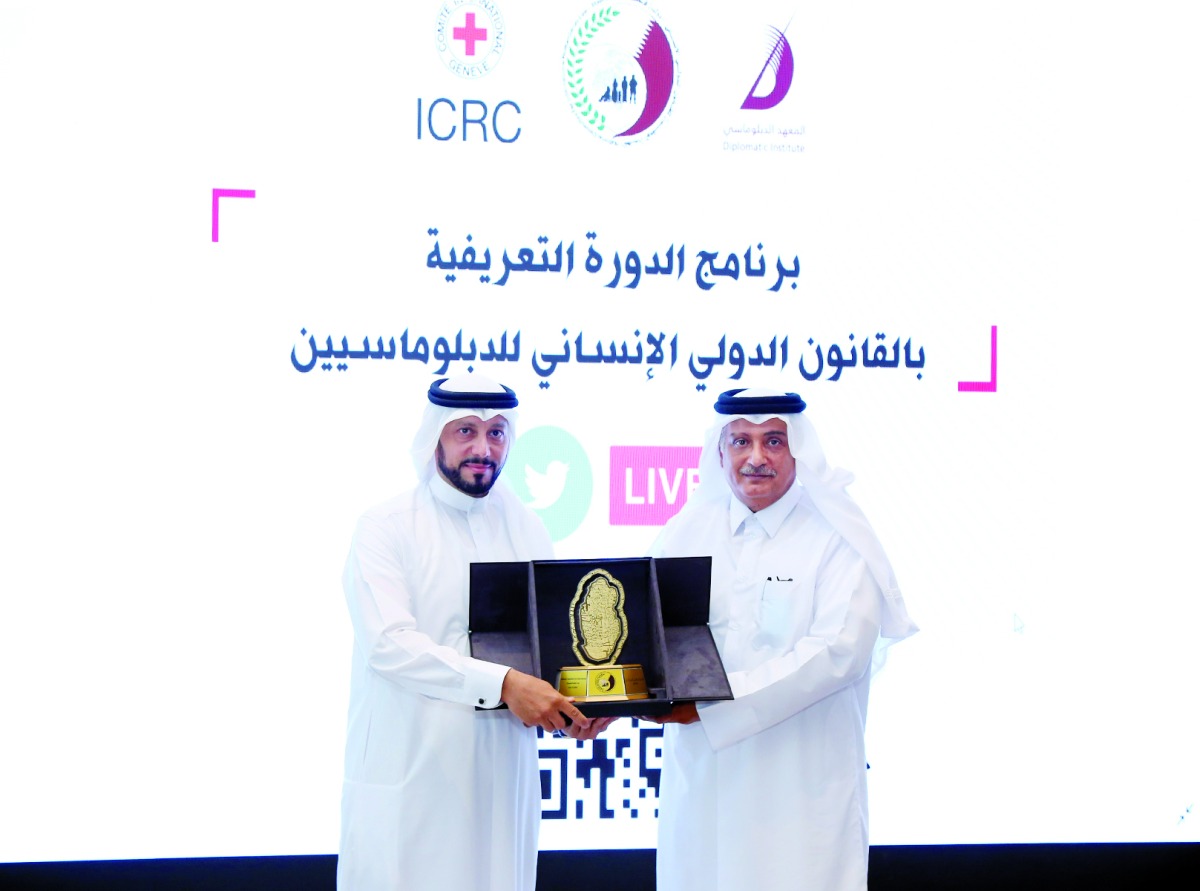
Minister of Justice H E Masoud bin Mohammed Al Ameri during the opening of the introductory course.
Doha: Minister of Justice H E Masoud bin Mohammed Al Ameri inaugurated on Monday the two-day introductory course on international humanitarian law for diplomats, organised by the National Commission for International Humanitarian Law and the Diplomatic Institute of the Ministry of Foreign Affairs in cooperation with the International Committee of the Red Cross represented by the regional mission of the Gulf Cooperation Council.
In his opening speech, Undersecretary of the Ministry of Justice and Chairman of the National Commission for International Humanitarian Law Sultan bin Abdullah Al Suwaidi stressed the importance of this course in introducing the international humanitarian law related to the protection of the life and dignity of people during armed conflicts, as these laws provide protection and assistance to the victims of conflicts.
Al Suwaidi also referred to the prominent role Qatar plays in several international forums via its ambassadors and permanent delegates, where it constantly urges humanitarian action, such as the protection of civilians, women and children.
Qatar always provides its full and continuous support to all conflicted countries in order to mitigate the burdens of humanitarian crises, and to help all people to overcome their challenges, he added.
Qatar also supports all international efforts aimed at reaching lasting peace through dialogue, in addition to advancing development and improving living conditions, manifesting Qatar’s policy of mitigating the effects of humanitarian crises, he pointed out.
He added that this introductory seminar, which targets elite diplomats, comes within the framework of spreading awareness of international humanitarian law, and is in line with the decision to establish the national commission in Qatar, which states that one of the objectives of establishing the committee is to raise awareness of the topic.
Al Suwaidi noted that Qatar always urges for the respect of international humanitarian law, given that it ratified the Four Geneva Conventions whose Common Article 1 stipulates that states and parties involved in armed conflicts must undertake to “respect and ensure the respect” for international humanitarian law in all cases and that they must exercise their influence in order to avoid and put an end to violations of international humanitarian law, and not encourage other parties to commit such violations.
For his part, Director of the Human Rights Department at the Ministry of Foreign Affairs Dr. Turki Abdullah Al Mahmoud said that this introductory session aims to support and enhance knowledge of international humanitarian law among diplomats in order to be equipped to deal with violations of the international humanitarian law.
He added that any violations must be firmly condemned by the international community, as stipulated by the Declaration on the Protection of War Victims adopted in Geneva on September 1, 1993. Al Mahmoud pointed out that this session comes at a time when the world is witnessing the most severe period experienced in decades, with wars, internal strife, and migrations of peoples from the south to the north, and from the east to the west.
For her part, Cherine Pollini, the Head of Mission of the International Committee of the Red Cross in Qatar, said that this event contributes to bringing together future diplomats interested in this field in particular in Doha, with the aim of exchanging views on international humanitarian law and working together towards enhancing its recognition and respect, whether at the regional level or on a wider scale.