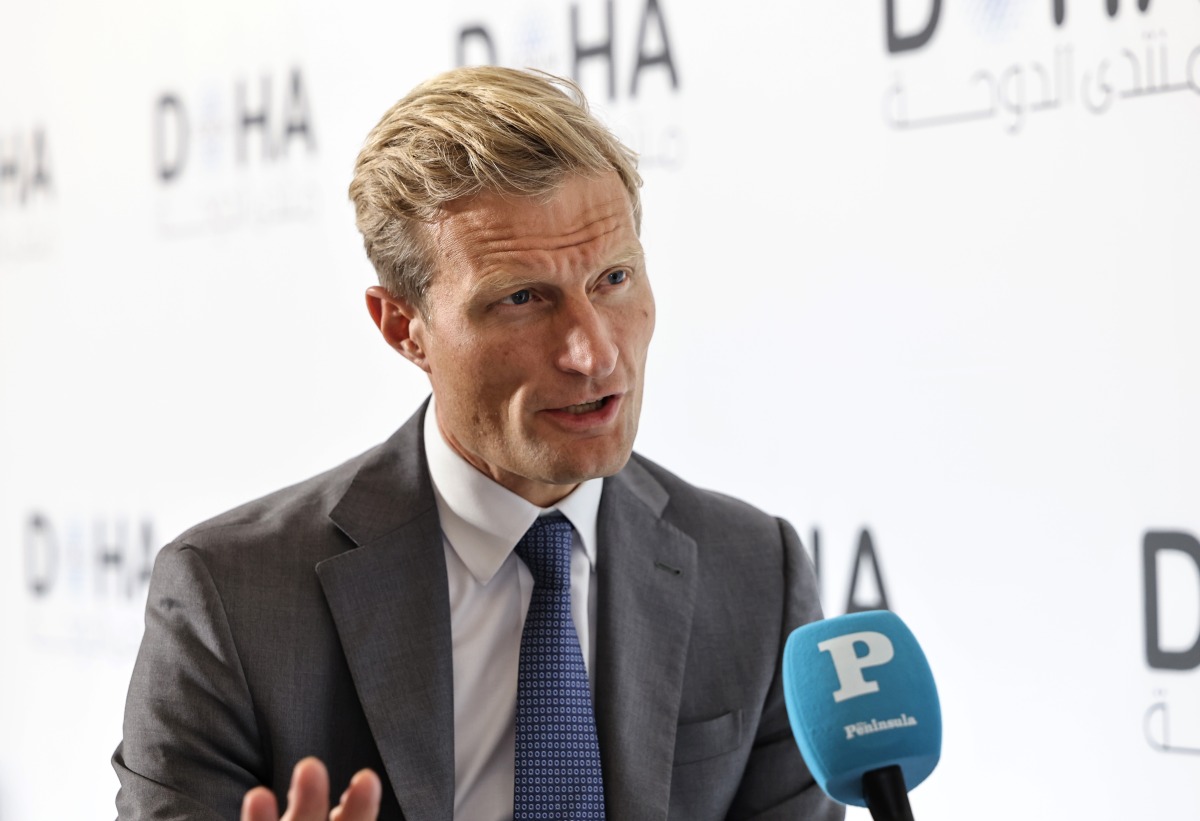
Carl Skau, Deputy Executive Director and Chief Operating Officer of the World Food Programme
Doha, Qatar: The World Food Programme (WFP) took part in this year’s Doha Forum, using the global policy platform to draw attention to rapidly worsening food insecurity and to push for greater humanitarian support.
In an interview with The Peninsula, Carl Skau, Deputy Executive Director and Chief Operating Officer of the World Food Programme, said the Forum has become an essential venue for humanitarian advocacy and coordination as global hunger reaches unprecedented levels.
Speaking on the sidelines of the event, Skau said participating in Doha is strategically important for the agency’s mission.
“The Doha Forum has really established itself as one of the key diplomatic moments of the year in the diplomatic calendar,” he said. “So it’s key for us to be here, of course, to bring attention to the needs of food insecurity across the world globally, but also to specific crises.” While the organisation is responding to multiple emergencies globally, Skau said Sudan currently demands the most urgent attention.
“In Sudan, it’s terrifying, really, what’s happening,” he said. “I was just recently there. I spoke to people who had many problems getting out, to flee, and they were bearing witness to terrible atrocities.” He warned that unless pressure and support increase, the violence observed in El Fasher could spread rapidly.
“We need to make sure that what happened in El Fasher does not happen in the southern Kordofan and cities like Kadugli, Dilling, but even El Obeid,” he said, calling for immediate action to support civilians trapped in besieged areas.
Skau highlighted progress in Gaza during the current ceasefire window, where WFP has expanded food distribution and restarted digital cash support.
“We have now established some 25 bakeries, we have hundreds of distribution points, we have been able to again start off with our e-wallet, the cash assistance,” he explained.
In November alone, humanitarian teams reached 1.4 million people, but Skau cautioned that access remains unstable and needs continue to grow.
The official said, “It’s fragile, obviously, and the needs are massive. More aid is needed, not least to prepare for the winter.”
Skau also raised alarm about deteriorating conditions in Yemen, where 29 WFP staff members are currently being detained by Houthi authorities, a situation he described as deeply concerning. He noted that Syria and other long-running crises remain heavily underfunded.
Meanwhile, partnership with Qatar is another focus of WFP’s presence at the Forum. “We already have an excellent partnership with Qatar, but we hope to deepen and further that partnership even more,” Skau said, mentioning Qatar’s role now includes innovation, frontline access negotiations, and diplomacy, not just financial support.
Globally, Skau warned that 320 million people are now acutely food insecure, a figure he compared to the population of a large nation.
He further added, “We’re talking here of needs at historic proportions. Yet despite growing urgency, WFP funding has fallen 40 percent, forcing difficult rationing and reduced support to vulnerable communities.