Doha, Qatar: The US Federal Reserve (Fed) has entered one of its most contested policy periods in decades. The 25 basis points (bps) policy rate cut delivered in October was notable not for its size, but for the lack of consensus in reaching this decision. As highlighted in our November commentary, Kansas City Fed President Jeffrey Schmid voted against any cut while Governor Stephen Miran dissented in favour of a larger 50 bps reduction. This combination of simultaneous “hawkish” and “dovish” dissents remains exceedingly rare in the modern Fed, an institution that historically prized for consensus and predictability, QNB said in its economic commentary.
They show growing disagreement around both the inflation outlook and the appropriate pace of easing. While most participants acknowledged that disinflation is progressing and that labour market slack is widening, the degree of conviction varies widely. Some policymakers view the current stance as still “restrictive,” requiring continued steps toward more rate cuts to neutral or even accommodative territory. Three main reasons support our view.
First, political pressures and incoming changes in the Board of Governors favour at least a move towards a neutral stance from the Fed. President Trump’s increasingly vocal preferences for deeper rate cuts and his early signalling about the type of “dovish” successor he wants for the Chairmanship after Powell’s term ends in May 2026 have raised the stakes around every FOMC meeting.
Second, inflation uncertainty has declined significantly compared to the peaks witnessed after the “Liberation Day” tariffs. Shelter inflation, previously the main source of inflation stickiness, has moderated steadily, and goods inflation continues to normalize as supply chains adjust.
Third, despite month-to-month volatility and uncertainty associated with shutdown date release delays, labour markets trends continue to point to a significant deterioration. Job opening has fallen precipitously, layoffs have accelerated, and private payroll trackers point to further softening.
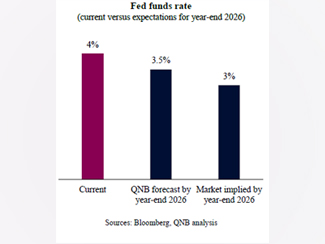
All in all, we maintain our view that there is policy space for two additional 25 bps cuts, one later this week in December and another one in Q1 2026, bringing the policy rate close to the lower bound of our neutral level estimate of 3.5%.
However, we also believe market expectations for a longer series of cuts throughout 2026 are too optimistic. The economy is slowing but shows no sign of a sharper downturn, while improving, faces uncertainties related to tariffs and the speed of convergence back to the 2% target.
In other words, the Fed is divided, the debate is intensifying, but the medium-term path is likely to be more moderate than either the most dovish FOMC members or current market pricing suggest.