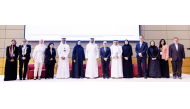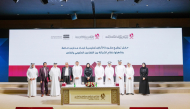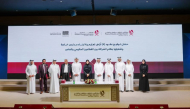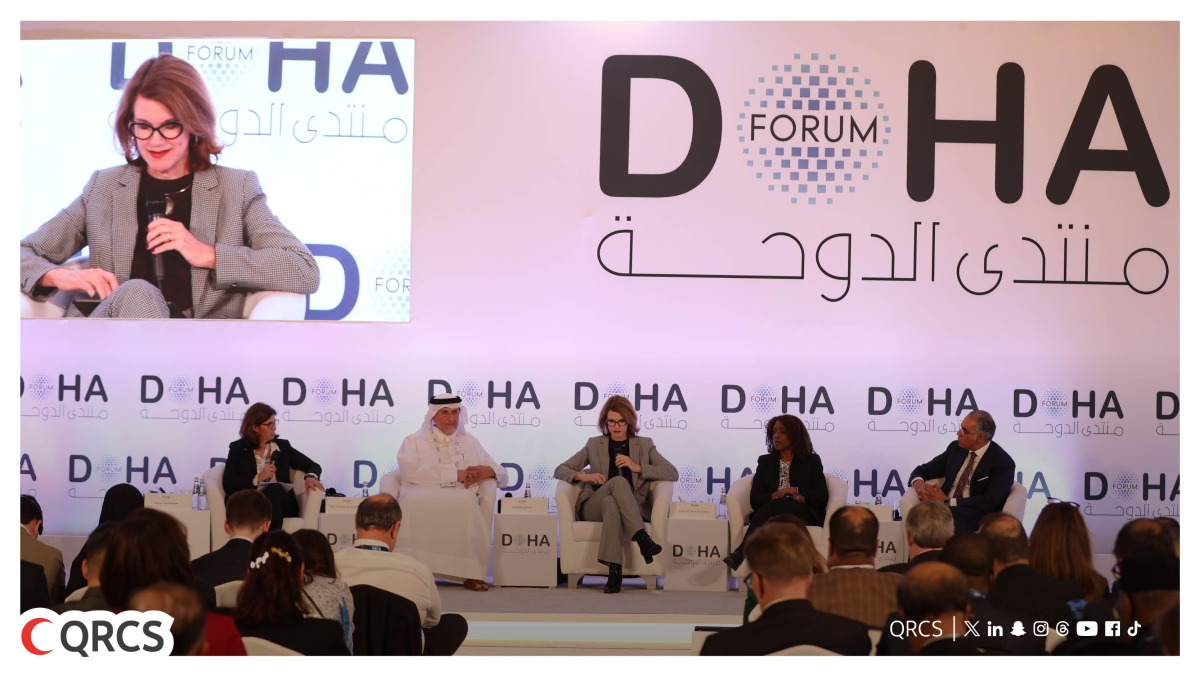
Panelists attending ‘How Shifts in Global Aid Are Reshaping Fragile States’ session yesterday.
Doha, Qatar: The Doha Forum convened a high-level session titled “How Shifts in Global Aid Are Reshaping Fragile States,” bringing together leading figures from humanitarian organizations, international agencies, and policy think tanks.
The panel examined the mounting challenges facing fragile states as global crises intensify and humanitarian funding declines, and explored how new strategies, partnerships, and technologies may help bridge critical gaps.
Moderated by Mona Yacoubian, Director and Senior Adviser at the Center for Strategic and International Studies (CSIS), the session featured H E Yousef Ali Al-Khater, Chairman of the Qatar Red Crescent Society (QRCS); Tjada D’Oyen McKenna, CEO of Mercy Corps; Lisa Doughten, Director at OCHA; and Fadi Chehade, Chair of the PAX Foundation.
Yousef Ali Al-Khater highlighted how QRCS is adapting its strategy to meet the rapidly evolving landscape of global crises. He emphasised the organisation’s shift from emergency response to long-term sustainability, noting that QRCS’ work now focuses heavily on strengthening livelihoods and supporting vulnerable communities through sustainable projects.
“Our strategy is based on balanced local and national abilities,” he said, explaining that this approach has enabled QRCS to form extensive partnerships with UN agencies and expand its global reach. Last year alone, QRCS programmes benefited over one million people across more than 20 countries, spanning regions well beyond the Middle East.
He detailed initiatives in waste management, portable water supply, and community-level development. Investing in local partnerships, Al-Khater noted, has improved coordination, strengthened governance, and increased trust between national societies and international actors.
“Our strategy must be flexible because crises change,” he added, pointing to the growing funding gap and the protracted nature of modern conflicts. Accurate impact measurement, transparency, and adaptability, he said, are key to sustaining effective humanitarian response.
Representing the United Nations Office for the Coordination of Humanitarian Affairs, Lisa Doughten delivered a stark assessment of today’s global humanitarian landscape.
She described the moment as one “of profound consequence,” as needs across fragile states escalate sharply while available funding declines.
“Conflicts are multiplying, they’re more protracted, and we have climate emergencies that are escalating,” she said.
Offering a perspective on innovation, Fadi Chehade of the PAX Foundation underscored how technology, particularly artificial intelligence, is transforming aid delivery. AI tools, he explained, are helping design projects, streamline proposals, track field teams, and analyse satellite imagery to monitor progress remotely.
These advancements, he said, significantly reduce inefficiencies: “This allows us to deliver every dollar, every euro from the donor to the ground, to the beneficiary, with less than 5 percent leakage.” Chehade described this as a model for scalable and accountable humanitarian funding, enabling donors to track impact more accurately and in real time.
Mercy Corps CEO Tjada D’Oyen McKenna focused on the human consequences of disrupted aid systems. She noted that when large humanitarian operations stall or withdraw, communities are often left suddenly “stranded with nowhere to go,” exposing the fragility of systems many governments did not realise they relied upon.
McKenna stressed the need for a fundamental shift toward empowering local actors. “We need to help governments, civil society, and other local actors take the lead themselves,” she said, calling for debt relief, capacity-building initiatives, and meaningful consultations that bring affected people into the decision-making process.
More coordinated planning, she argued, is essential to ensure aid truly meets the needs on the ground.