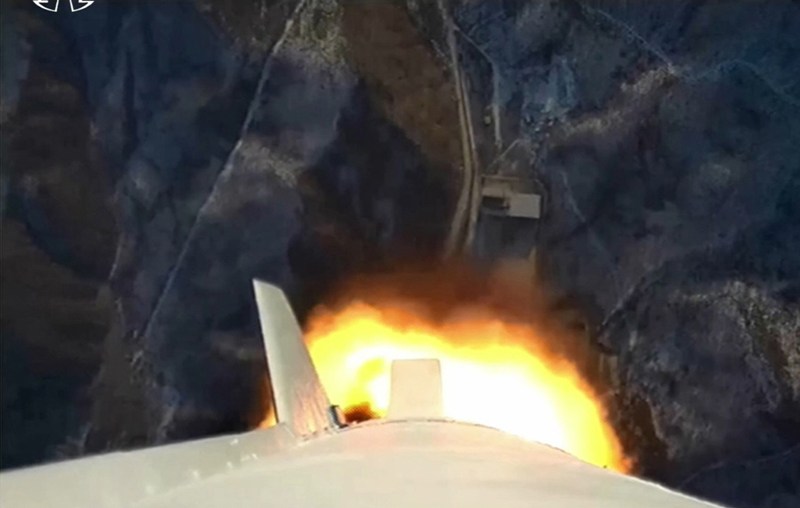
SEOUL, South Korea: North Korea on Sunday defied international warnings and launched a long-range rocket that the United Nations and others call a cover for a banned test of ballistic missile technology.
The rocket was fired from North Korea's west coast and its path was tracked separately by the United States, Japan and South Korea; no damage from debris was reported. At an emergency national security council meeting in Seoul, the country's president called the firing an "intolerable provocation."
North Korea, which calls its launches part of a peaceful space program, trumpeted the beauty of the launch's "fascinating vapor" as the rocket cut through the clear blue sky and said it had successfully put a new Earth observation satellite, the Kwangmyongsong 4, or Shining Star 4, into orbit less than 10 minutes after liftoff. It vowed more such launches. A U.S. official said it might take days to assess whether the launch was a success.
The firing came about two hours after an eight-day launch window opened Sunday morning. It follows North Korea's widely disputed claim last month to have tested a hydrogen bomb. Washington and its allies will consider it a further provocation and push for more tough sanctions. The United States and Japan quickly requested an emergency meeting of the U.N. Security Council on Sunday morning, saying Pyongyang violated a council ban on ballistic missile launches.
North Korean rocket and nuclear tests are seen as crucial steps toward the North's ultimate goal of a nuclear armed missile that could hit the U.S. mainland. North Korea under leader Kim Jong Un has pledged to bolster its nuclear arsenal unless Washington scraps what Pyongyang calls a hostile policy meant to collapse Kim's government. Diplomats are also pushing to tighten U.N. sanctions because of the North's Jan. 6 nuclear test.
In a statement, North Korea's National Aerospace Development Administration, in typical propaganda-laden language, praised "the fascinating vapor of Juche satellite trailing in the clear and blue sky in spring of February on the threshold of the Day of the Shining Star." Juche is a North Korean philosophy focusing on self-reliance; the Day of the Shining Star refers to the Feb. 16 birthday of former dictator Kim Jong Il. North Korea has previously staged rocket launches to mark important anniversaries.
Defense Ministry spokesman Moon Sang Gyun said a South Korean Aegis-equipped destroyer detected the North Korean launch at 9:31 a.m. The rocket's first stage fell off North Korea's west coast at 9:32 a.m. and the rocket disappeared from South Korean radars at 9:36 a.m. off the southwestern coast. There was no reported damage in South Korea.
The South Korean government couldn't immediately confirm reports by Yonhap news agency and YTN TV that the rocket might have failed.
The U.S. Strategic Command issued a statement saying it detected and tracked a missile launched on a southern trajectory but it did not pose a threat to the United States or its allies.
Japan's NHK broadcaster showed footage of an object visible in the skies from the southern island of Okinawa that was believed to be the rocket. Japanese chief Cabinet spokesman Yoshihide Suga told reporters that no debris fell on Japanese territory.
The global condemnation began almost immediately.
South Korean President Park Geun-hye called the launch an "intolerable provocation." She said the North's efforts to advance its missile capabilities were "all about maintaining the regime" in Pyongyang and criticized the North Korean leadership for ignoring the hardships of ordinary North Koreans.
Japanese Prime Minister Shinzo Abe vowed to "take action to totally protect the safety and well-being of our people." U.S. National Security Adviser Susan Rice called the North's missile and nuclear weapons programs a "serious threats to our interests — including the security of some of our closest allies."
The Foreign Ministry in China, the North's only major ally and protector in the U.N. Security Council, where Beijing wields veto power, expressed "regret that, disregarding the opposition from the international community, the (North) side obstinately insisted in carrying out a launch by using ballistic missile technologies."
AP