Palestinian children, many of whom are part of displaced families, sit on the floor as they attend class, at the UNRWA Deir Al-Balah Joint School, west of Deir Al-Balah. (AFP)
Doha, Qatar: Advisor to the Prime Minister and Spokesperson for the Ministry of Foreign Affairs Dr. Majed Mohammed Al-Ansari has said that Qatar is in communication with its partners to begin the second phase of peace agreement in Gaza.
“Regarding the second phase of the agreement, the State of Qatar, along with Egypt, Türkiye, and the United States, has worked since day one of the agreement to ensure the transition to the second phase through communications between the various parties. These communications are still ongoing ... they involve many obstacles while consensus has been reached on many of them, further discussion is still required to reach this stage,” he said during a weekly media briefing yesterday.
Regarding the Rafah crossing, Al Ansari noted that Qatar has called from the day one for humanitarian aid not to be used as a political tool in any conflict anywhere in the world. “Specifically here, political blackmail through the use of humanitarian aid is something that should not be acceptable to the international community,” he said.
To a question on Yemen situation, he said, “We’ve been very clear on the Yemen issue in support of the central government in Yemen. This has been our position since the situation in Yemen started more than a decade ago, and our support for the legitimate government in our brotherly state of Yemen continues to this day.”
He added, “We have also ensured that any unilateral actions by any actor in Yemen that could undermine the unity of Yemen and the safety and security of the Yemeni people are condemned by Qatar and not supported by Qatar in any sense. And therefore, we have called for all parties not to take any unilateral action but to engage constructively in talks to solve all the underlying issues peacefully.”
He said that Qatar welcomed the call of the president of the Presidential Council in Yemen and the hosting of the conference by Saudi Arabia. “And we stand in economic support of our Yemeni brothers. And anyway, if possible, our commitment to working in Yemen continues, and we’re working very closely with our partners in Saudi Arabia and the UAE and other countries in the region to make sure that the outcome will be beneficial for Yemen.”
Responding to a question about Venezuela, he said that Qatar is very much concerned by what’s happening over there. “And this is not an issue that is related only to Venezuela; it’s about stability in the region as a whole. And therefore, we are committed to any international efforts that might help in finding a resolution to this issue over there. And the channels of communication remain open with both parties. As you know, Qatar was a successful mediator in the past between Venezuela and the United States.”
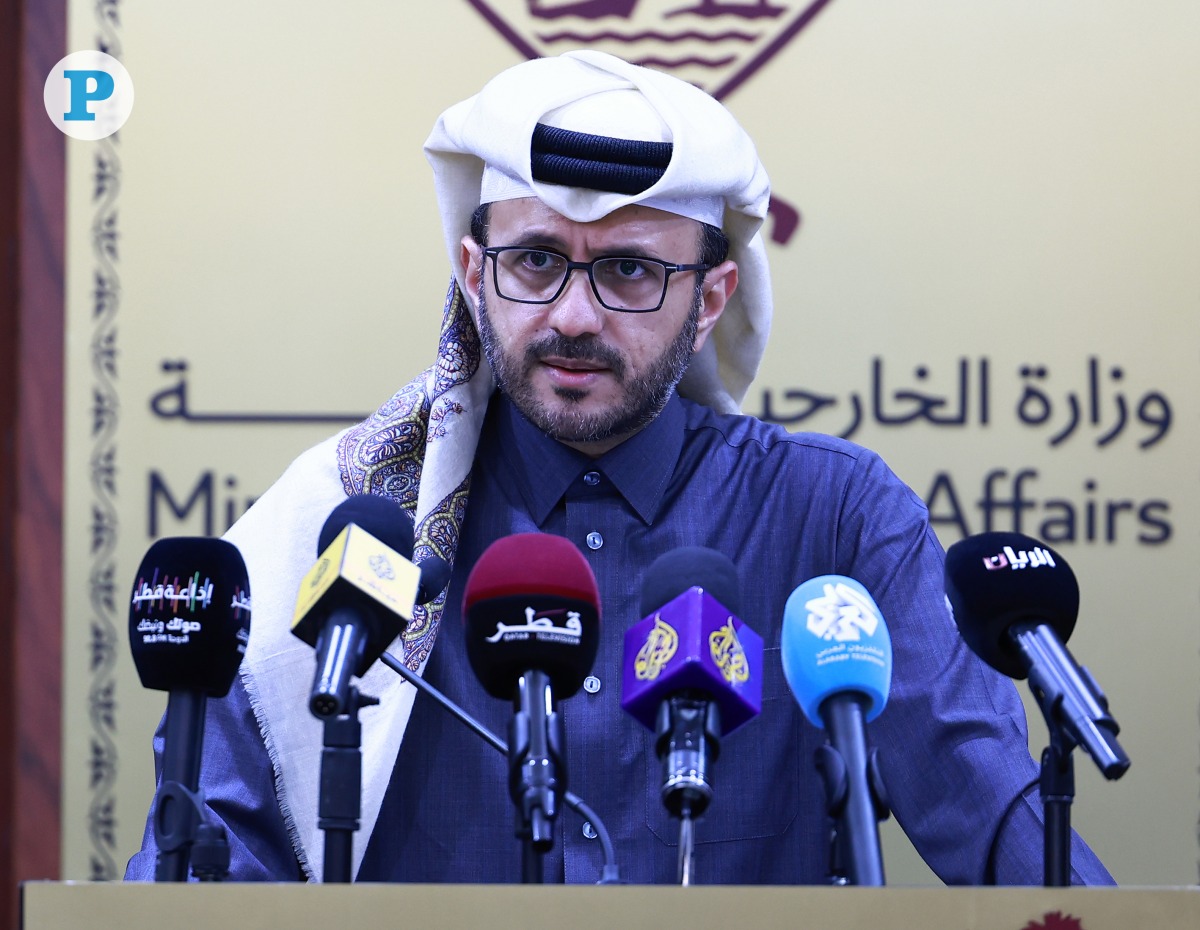 Advisor to the Prime Minister and Spokesperson for the Ministry of Foreign Affairs Dr. Majed Mohammed Al-Ansari addressing a media briefing yesterday. Pic: Rajan Vadakkemuriyil/The Peninsula
“And these channels of communication are ready to be used if we are asked to do so by any of the governments involved. As of now, the relationship with the government of Venezuela is as it was before, through the same diplomatic means, with channels of communication open.”
To another question about deteriorating humanitarian situation in Sudan, Al Ansari said that humanitarian aid should never be used as leverage in any context around the world.
“Today, it is not something that we accept. It’s not something that the international community should accept.
“The situation in Sudan is becoming rapidly the worst humanitarian catastrophe in our generation. This year, the coming year, we hope will be the end of that conflict, but we are seeing alarming news coming out of that region, especially on the humanitarian front.”
He further said, “We are calling on all parties in Sudan and in the international community to make sure that these corridors for humanitarian support are open, regardless of the geography, regardless of the situation of the conflict in that area. Our humanitarian support to our brothers in Sudan continues.
"The support is going, of course, to Sudan and through other avenues, and we are hoping to see more of that support go in—not only Qatari support, but international support. But our position has always been that humanitarian access and access to humanitarian aid should not be impeded by any conditions, whether political or military.”
To a question about delay in start of the second phase of peace plan in Gaza and new threats by Israeli Prime Minister to Iran, Al Ansari said that the whole world has the frustration with the pace of these talks and the delay in reaching a final settlement over there.
“I think this frustration goes back further, and it’s not something that has developed out of the recent talks, but rather the incapacity of the international community to end a lot of these crises, including the situation in Gaza.
"This has been something that frustrates us as individuals on both sides of this podium, but also affects our trust in the international community and its ability to solve these issues.”
He added, “When it comes to the threat to Iran, any escalation in the region is a threat not only to stability in this region, but to stability in the world as a whole, to international peace and security. The situation we have seen in 2025 has included crossing a lot of very dangerous redlines in escalation in the region, and thankfully, this did not result in a regional collapse.”
“But it did result in a lot of challenges to security in the region that are the first time we see this happening, including, of course, the two attacks on my country here that are a direct result of these escalations.
"And therefore, we have been, as we have always been, supportive of any effort that might reach a peaceful resolution through the discussions that are taking place, including communication with both governments in Iran and the United States.”
He further said, “It is our firm position that any disagreements with Iran should be dealt with through the negotiation table, and this is why we have been supporting every possible avenue for these talks taking place, whether it is through our mediation or the mediation of our brothers in Oman or any international effort.”