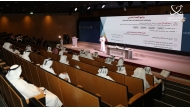
Doha: The Sheikh Hamad Award for Translation and International Understanding will hold an international symposium titled "Translation and Artificial Intelligence" next Tuesday morning, featuring experts and specialists from Qatar and several Arab countries to discuss the challenges posed by artificial intelligence in the field of translation.
The symposium forms part of the cultural program accompanying the announcement and honoring of the winners of the eleventh edition of the Sheikh Hamad Award for Translation and International Understanding, scheduled for the same evening.
The event will feature three main presentations.
The first, titled "Smart Tools and Open-Source Lexical Resources for Translation and Arabization", will be delivered by Dr. Mustafa Jarrar, Professor of Artificial Intelligence at Hamad Bin Khalifa University and Director of the Ibn Sina Laboratory for Language Processing and Artificial Intelligence at both Hamad Bin Khalifa University and Birzeit University in Palestine.
The second presentation, titled "Translation and Artificial Intelligence: Knowledge and Academic Gaps in the Arab Context", will be given by Dr. Ghassan Mourad, researcher in language computation, artificial intelligence, and digital media at the Lebanese University.
The third presentation, "Artificial Intelligence and the Art of Translation: Identity of Meaning or Struggle of Wills", will be delivered by Tunisian translator and researcher Abdelhaq Azmouri, Director-General of Ab'ad Center for Futures Studies in Washington.
His talk will address AI's capacity to process philosophically open-ended texts and highlight the epistemological and cultural limitations of machine translation compared with human translation.
As part of the cultural program accompanying the award ceremony, two closed workshops will also be held on "Recommendations to Support Translation between Arabic and Each of German and Albanian." The workshops will feature leading translators and experts working between Arabic and both Albanian and German, and will discuss the challenges facing translation among these languages while exploring practical ways to enhance exchange and support the growth of translation in these linguistic spheres.
The eleventh edition marks a milestone in the award's continuous evolution as it enters its second decade, expanding its cultural impact and updating its tools and areas of work to keep pace with global transformations in the field of translation.
For the first time, the award has adopted three of the world's most widely spoken languages - English, German, and Turkish - alongside two lesser-used languages, Albanian and Thai.
This step reflects the award's commitment to bridging influential global languages with local languages that require greater support to strengthen their presence in translation to and from Arabic.
This year's edition has seen a notable increase in the number of nominations across all approved languages, including Turkish, which was added to the honored languages only three years ago - an indication of the award's growing influence and rising credibility in cultural and academic circles.
The award's total value amounts to two million US dollars, distributed across two categories: translation of individual books in the two main languages, and lifetime achievement awards in both the main and secondary languages.