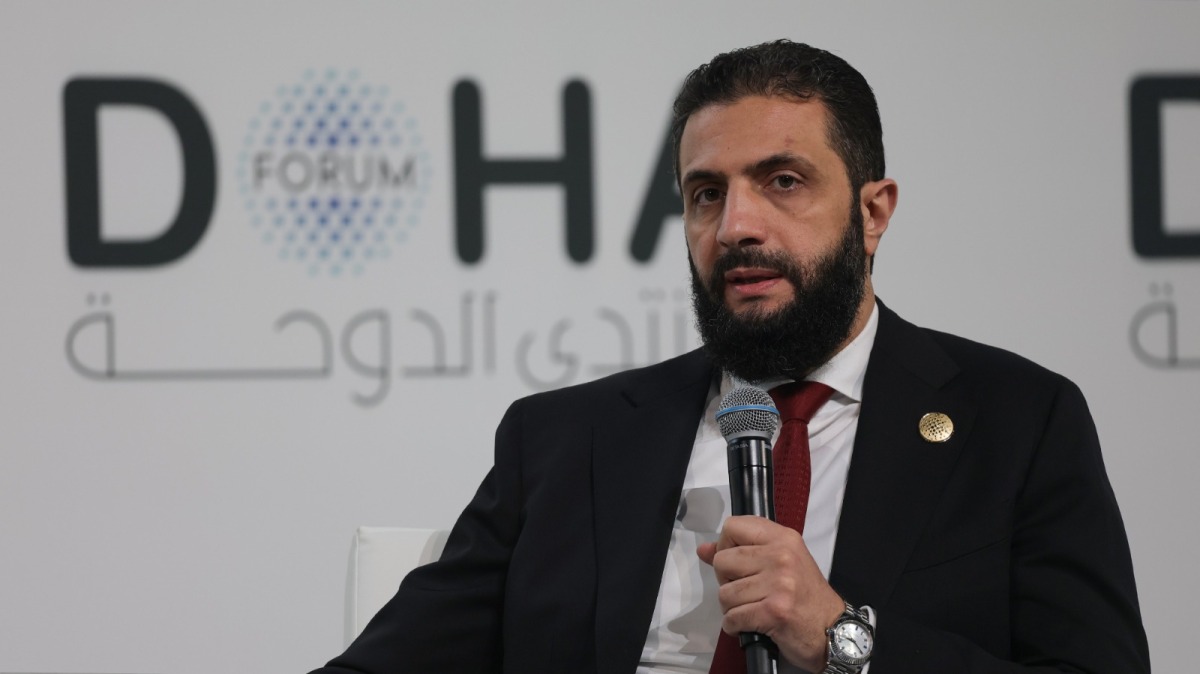
Doha: The President of the Syrian Arab Republic, Ahmed Al Shar’a, affirmed that Israel had carried out, since Dec. 8 of last year, more than a thousand airstrikes and 400 ground incursions into Syria up to the present day, the latest of which was the massacre committed in the Beit Jin area in the Damascus countryside, leaving more than 25 people dead.
His Excellency said during a newsmaker interview on the first day of the Doha Forum 2025 said that Israel was managing its regional crises by exporting them to other countries in an attempt to evade responsibility for the horrific massacres it committed in the Gaza Strip, and that it behaved as though it were fighting ghosts while justifying its actions with claims of security concerns and instability, projecting the events of Oct. 7 onto everything happening around it.
He added that since Dec. 8, 2024, Syria had sent clear positive messages affirming its commitment to peace and regional stability, clearly expressing its desire to be a stable state not interested in exporting conflicts to other countries, including Israel, yet Israel responded to this approach with severe violence.
President Al Shar’a said that his country was confronting these developments through communication with influential regional and international actors, noting that the world today supported Syria’s demands for Israel to withdraw to the positions held prior to Dec. 8.
He reiterated Syria’s full commitment to the 1974 agreement and its respect for it, explaining that the agreement had successfully endured for more than 50 years with international and UN Security Council consensus, while warning against tampering with it or seeking alternative arrangements such as establishing a buffer zone or similar ideas, which he said would open the door to dangerous and uncertain paths.
The Syrian President also touched on the concept of a demilitarized zone, questioning how it would be managed and who would protect it under Israel’s claims that it feared attacks being launched from southern Syria toward it.
He noted that the absence of Syrian military and security forces in southwestern Syria raised fundamental questions about how security could be ensured in that area.
His Excellency revealed that negotiations were currently underway in this regard, and that the United States was involved in them, stressing that all countries supported Syria’s demands for Israel to withdraw to pre-Dec. 8 lines, while addressing what he described as reasonable security concerns of both sides and ensuring their safety.
In a related context, President Al Shar’a said that Syria had gone through dangerous periods over the past 100 years, especially during the last six decades, where the country had lived in great isolation alongside a suffocating economic blockade. He said that the policies of the previous regime led most regional and international actors to withdraw from Syria, depriving the world of insight into the Syrian reality, and depriving Syria of engagement with its regional and international surroundings.
He affirmed that his country had restored many of its regional and international relations over the past year, and had moved beyond merely easing tensions into a more advanced phase. He stressed that everything promised upon visits to Damascus had been fulfilled, which had strengthened the confidence of various regional and international partners.
The President said that the path the country was taking was the correct one, and that every step taken had served the Syrian public interest. He indicated that Syria had regained its important regional and international standing, transitioning from being a country once exporting crises to becoming a place where hope was born, by presenting a living model of regional stability.
He also said that the world had quickly recognized this opportunity and had engaged with Syria rapidly and positively, in order to benefit from its important position and influential role in reinforcing stability in the regional environment.
He confirmed that Syrians today did not feel fear, noting that millions of Syrians had been going out since last week, and would continue for days to come, spontaneously to express their joy in commemorating the fall of the previous regime.
He added that Syria was in much better circumstances, noting that no country was free from some internal challenges, and that no government in the world enjoyed one-hundred-percent consensus.
HE President Al Shar’a reviewed the trajectory of the formation of the modern Syrian state over the past one hundred years, explaining that it went through multiple and evolving phases, starting from the period preceding full independence from the French occupation, passing through the era of coups, and reaching the rule of the previous regime, which lasted nearly sixty years.
His Excellency said that during the rule of the previous regime, Syrians did not know one another well, whereas the Syrian revolution became a milestone that brought together the various components of the Syrian people.
He said that the previous regime had left behind numerous conflicts, as it used certain sects against others, while the country’s new leadership had, since the start of military operations, been careful to consider this, prioritizing forgiveness and reconciliation to ensure a safe and sustainable future for the Syrian people.
HE President of the Syrian Arab Republic pointed to the inclusion of multiple sects in the formation of the government and the national assembly, a step that helped calm the situation and prevented the country from slipping into the post-conflict phase, which is often longer than the war itself.
He added that it was illogical to demand that his country achieve full consensus at one hundred percent, noting that such a thing is not achieved even in stable and advanced nations, and that Syria had transitioned from one ruling system to another that was completely different, and such a transition would inevitably produce individuals harmed by the change who had previously benefited from the former regime.
He noted that the Syrian government was working to manage this transition with a high degree of responsibility, and that major achievements had been realized in the past year, despite the occurrence of certain violations that could not be accepted under any circumstances, stressing that work was underway to hold those responsible for these violations accountable.
President Al Shar’a sid that Syria was moving positively toward stability, with the beginning of gradual economic growth and a tangible improvement in service-related conditions during the past year. He noted in this regard that electricity had previously been available only for one hour and a half per day, whereas today it had reached 12-14 hours daily. He added that and that by the end of the current year, the country would achieve self-sufficiency in electricity.
His Excellency noted that Syria was heading toward a rising economic environment, pointing out that economic investments anticipated in the country would contribute to strengthening stability.
He also revealed that several meetings had been held with members of the US Congress to urge them to lift the Caesar Act, stressing that the law had originally been enacted to hold the former regime accountable for crimes committed against the Syrian people, and should not become a tool for starving Syrians again.
His Excellency affirmed that the current US administration, under President Donald Trump, supported the process of lifting sanctions on Syria, stressing that the fate of 25 million Syrians should not be tied to a few individuals who were unconvinced about lifting sanctions on the country.
He said that throughout its civilizational history, which spans more than eight thousand years, Syria had been an advanced model of peaceful coexistence, and that the country had hosted religious diversity living together for 1,400 years, which had made an example for the world to follow when it comes to peaceful coexistence.
He added that Syrians had inherited a complex problem for which no single party bore sole responsibility, and that everyone had been a victim of its consequences, pointing out that conflicts had taken place during the recent period.
He said that as a result of these conflicts, fact-finding committees had been established, and international fact-finding teams had been received, in addition to the establishment of courts (some of which had announced the names of those who committed crimes in the coastal region and in As-Suwayda), noting that although such practices were atrocious, they had been initiated by remnants of the former regime before escalating and expanding.
President Al-Shar’a continued by saying that Syria was a state governed by the rule of law, and that it was the law that safeguarded the rights of all. He added that his country was rich in culture and knowledge and had a large pool of doctors, engineers, legal experts, and diverse human talent, and that it was befitting for Syria to be a state of law.