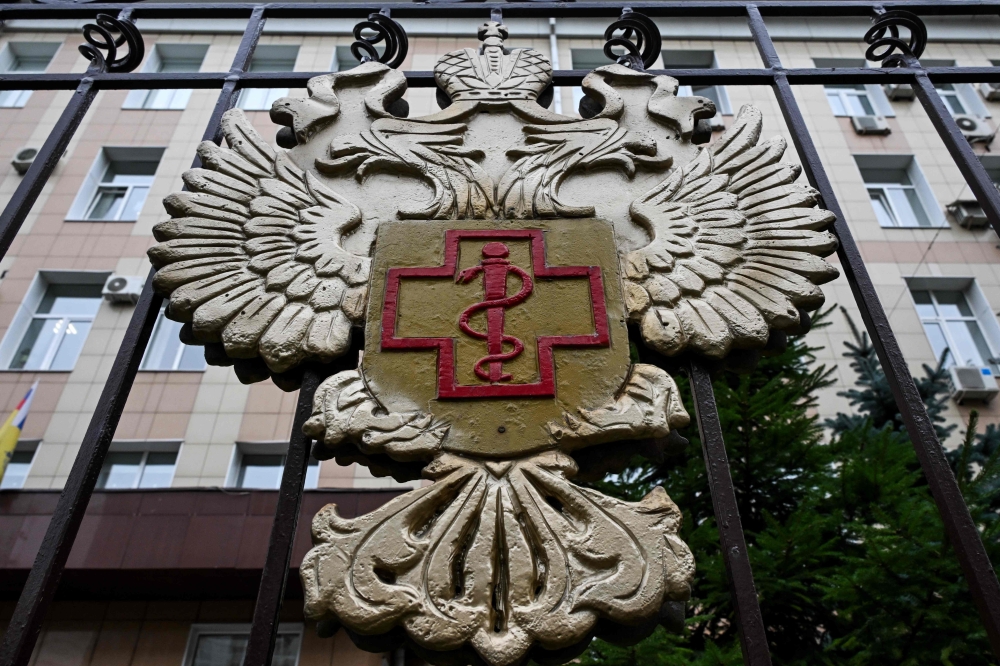
The logo of Russia's consumer and health watchdog Rospotrebnadzor sits on its grounds' fencing in Moscow on October 5, 2026. (Photo by Igor Ivanko / AFP)
After reports that a lab technician’s death was possibly linked to pneumonic plague in Russia, US officials said they are closely watching the situation.
The lab technician is a 28-year-old woman who worked at the Irkutsk Antiplague Research Institute of Siberia and the Far East, which was set up in the 1930s as an anti-plague body and later expanded its scope to other highly dangerous diseases. The woman died after being diagnosed with pneumonia of "unknown” origin, according to the public health agency, Rospotrebnadzor.
Secretary of State Marco Rubio told reporters on Monday morning that Russian officials had shared some information about an infected lab worker and their concerns that other Russians could be affected.
"There’s very limited travel between the US and Russia, obviously, but … if something like that gets out, it could quickly spread,” said Rubio, who added that he didn’t think it was cause for alarm. "We’re watching and monitoring it closely.”
Here’s what to know about the pneumonic plague.
- The main clinical forms of plague are bubonic, pneumonic and septicemic.
- All forms - caused by the bacteria - are treatable, particularly when detected early.
- is the most common form of plague globally, according to the World Health Organization, and is caused by the bite of an infected flea. Human-to-human transmission is rare.
- is the most virulent form. Symptoms can appear quickly, sometimes within 24 hours after infection. The lung-based plague can spread from person to person through respiratory particles. Without early diagnosis and treatment, pneumonic plague is fatal. However, when detected and treated early, within 24 hours of symptom onset, recovery rates are high.
- occurs when the bacteria multiplies quickly in the bloodstream. It can develop from any other form of plague and can lead to severe complications, including organ failure, tissue damage, respiratory distress and bleeding under the skin, according to WHO. If left untreated, septicemic plague is fatal.
- Plague is an infectious disease usually found in small mammals and their fleas. Humans can be infected through the bite of infected fleas or animals, unprotected contact with infectious bodily fluids or contaminated materials, or the inhalation of respiratory particles from a patient with pneumonic plague.
- Plague is particularly severe when the bacteria spreads through the bloodstream, causing septicemic plague, or infects the lungs in the case of pneumonic plague.
Bubonic plague has a case-fatality ratio of 30 to 100 percent, according to the World Health Organization. The pneumonic and septicemic forms are always fatal if left untreated. "pneumonic plague is especially contagious and can trigger severe epidemics through person-to-person transmission via respiratory particles,” according to WHO.
The bacteria is endemic among rodents in northern Arizona, and eight human plague cases were reported in the state from 2000 to 2024.
In July 2025, Arizona reported its first pneumonic plague death since 2007, in a young man who was exposed to sick cats, according to a report from the Centers for Disease Control and Prevention.
The man sought hospital care after two days of abdominal pain, chest pain and dry cough. "Clinicians initially suspected hantavirus disease or bacterial pneumonia,” the CDC report said. The man was admitted and received antibiotics, but despite progressively intensive oxygen therapy, he died less than eight hours after admission. Forty-six people who were potentially exposed, including household members, co-workers and hospital staff, received a seven-day course of ciprofloxacin.
No contacts became sick.
If Russian authorities confirm that the death was caused by pneumonic plague, they are supposed to report that to the WHO. But that reporting may not be immediate while Russian officials conduct lab and tissue samples to confirm the presence.
Current and former US officials urged Russian leaders to share as much information about the situation as possible.
"What we need right now is really transparency from the Russian authorities, and I’m worried about whether we’re going to get that or not,” said Ashish Jha, who helped lead the White House’s pandemic response under the Biden administration.
Bubonic plague is known for its dramatic boils, called "buboes,” caused by lymph nodes swollen with multiplying bacteria.
But these are not necessarily present with pneumonic plague. "Patients develop fever, headache, weakness, and a rapidly developing pneumonia with shortness of breath, chest pain, cough, and sometimes bloody or watery mucous,” according to the CDC.
Septicemic plague symptoms can include chills, abdominal pain, shock, bleeding into the skin and other organs, and skin and tissue turning black and dying.
While plague was infamously known as the "Black Death” during the 14th century, causing more than 50 million deaths in Europe, the disease is now treatable with antibiotics, and standard precautions can prevent infections.