

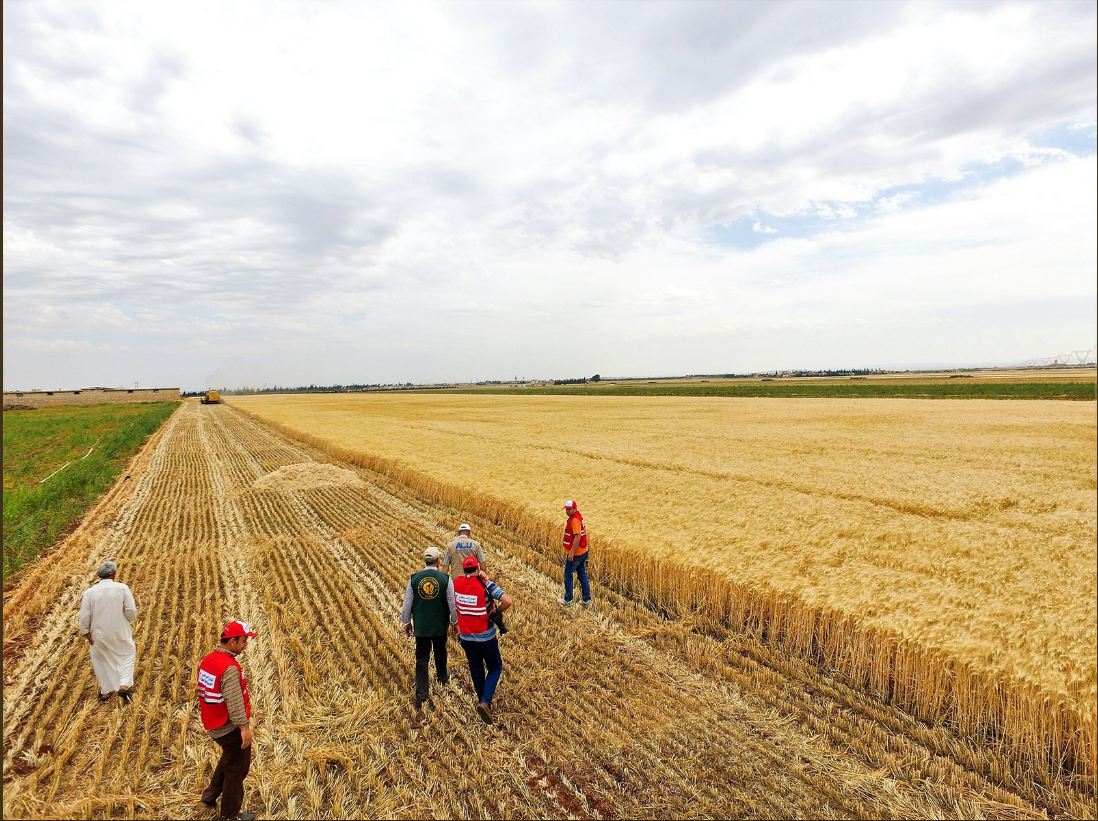
Doha: Qatar Red Crescent (QRCS) has completed the third phase of its development project to support wheat crop growing in Syria, QRCS said in a press release on Sunday.
By the end of July, Syrian farmers have harvested more than 24 tonnes of wheat, a strategic factor of food security for local populations.
The project was done in cooperation with the General Organization for Seed Multiplication (GOSM), the Assistance Coordination Unit (ACU), and the Food and Agriculture Organization of the United Nations (FAO), with support from Qatar Fund for Development (QFFD).
Half of the project's $6.3 million funding was provided by QRCS, while GOSM and ACU provided 25% each.
In total, 7,733.5 hectares of agricultural land was cultivated in eight governorates (Aleppo, Idlib, Homs, Hama, Daraa, Quneitra, Damascus, and Rif Dimashq). The project benefited 17,697 farmer families (88,485 people) who lacked agricultural and marketing input.
Harvesting is the culmination of the project. Over 45 days, the farmers have been harvesting and packing wheat for the purpose of producing bulgur, flour, etc.
According to the plan, QRCS will purchase a portion of the crop at a reasonable price. 75% of the wheat will be used in producing bread, while 25% will be purified and resold to the farmers at minimal prices for the coming season. This percentage, which equals 6,000 tonnes of seeds, will be used to cultivate 24,000 hectares.
A $4 million fund was established to give the farmers zero-interest loans to purchase agricultural resources. The loans are either cash or in-kind (seeds, fertilizers, etc.). The debt is repaid from the produced wheat.
Another aspect of the project is to improve quality, by offering incentives for farmers depending on the purity of the harvest. Also, 13 species of wheat were preserved, and three species were restored by importing seeds from approved suppliers.









