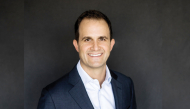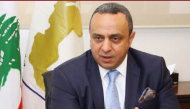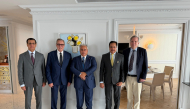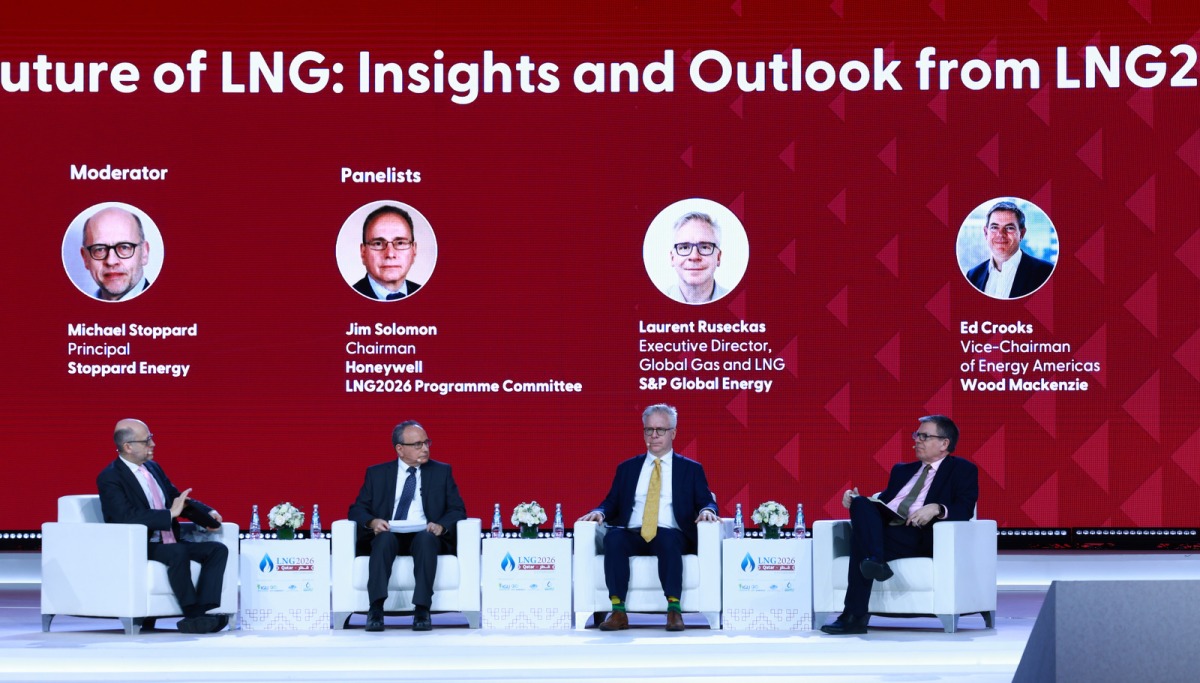
Panelists exchanging ideas during the panel discussion, yesterday. PIC: Rajan Vadakkemuriyil
DOHA: Confidence in liquefied natural gas markets, strong industry engagement, and a renewed focus on LNG over alternative fuels defined the closing panel of LNG Conference 2026, as senior market leaders reflected on the event’s themes and the sector’s outlook.
The session, titled ‘The Future of LNG: Insights and Outlook from LNG2026’, was moderated by Michael Stoppard, Principal at Stoppard Energy, and brought together executives from Honeywell, Wood Mackenzie, and global gas research firms.
Jim Solomon, Chairman of Honeywell, highlighted the depth of industry participation at this year’s conference, pointing to the overwhelming response to the call for papers.
“About a year ago, we issued the call for abstracts and received almost 500 submissions from all over the world, covering every aspect of the energy industry,” Solomon said.
“The unfortunate thing was that the quality was so high we had to reject about three-quarters of them. But that means the papers and panels we have seen here are truly top quality and the audience reaction confirms that.”
Attendance figures underscored the momentum as Solomon noted that most sessions were filled to capacity, with technical presentations drawing between 150 and 200 participants despite multiple sessions running simultaneously.
“To me, that shows the strength of the industry and the level of optimism people have,” he said.
A notable takeaway from the conference was the limited role of hydrogen and ammonia in technical discussions. While ammonia featured in executive-level programming, Solomon said it was largely absent from technical sessions.
“There was very little discussion of ammonia or hydrogen in the technical tracks,” he said. “Some automakers even said the words weren’t mentioned. I think that reflects how much is happening in LNG itself; people saw alternatives as a distraction from what is clearly an LNG-focused event.”
Solomon acknowledged that progress continues in low-carbon fuels, particularly ammonia, but at a slower pace than many anticipated several years ago.
“There is progress being made, but not at anything like the pace people expected back in 2023,” he said. “Ammonia is probably the most promising option, but it’s growing alongside energy and is not something that’s going to displace large volumes of LNG.”
Laurent Ruseckas, Executive Director for Global Gas and LNG, said this year’s conference marked a sharp contrast with the uncertainty that dominated discussions three years ago following the suspension of Russian gas supplies to Europe.
“In 2023, there was a lot of nervousness, such as price spikes, supply fears, and a sense that the industry was living on borrowed time,” Ruseckas said. “That’s very much in the rear-view mirror now.” He attributed the shift to greater supply confidence and a wave of final investment decisions that have strengthened market stability. “There’s much more confidence that the gas will be there,” he said. “There’s also less talk about LNG as just a transition fuel. People now see it as a stable, long-term part of the energy system.”
Ed Crooks, Vice-Chairman of Energy Americas at Wood Mackenzie, emphasised the value of the conference as a meeting point for the full spectrum of the LNG industry.
“Everyone is here, including technical experts, financiers, established players, and emerging ones,” Crooks said. “In a few days, you get five to ten times the perspectives you would in day-to-day work, and that really broadens your view of the market.”
Crooks, visiting Doha for the third time, also praised the organisation of the event and the host city.
“It’s been incredibly well organised,” he said. “And everywhere you go in Doha, you are reminded why this is such an important hub for the global LNG industry.”
As the conference closed, panelists agreed that LNG Conference 2026 reflected a sector that has moved beyond crisis management and into a period of renewed confidence, long-term planning, and sustained global relevance.