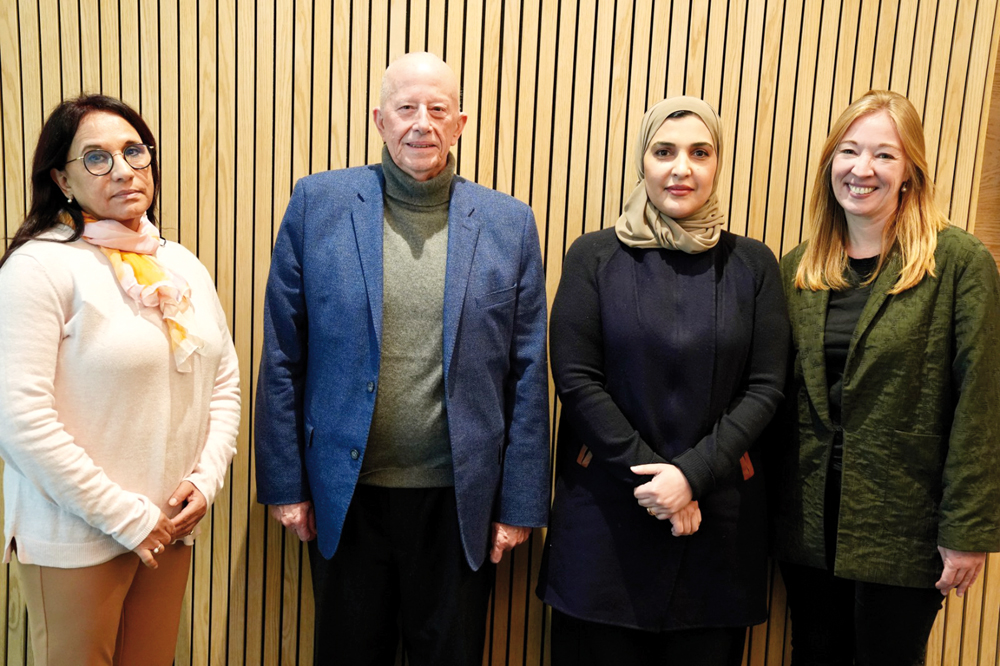
NHRC chairperson Maryam bint Abdullah Al Attiyah (second right) with officials ahead of the 14th International Conference of NHRIs.
Copenhagen: Chairperson of the Global Alliance of National Human Rights Institutions (GANHRI), and the National Human Rights Committee (NHRC) Maryam bint Abdullah Al Attiyah held a preparatory meeting with the global alliance team for the 14th International Conference of National Human Rights Institutions (NHRIs) under the title: “Torture and other ill-treatment: the role of national human rights institutions (NHRIs), organized by GANHRI in the Danish capital, Copenhagen, from 6 to 8 November.
The meeting was attended by GANHRI Secretary-General Amina Bouayach, along with the Chairpersons of the GANHRI regional networks: Africa Chairperson Joseph Whittal, Americas Chairperson Pedro Francisco Callisaya Aro, and Asia Pacific Chairperson Doo-Hwan Song, and HE Europe Chairperson Sirpa Rautio.
Al Attiyah held a separate meeting with the Chairperson of the United Nations Committee against Torture Claude Heller.
Discussing the upcoming Conference, GANHRI Chairperson said that it will address “Torture and other ill-treatment,” in a wholistic manner, serving as an important opportunity for NHRIs to build on their previous achievements, and to work together with partners and stakeholders to exchange expertise, identify best practices, and reaffirm the importance of their individual and collective commitment to the right of all persons to be free from torture and other forms of ill-treatment under international law. She added that torture and other forms of cruel, inhuman, and degrading treatment and punishments are totally prohibited and can neither be justified nor tolerated, constituting one of the few crimes prohibited globally.
Al Attiyah explained that despite the global prohibition, torture still exists in all regions of the world, with empirical research showing that the right to bodily integrity is still the most violated right in the last quarter of the 20th century, so much so that torture and other ill-treatment are sometimes employed as an ordinary governance tool, pointing out that the prohibition is not adequately complied with in practice, due to a lack of understanding of the legal definitions of torture and other ill-treatment. She said that the work of NHRIs is especially crucial for those people and groups who are at greater risk of discrimination, violence, and other forms of human rights violations and abuses.
She highlighted that the conference’s general objective is to explore the role of NHRIs and national mechanisms in combating and preventing torture and other ill-treatment in their jurisdictions, in addition to fostering cooperation regionally and internationally, to identify all practical and effective ways for NHRIs to employ its broad mandates and various functions under the Paris Principles, in order to uphold the rights of all persons to human dignity and freedom from torture and other ill-treatment.
She noted that the conference will see the participation of Vladlen Stefanov from the Office of the High Commissioner for Human Rights, and Sarah Rattray from the United Nations Development Programme.