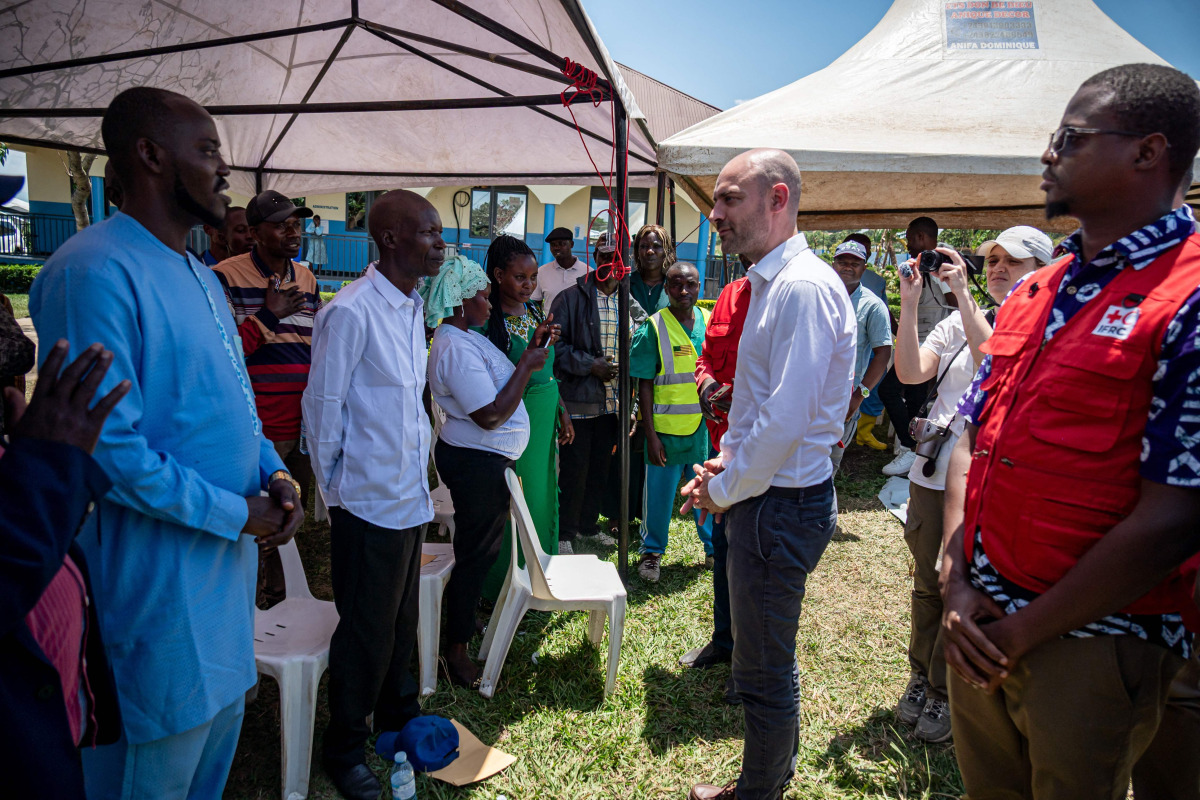
French Minister for Europe and Foreign Affairs Jean-Noël Barrot speaks with family members of Ebola patients during his visit to the Rwampara Ebola Treatment Centre in Bunia, Ituri Province, Democratic Republic of Congo, on October 3, 2026. (Photo by Hardy BOPE / AFP)
Geneva: Medical charity Medecins Sans Frontieres warned on Monday of an "alarming surge" in Ebola cases in the North Kivu region of eastern DR Congo and called for more treatment capacity.
In mid-May, already several weeks late, the Democratic Republic of Congo declared its 17th Ebola outbreak, an extremely deadly disease that has already killed more than 15,000 people in Africa over the past 50 years.
As of October 2, the World Health Organization had recorded 4,082 deaths out of 8,463 cases since the emergence of the Bundibugyo strain of the virus, for which there is still neither a vaccine nor a specific treatment.
Starting in the northeastern Ituri province, Ebola has spread to seven provinces in the country. Ituri, North Kivu and the northeastern Haut-Uele (northeast) account for the majority of the reported cases.
MSF said the outbreak in North Kivu had "intensified dramatically since early September, with the province now accounting for nearly 40 percent of all newly confirmed cases nationwide".
"It is like fighting a megafire," said Stephanie Hoffmann, the coordinator of the MSF Ebola treatment centre in the city of Butembo, close to North Kivu's border with Uganda.
"With new hotspots emerging every week, treatment capacities remain largely insufficient and inadequate. This situation places current patients and entire communities at even greater risk," MSF said.
MSF said capacity to treat the contagious viral disease in North Kivu was "stretched to the limit".
As of late last week, 34 percent of confirmed Ebola patients were still being treated in non-specialised health facilities that "lack the resources and expertise required... raising the risk of further transmission among patients and healthcare workers".
"Because there are not enough beds available, we are sometimes forced to refer confirmed Ebola patients elsewhere, despite the significant risk this poses to the wider community," Hoffman explained.
She said it was also vital to build trust with local communities, some of whom have been suspicious of the treatment centres.
"More than 60 percent of Ebola-related deaths continue to occur in the community," she pointed out.
"Patients must be willing to seek care early and accept isolation measures. Without that trust, we risk seeing more deaths and further spread of the disease into neighbouring areas."