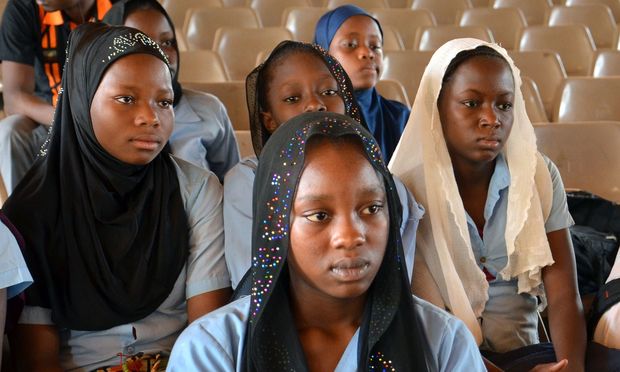
Maradi, Niger: Fifteen-year-old Ousseina's dream of becoming a nurse is already over. "For me, school's finished," said the frail teenager who sells eggs by a roadstop in the southern Niger town of Maradi.
She, like so many other girls in this deeply poor west African state bordering the Sahara, has no choice but to wed very early.
"My marriage?" she said, her little body shrouded in a sky-blue veil.
"It will be after the harvest towards the end of November" -- seven months before she would have passed her school certificate, the key to further education and, with luck, a nursing career.
The lot of women in Niger is among the worst, if not the worst, in the world thanks largely to a relentless tradition of early marriage, big families and having pregnancies in quick succession.
Even efforts by the United Nations and rights groups to point out the ravages -- notably the damaged bodies of girls not ready to bear babies -- have met with fierce resistance.
Some clerics have condemned initiatives to hold off wedlock and promote contraception as "the devil's work brought by the West".
Even among the general populace reasons abound to ignore the "required" minimum age of 18 before a girl is wed.
School is a frequent excuse -- notably if the girl is not doing well in class. "Send your daughter to school and she's likely to come back with a baby instead of a diploma!" scoffed a Maradi moto-taxi driver named Balla Issa.
Such thinking has stymied education -- and chances -- for Niger's women. According to UN figures, only four out of every 10 girls are enrolled in primary school and two out of 10 carry on to middle school. The percentage drops radically for high school -- only three out of 100 girls make it that far.
"Girls are married as young as 15 and at times to much older men, against their will," deplored Mintou Moctar, a midwife in Safo, a village south of Maradi.
UN statistics on forced or arranged marriages are alarming: 30 percent of girls are married before 15 and 75 percent before 18, according to the UNICEF office in the capital Niamey. A separate, recent government enquiry found the same results.
Economic reasons are also used to justify the custom in a nation prone to drought, food shortages and malnutrition and where 60 percent of the population lives below the poverty line, notably in the vast rural zones.
AFP